
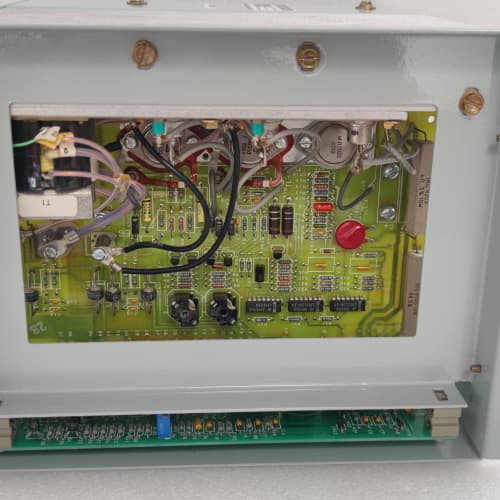
Description
Key Parameters
-
Current Monitoring Channels: 8 or 16 independent current sensing channels (double the standard capacity)
-
Current Range: 0–10A per channel (configurable with external shunts)
-
Voltage Monitoring Channels: 4 or 8 DC voltage inputs (for battery and bus monitoring – expanded)
-
Battery Monitoring: Battery voltage, charge/discharge status, battery health estimation
-
Input Types: External current shunts (50mV or 100mV) or Hall-effect sensors
-
Monitoring Resolution: 12-bit ADC with ±0.5% accuracy
-
Alarm Outputs: Form-C relay contacts for power alarm and battery alarm (normally energized)
-
Diagnostics: Per-channel LED status, over-current alarm, under-voltage alarm, battery low alarm, self-test on power-up
-
Isolation: 2500V RMS channel-to-backplane (enhanced)
-
Temp Range: –40°C to +85°C (extended)
-
Power Supply: +5V (logic), +24V (field power) from backplane (higher current draw due to channel count)
-
Physical: 6U VME single-slot board
-
Key Features: 8–16 current channels, 4–8 voltage channels, battery health estimation, alarm relay outputs, extended temp range, self-test, higher I/O density
Advantages
-
High channel density – the DS3810CMBB provides double the number of current and voltage monitoring channels compared to the standard DS3810CMBA, reducing the number of boards required for comprehensive power monitoring.
-
Power system health monitoring – provides continuous monitoring of critical DC power distribution circuits, detecting over-current, under-voltage, and battery degradation.
-
Battery health estimation – monitors multiple battery strings, providing early warning of failing backup batteries.
-
Dual alarm outputs – independent relay alarms for power faults and battery faults, allowing separate alerting and control actions.
-
Flexible input configuration – supports external current shunts (50mV or 100mV) or Hall-effect sensors, accommodating different current ranges.
-
Extended temperature range – operates from –40°C to +85°C for harsh environments.
-
Visual diagnostics – per-channel LEDs and alarm status simplify troubleshooting of power distribution issues.
-
High isolation – 2500V RMS isolation protects the backplane and processor from field-side faults.
-
Self-test on power-up – the General Electric DS3810CMBB verifies its monitoring circuitry at startup.
-
Drop-in compatible – works with all Mark IV backplanes and processor configurations.
Applications
-
DC power distribution monitoring – monitors current draw on multiple power supply outputs (+5V, ±15V, +24V) across multiple racks or sections.
-
Battery backup system monitoring – monitors voltage and charge status of multiple backup battery strings used for memory retention and critical circuit power.
-
Large turbine control systems – the General Electric DS3810CMBB provides comprehensive power monitoring for combined-cycle plants or multi-turbine installations.
-
Preventive maintenance – provides early warning of power system degradation, enabling proactive replacement of failing power supplies or batteries.
-
Alarm annunciation – drives panel alarms and DCS inputs for power faults and battery low conditions.
-
Retrofits – replaces multiple discrete current meters and battery monitors with a single, integrated VME solution.
vs Competitors & Previous Variants
| Feature | DS3810CMBB | Standard DS3810CMBA | Discrete Meters + Monitors | Generic VME Power Monitor |
|---|---|---|---|---|
| Current channels | 8–16 | 4–8 | 1–4 (per meter) | 2–4 |
| Voltage channels | 4–8 | 2–4 | 1–2 | 2 |
| Extended temp range | –40°C to +85°C | –30°C to +70°C | 0°C to +50°C | 0°C to +60°C |
| Battery health estimation | Yes | Yes | Rarely | No |
| Alarm relay outputs | Yes | Yes | Sometimes | No |
| Self-test | Yes | Yes | No | No |
| Isolation | 2500V | 2500V | 500–1500V | 500–1500V |
| Slot savings | Replaces multiple boards | Baseline | N/A | N/A |
Selection Tips
-
Comprehensive power monitoring – choose the DS3810CMBB when you need to monitor multiple power supplies, bus bars, and battery strings across a large turbine control system.
-
Slot-limited installations – the high channel density of the General Electric DS3810CMBB reduces board count in cabinets with limited rack slots.
-
Harsh environments – the extended temperature range makes it suitable for offshore, desert, or unheated cabinet installations.
-
Battery-backed systems – if your installation uses multiple battery strings for memory retention (e.g., DS3800NVMB) or critical power, the DS3810CMBB provides comprehensive battery health monitoring.
-
Current range matching – select the appropriate external shunt (50mV or 100mV) based on the expected current range for each monitored circuit.
-
Alarm configuration – configure the relay alarm thresholds (over-current, under-voltage, battery low) to match your system’s operational limits.
-
Power budget verification – the DS3810CMBB draws more current due to higher channel count. Verify your backplane power capacity before installing multiple units.
-
Spare strategy – keep one DS3810CMBB per 5–8 installed units, especially in systems where comprehensive power monitoring is critical.
-
Calibration – periodically verify current and voltage monitoring accuracy using a precision multimeter and current source.
Critical Precautions
-
Current shunt installation – ensure the DS3810CMBB current shunts are correctly installed in the monitored circuit (in-line with the power supply output). Incorrect installation can create safety hazards or damage the board.
-
Shunt selection – use only the specified shunt type (50mV or 100mV) for each channel of the DS3810CMBB. Using an incorrect shunt will produce inaccurate current readings.
-
Voltage input limits – never apply voltage above 60V DC to the voltage monitoring inputs of the General Electric DS3810CMBB. Over-voltage can damage the input circuitry.
-
Alarm wiring – the alarm relay contacts are typically normally energized; ensure proper wiring for fail-safe operation (alarm on loss of power).
-
Wiring separation – keep low-level current sense wiring away from high-voltage AC power lines to prevent noise pickup on the DS3810CMBB.
-
Grounding – use single-point grounding for all current shunts and voltage monitoring connections to avoid ground-loop currents that can affect accuracy.
-
Battery monitoring – when monitoring battery systems, ensure the DS3810CMBB is not drawing significant current from the battery, which could affect battery health estimation.
-
Self-test – allow the DS3810CMBB to complete its power-up self-test (~1 second) before relying on monitoring data.
-
Heat dissipation – due to higher component density, ensure adequate cabinet cooling (>250 CFM) if multiple high-density boards are installed.
-
Calibration intervals – schedule periodic calibration verification (every 12–18 months) to maintain monitoring accuracy.
-
Hot-swap – never insert or remove the DS3810CMBB while the rack is powered; this can cause measurement errors or damage.
-
ESD handling – always use a grounded wrist strap when handling the DS3810CMBB; sensitive analog components are ESD-sensitive.
-
Storage – store spare DS3810CMBB boards in anti-static bags in a dry, temperature-controlled environment.
SIEMENS 5ST3020-0CC
Siemens 6ES7138-4CA01-0AA0
Siemens 3SB3000-1HA20+2




Reviews
There are no reviews yet.