
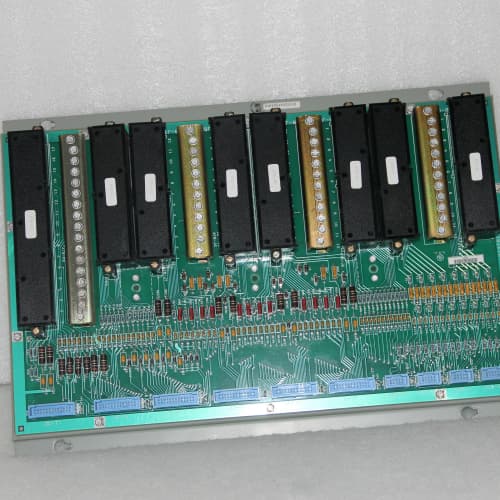
Description
Key Parameters
-
Input Channels: 8 or 16 differential vibration inputs (depending on configuration – double the standard capacity)
-
Input Types: Accelerometer (IEPE/ICP®), velocity (mV/mm/s), proximity probe (eddy-current), or general-purpose voltage (software/jumper-selectable per channel)
-
Signal Conditioning: Integrated IEPE excitation (constant current), charge amplifier (for piezoelectric sensors), integration (velocity to displacement), and programmable filtering
-
Excitation: 24V DC, 4mA constant current (IEPE)
-
Frequency Range: 0.5 Hz to 10 kHz (programmable high-pass and low-pass filtering)
-
Resolution: 16-bit ADC with ±0.1% accuracy
-
Measurement Parameters: Acceleration (g), Velocity (mm/s or in/s), Displacement (µm or mils) – software-selectable integration
-
Isolation: 1500V RMS channel-to-backplane
-
Diagnostics: Per-channel LED status, transducer fault detection (open/bias/overload), over-range detection, self-test on power-up
-
Temp Range: –30°C to +70°C
-
Power Supply: +5V, ±15V from VME backplane (higher current draw)
-
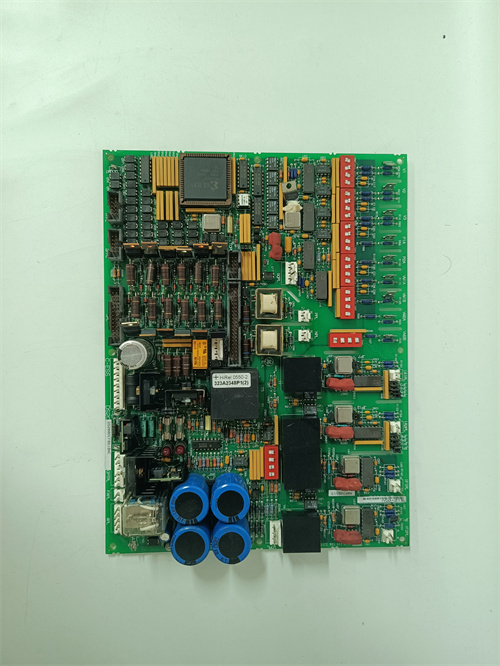
Physical: 6U VME single-slot board
-
Key Features: High-channel-count vibration inputs (8/16 channels), IEPE excitation, charge amp, programmable filtering, acceleration/velocity/displacement output, built-in transducer diagnostics, higher I/O density
Advantages
-
High channel density – the DS3800XVIB provides double the number of vibration input channels compared to the standard DS3800XVIA, reducing the number of boards required for large monitoring systems.
-
Integrated signal conditioning – includes excitation, charge amplification, filtering, and integration circuitry, eliminating the need for external signal conditioners for most vibration sensors.
-
Multi-parameter measurement – can output acceleration, velocity, or displacement from a single sensor input (software-configurable integration).
-
IEPE/ICP compatibility – supports modern piezoelectric accelerometers with built-in electronics, using constant current excitation.
-
Proximity probe support – can also interface with eddy-current probes for shaft relative vibration and position.
-
Transducer diagnostics – detects open circuits, bias faults, and overload conditions, alerting the system to sensor issues.
-
Programmable filtering – the General Electric DS3800XVIB allows setting high-pass and low-pass filters to reject unwanted noise and focus on specific frequency bands.
-
High accuracy – 16-bit ADC ensures precise vibration measurement for early fault detection.
-
Drop-in compatible – works with all Mark IV backplanes and processor configurations.
Applications
-
Large turbine vibration monitoring – provides comprehensive shaft, bearing, and casing vibration monitoring for large gas and steam turbines with multiple measurement points.
-
Combined-cycle plants – monitors multiple turbine sections and balance-of-plant equipment from a single board.
-
Multiple-machine installations – monitors vibration on multiple compressors, pumps, or generators in a single rack.
-
Bearing vibration monitoring – the General Electric DS3800XVIB monitors bearing housing vibration across many bearings.
-
Condition monitoring and predictive maintenance – provides extensive vibration data for trending, FFT analysis, and fault diagnosis.
-
Space-constrained cabinets – reduces board count in cabinets with limited rack slots.
vs Competitors & Previous Variants
| Feature | DS3800XVIB | Standard DS3800XVIA | External Vibration Monitor | Generic VME Vibration Board |
|---|---|---|---|---|
| Input channels | 8–16 | 4–8 | 4–16 (external rack) | 4–8 |
| Signal conditioning | Built-in | Built-in | External required | Limited |
| IEPE excitation | Yes | Yes | Varies | Rarely |
| Parameter output | Accel, velocity, displacement (selectable) | Accel, velocity, displacement (selectable) | Usually fixed | Fixed |
| Transducer diagnostics | Yes | Yes | Sometimes | Rarely |
| Programmable filtering | Yes | Yes | Sometimes | Limited |
| Isolation | 1500V | 1500V | 500–1500V | 500–1500V |
| Temp range | –30°C to +70°C | –30°C to +70°C | 0°C to +50°C | 0°C to +60°C |
| Slot savings | Replaces multiple boards | Baseline | N/A | N/A |
Selection Tips
-
High-density monitoring – choose the DS3800XVIB when you need a large number of vibration input channels (8–16) in a single slot for large turbines or multiple machines.
-
Slot-limited installations – ideal for cabinets with limited rack space where multiple vibration boards would otherwise be required.
-
Sensor compatibility – verify that your vibration sensors (accelerometer, velocity, proximity probe) are supported by the General Electric DS3800XVIB input and excitation options.
-
Measurement type – select the appropriate output parameter (acceleration, velocity, or displacement) for your application; the DS3800XVIB provides software-selectable integration.
-
Filtering requirements – configure the high-pass and low-pass filters to reject noise while preserving the vibration frequency band of interest.
-
Power budget verification – the DS3800XVIB draws more current due to higher channel count. Verify your backplane power capacity before installing multiple units.
-
Spare strategy – keep one DS3800XVIB per 5–8 installed units, especially in critical rotating equipment applications with extensive vibration monitoring.
Critical Precautions
-
Power supply loading – the DS3800XVIB has higher power draw than standard boards. Do not exceed backplane power ratings, especially when installing multiple high-channel-count boards.
-
Sensor wiring – use shielded twisted-pair cables for vibration sensor connections. Ground the shield only at the DS3800XVIB end to prevent ground loops.
-
IEPE sensor power – for IEPE accelerometers, ensure the DS3800XVIB excitation voltage and current (typically 24V DC, 4mA) are correctly configured. Incorrect settings can damage the sensor.
-
Proximity probe compatibility – eddy-current probes require specific excitation voltage and calibration; verify that the General Electric DS3800XVIB is configured for the correct probe type.
-
Frequency range – set the high-pass and low-pass filters appropriately. Too high a high-pass cutoff can miss low-frequency vibration components; too low a low-pass cutoff can let noise through.
-
Integration selection – when selecting velocity or displacement output, ensure the integration algorithm is correctly configured. Double integration (acceleration to displacement) can introduce low-frequency drift.
-
Transducer fault detection – if the DS3800XVIB detects a transducer fault, verify sensor and cabling integrity before replacing the board.
-
Ground loops – use single-point grounding for all vibration sensors to avoid ground-loop noise that can mask true vibration signals.
-
Heat dissipation – due to higher component density, ensure adequate cabinet cooling (>250 CFM) if multiple high-density boards are installed.
-
Hot-swap – never insert or remove the DS3800XVIB while the rack is powered; this can cause signal glitches or damage.
-
ESD handling – always use a grounded wrist strap when handling the DS3800XVIB; sensitive analog and charge amplifier components are ESD-sensitive.
-
Storage – store spare DS3800XVIB boards in anti-static bags in a dry, temperature-controlled environment.
Panasonic S2EB-L2-DC24V
SIEMENS 5SY51037CC
A-B 1756-N2



Reviews
There are no reviews yet.