
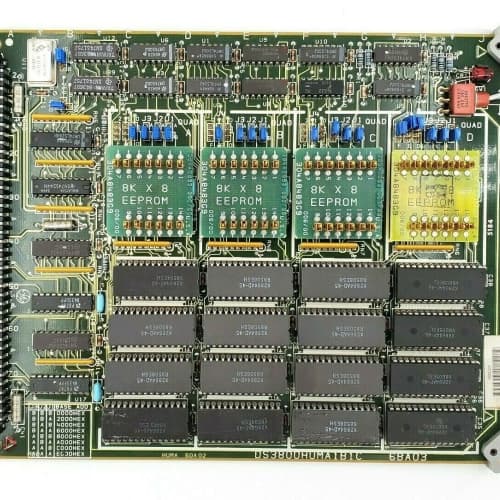
Description
Key Parameters
Temperature Section:
-
Input Channels: 8 differential thermocouple/RTD inputs
-
Input Types: Thermocouple (J, K, T, E, R, S, B, N), RTD (Pt100, Ni100), millivolt
-
Resolution: 16-bit ADC with ±0.05% accuracy
-
Cold-Junction Compensation: Built-in per channel
-
Diagnostics: Burnout detection, open-circuit detection, over-range/under-range detection
Frequency Transmitter Section:
-
Input Channels: 2 independent frequency input channels
-
Input Types: Magnetic pickup, proximity, TTL (5V), or 24V DC (jumper-selectable)
-
Maximum Input Frequency: 100 kHz
-
Output Types: Analog (4–20mA or 0–10V) or digital (frequency/pulse) output (software-selectable)
-
Output Accuracy: ±0.05% of full scale (analog) or ±0.01% (digital)
-
Transmitter Function: Converts frequency input to scaled analog signal or retransmits frequency for external systems
-
Diagnostics: LED status per channel, input signal loss detection, output fault detection
Common Section:
-
Isolation: 1500V RMS channel-to-backplane
-
Temp Range: –30°C to +70°C
-
Power Supply: +5V, ±15V from VME backplane
-
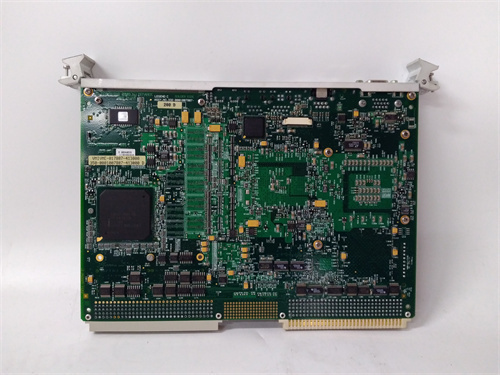
Physical: 6U VME single-slot board
-
Key Features: Combined temperature and frequency transmitter, 16-bit ADC, built-in CJC, burnout detection, frequency-to-analog conversion, 100 kHz input
Advantages
-
Multi-function capability – the DS3800XTFT combines temperature measurement and frequency-to-analog/digital conversion in a single slot, reducing board count and rack space requirements.
-
Built-in cold-junction compensation – on-board CJC for thermocouple inputs eliminates the need for external reference junctions.
-
Burnout detection – automatically detects broken thermocouple wires and flags the channel.
-
Flexible frequency input – supports magnetic, proximity, TTL, or 24V inputs for speed, flow, or position sensors.
-
Scalable output – the General Electric DS3800XTFT converts frequency signals to 4–20mA, 0–10V, or digital pulse outputs for integration with external systems (DCS, SCADA, recorders).
-
Diagnostic visibility – per-channel LED status and fault detection simplify troubleshooting.
-
Isolation – 1500V RMS isolation protects the backplane from field-side noise and transients.
-
Drop-in compatible – works with all Mark IV backplanes and processor configurations.
Applications
-
Turbine EGT and speed transmitter – measures exhaust gas temperature (EGT) and converts turbine speed frequency to a 4–20mA signal for external monitoring systems.
-
Temperature plus flow transmitter – monitors thermocouple or RTD temperatures while converting flowmeter frequency pulses to analog signals for plant DCS.
-
Bearing temperature and speed transmitter – combines bearing RTD inputs with speed pickup frequency-to-analog conversion.
-
Signal conditioning for external systems – the DS3800XTFT provides isolated analog outputs for vibration monitors, speed controllers, or plant historians.
-
Retrofits – replaces separate temperature boards and frequency transmitters with a single, integrated solution.
vs Competitors & Separate Boards
| Feature | DS3800XTFT | DS3800XTBA (Temp) + External Frequency Transmitter | Generic VME Combo Board |
|---|---|---|---|
| Temperature channels | 8 | 16 (XTBA) + 0 | 8 |
| Frequency input channels | 2 | 0 + variable (external) | 2 |
| Frequency-to-analog output | Yes | No (requires external transmitter) | Sometimes |
| Output types | 4–20mA, 0–10V, digital pulse | None | Varies |
| Board count | 1 | 2+ (with external transmitter) | 1 |
| CJC | Built-in | Built-in | External |
| Burnout detection | Yes | Yes | Sometimes |
| Isolation | 1500V | 1500V + external | 500–1500V |
| Temp range | –30°C to +70°C | –30°C to +70°C | 0°C to +60°C |
Selection Tips
-
Signal transmission needed – choose the DS3800XTFT when you need both temperature measurement and frequency-to-analog/digital conversion for integration with external systems (DCS, SCADA, recorders).
-
Slot-limited installations – ideal for compact systems with limited rack slots where both measurement and transmission are required.
-
Application matching – ensure that the 8 temperature channels and 2 frequency transmitter channels meet your system’s requirements.
-
Output type selection – the General Electric DS3800XTFT supports 4–20mA, 0–10V, or digital pulse outputs; verify which output type is required by your external system.
-
Sensor compatibility – verify that your thermocouple/RTD types and frequency sensors (magnetic, proximity, TTL, 24V) are supported by the DS3800XTFT.
-
Spare strategy – keep one DS3800XTFT per 5–8 installed units, especially in systems where it serves multiple critical functions.
-
Calibration – periodically verify temperature accuracy using a precision calibrator and frequency-to-output scaling using a signal generator and accurate measurement instrument.
Critical Precautions
-
Thermocouple wiring – use the correct extension-grade thermocouple wire (not copper) for temperature inputs to the DS3800XTFT; incorrect wire types introduce cold-junction errors.
-
Thermocouple polarity – observe correct polarity when connecting thermocouples; reversed polarity produces inverted readings.
-
RTD wiring – use 3-wire or 4-wire RTD connections to cancel lead resistance; 2-wire connections introduce measurement errors.
-
CJC location – the DS3800XTFT cold-junction compensation measures the temperature at the terminal block. Ensure the terminal block is not exposed to drafts or radiant heat.
-
Frequency input voltage limits – never apply voltage above 30V to the frequency inputs; magnetic pickups can generate high voltages at high speeds – use appropriate attenuation.
-
Output load limits – do not exceed the maximum load resistance for 4–20mA outputs (typically 600Ω) or the minimum load resistance for 0–10V outputs (typically 2kΩ) on the General Electric DS3800XTFT.
-
Cable shielding – use shielded twisted-pair cables for all thermocouple, RTD, frequency inputs, and analog outputs. Ground the shield only at the DS3800XTFT end to prevent ground loops.
-
Ground loops – use single-point grounding for all sensors and outputs connected to the DS3800XTFT to avoid ground-loop noise.
-
Output scaling – ensure the scaling parameters (frequency range to output range) are correctly configured in the DS3800XTFT before commissioning.
-
Hot-swap – never insert or remove the DS3800XTFT while the rack is powered; this can cause bus errors or component damage.
-
ESD handling – always use a grounded wrist strap when handling the DS3800XTFT; CMOS and precision analog components are ESD-sensitive.
-
Storage – store spare DS3800XTFT boards in anti-static bags in a dry, temperature-controlled environment.
A-B 1756-N2
A-B 1769-ECR
P+F NBN40-U1-E0


Reviews
There are no reviews yet.