
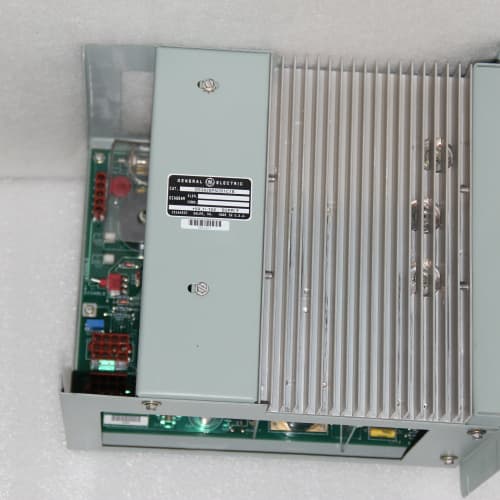
Description
Key Parameters
-
Function: Galvanic isolation and voltage conversion for sensor power/excitation
-
Input Voltage: Configurable (typically 120/240V AC or 24/48V DC)
-
Output Voltages: Multiple isolated DC outputs (e.g., ±15V, +24V, or custom excitation voltages)
-
Isolation: 2500V RMS input-to-output and channel-to-channel
-
Output Accuracy: ±0.1% regulation
-
Ripple/Noise: <10 mV peak-to-peak
-
Current Capacity: Moderate (sufficient for typical sensor loads; consult board marking)
-
Diagnostics: LED status indicators per output, over-current protection, thermal protection, enhanced fault logging (firmware 1A1A) , self-test on power-up
-
Temp Range: –40°C to +85°C (extended, improved over standard DS3800XPTN)
-
Physical: 6U VME single-slot board
-
Key Features: Galvanic isolation, voltage conversion, multiple isolated outputs, extended temp range, enhanced diagnostics, self-test, firmware rev 1A1A
Advantages
-
Galvanic isolation – the DS3800XPTN1A1A provides 2500V RMS isolation between input and outputs, protecting sensors and the Mark IV system from ground loops and voltage transients.
-
Multiple isolated outputs – each output is independently isolated, allowing connection to sensors with different ground references without causing ground-loop issues.
-
Enhanced diagnostics – the 1A1A firmware provides improved fault logging, self-test on power-up, and detailed diagnostic reporting for predictive maintenance.
-
Extended temperature range – operates from –40°C to +85°C for harsh environments (improved over standard DS3800XPTN).
-
Voltage conversion – converts input power to the precise voltages required by speed pickups, proximity probes, LVDTs, and other transducers.
-
Low noise – <10 mV ripple ensures clean power for sensitive analog measurements.
-
Comprehensive protection – over-current and thermal protection safeguard the General Electric DS3800XPTN1A1A and connected field devices.
-
Diagnostic visibility – LED indicators simplify troubleshooting of power issues.
-
Drop-in compatible – works with all Mark IV backplanes and processor configurations.
Applications
-
Isolated sensor power – provides clean, isolated excitation for speed pickups, proximity probes, and LVDTs where ground loops are a concern.
-
Ground loop elimination – the DS3800XPTN1A1A breaks ground loops between field sensors and the control system, improving measurement accuracy.
-
Voltage conversion – converts a standard power bus voltage to the specific excitation voltage required by different sensors.
-
Offshore and harsh environments – extended temperature range makes it suitable for demanding applications.
-
Retrofits – the DS3800XPTN1A1A replaces aging transformer/isolator modules in legacy Mark IV systems with improved diagnostics.
vs Competitors & Previous Variants
| Feature | DS3800XPTN1A1A | Standard DS3800XPTN | Generic Isolation Board |
|---|---|---|---|
| Primary function | Isolation + conversion | Isolation + conversion | Isolation only |
| Isolation | 2500V | 2500V | 500–1500V |
| Outputs | Multiple, independently isolated | Multiple, independently isolated | Single or multiple |
| Extended temp range | –40°C to +85°C | –30°C to +70°C | 0°C to +60°C |
| Self-test on power-up | Yes (1A1A) | No | No |
| Fault logging | Enhanced (1A1A) | Standard | No |
| Ripple/noise | <10 mV | <10 mV | 10–50 mV |
| Firmware revision | 1A1A | Varies | N/A |
Selection Tips
-
Isolation required – choose the DS3800XPTN1A1A when you need to break ground loops or provide isolated power to sensors with different ground references.
-
Harsh environments – the extended temperature range makes it suitable for offshore, desert, or unheated cabinet installations.
-
Enhanced diagnostics – the 1A1A firmware provides improved fault logging and self-test, aiding predictive maintenance.
-
Voltage conversion – if your plant uses a different power bus voltage than required by your sensors, the General Electric DS3800XPTN1A1A can convert it to the correct excitation voltage.
-
Sensor compatibility – verify that the output voltages and current capacity of the DS3800XPTN1A1A match your sensors’ requirements.
-
Multiple ground references – the independently isolated outputs of the DS3800XPTN1A1A allow connecting sensors with different ground potentials.
-
Firmware compatibility – confirm your Mark IV main processor firmware supports the enhanced diagnostic features of the DS3800XPTN1A1A.
-
Spare strategy – keep one DS3800XPTN1A1A per 5–8 installed units, especially in installations with numerous isolated sensors.
-
Calibration – periodically verify output voltages under load using a precision multimeter.
Critical Precautions
-
Input voltage configuration – verify that the DS3800XPTN1A1A input jumpers are set correctly for your available input power before applying power. Incorrect settings can damage the board.
-
Output isolation – do not connect the isolated output commons together; this defeats the isolation and can create ground loops.
-
Overloading – do not exceed the DS3800XPTN1A1A current rating for any output. Overloading can cause voltage drop or overheating.
-
Wiring polarity – ensure correct polarity when connecting sensors to the General Electric DS3800XPTN1A1A outputs; reversed polarity can damage sensitive transducers.
-
Shielded cabling – use shielded cables for sensor connections to minimize noise pickup. Ground the shield only at the sensor or the DS3800XPTN1A1A end (not both) to avoid ground loops.
-
Grounding – ensure proper system grounding; the DS3800XPTN1A1A provides isolation but does not replace proper overall system grounding practices.
-
Self-test – allow the DS3800XPTN1A1A to complete its power-up self-test (~2 seconds) before relying on outputs.
-
Thermal considerations – ensure adequate cabinet cooling; the DS3800XPTN1A1A can generate moderate heat under load.
-
Hot-swap – never insert or remove the DS3800XPTN1A1A while the rack is powered; this can cause voltage spikes and damage connected sensors.
-
ESD handling – always use a grounded wrist strap when handling the DS3800XPTN1A1A; power components are ESD-sensitive.
-
Storage – store spare DS3800XPTN1A1A boards in anti-static bags in a dry, temperature-controlled environment.
A-B 1756-DNB
A-B 1786-XT
A-B 1756-N2
.jpg)


Reviews
There are no reviews yet.