
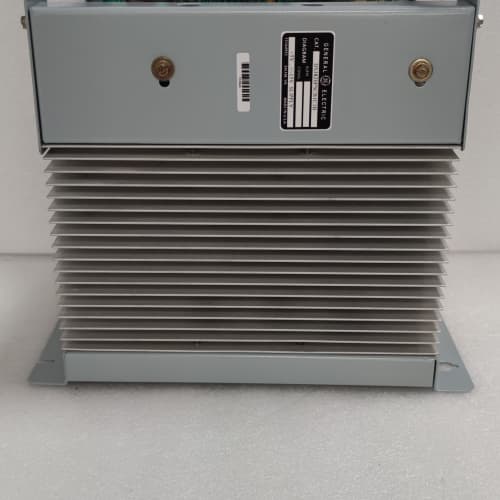
Description
Key Parameters
-
Input Channels: 4 independent frequency input channels
-
Input Types: Magnetic pickup, proximity, TTL (5V), or 24V DC (per-channel jumper-selectable)
-
Measurement Method: Frequency (period averaging) – not pulse counting
-
Frequency Range: 0.1 Hz to 500 kHz
-
Measurement Accuracy: ±0.001% of reading (best in class)
-
Measurement Update Rate: 10 Hz to 200 Hz (adjustable, improved)
-
Input Filtering: Programmable digital debounce and noise filters
-
Input Isolation: 2500V RMS channel-to-backplane (enhanced)
-
Diagnostics: Per-channel LED status, loss-of-signal detection, frequency out-of-range alarms, signal quality monitoring, self-test on power-up
-
Temp Range: –40°C to +85°C (extended)
-
Power Supply: +5V (logic), +24V (field inputs) from backplane
-
Physical: 6U VME single-slot board
-
Key Variant Features: ±0.001% accuracy, 0.1 Hz–500 kHz range, programmable filtering, 2500V isolation, extended temp range, self-test, firmware rev 1B1B
Advantages
-
Industry-leading frequency precision – the DS3800XCJB1B1B provides ±0.001% accuracy, the highest available in the Mark IV lineup, ideal for precise speed control and flow measurement.
-
Wide frequency range – measures from very low frequencies (0.1 Hz) for turning gear monitoring up to 500 kHz for high-speed turbine pickups.
-
Period-averaging measurement – superior to pulse counting for frequency determination, providing stable readings even with noisy or irregular signals.
-
Programmable filtering – digital filters can be tuned to reject vibration-induced noise on each channel independently.
-
Enhanced diagnostics – signal quality monitoring and self-test provide early warning of deteriorating sensors or board issues.
-
Superior isolation – 2500V RMS isolation protects the backplane from field-side surges and transients.
-
Extended temperature range – operates from –40°C to +85°C for harsh environments.
-
Drop-in compatible – works with all Mark IV backplanes and processor configurations, replacing standard DS3800XCJB boards.
Applications
-
Precision speed control (governing) – provides the most accurate turbine speed feedback for precise speed setpoint control during startup, synchronization, and load operation.
-
Critical overspeed protection – delivers highly accurate frequency data to ensure reliable overspeed trip logic.
-
High-accuracy flow measurement – measures frequency from turbine flowmeters (fuel gas, liquid fuel, steam) for precise flow rate and mass flow calculations.
-
Slow-speed monitoring – the 0.1 Hz lower limit is ideal for turning gear speed monitoring, slow roll, and low-speed shaft monitoring.
-
Offshore and harsh environments – the General Electric DS3800XCJB1B1B is designed for extreme temperature and corrosive conditions.
-
Condition monitoring – provides high-precision frequency data for vibration analysis and bearing condition monitoring.
vs Competitors & Previous Variants
| Feature | DS3800XCJB1B1B | DS3800XCJB | DS3800XCIA1A1A | Generic VME Frequency Board |
|---|---|---|---|---|
| Measurement method | Frequency (period avg) | Frequency (period avg) | Counting / quadrature | Counting |
| Frequency accuracy | ±0.001% | ±0.001% | <0.01% | ±0.05–0.1% |
| Frequency range | 0.1 Hz – 500 kHz | 0.1 Hz – 500 kHz | 0–250 kHz | 10 Hz–50 kHz |
| Input filtering | Programmable | None | Programmable | None |
| Isolation | 2500V | 1500V | 2500V | 500–1000V |
| Update rate | 10–200 Hz (adjustable) | 10–100 Hz | 100 Hz (fixed) | Variable |
| Signal quality monitoring | Yes | No | Yes | No |
| Self-test | Yes | No | Yes | No |
| Temp range | –40°C to +85°C | –30°C to +70°C | –40°C to +85°C | 0°C to +60°C |
| Firmware revision | 1B1B | Varies | 1A1A | N/A |
Selection Tips
-
Highest precision frequency measurement – choose the DS3800XCJB1B1B for applications requiring the best possible frequency accuracy (governing, overspeed, high-accuracy flow).
-
Programmable filtering – the 1B1B variant adds filtering capability not available on the standard DS3800XCJB, making it ideal for vibration-prone or noisy environments.
-
Slow-speed monitoring – the 0.1 Hz lower limit makes this board suitable for turning gear and low-speed shaft monitoring.
-
Not for encoders – the DS3800XCJB1B1B does not support quadrature encoders. If position feedback is required, use the DS3800XCIA1A1A or DS3800XCIB1B1B instead.
-
Power budget verification – the advanced features of the General Electric DS3800XCJB1B1B may increase power draw; verify your backplane power capacity.
-
Firmware compatibility – confirm your Mark IV main processor firmware supports the enhanced diagnostic and filtering features of the DS3800XCJB1B1B; older versions may require a configuration update.
-
Spare strategy – keep one DS3800XCJB1B1B per 5 installed units, especially in critical speed/flow applications.
-
Calibration verification – although factory-calibrated, verify frequency accuracy using a precision signal generator during commissioning.
Critical Precautions
-
Input voltage limits – never apply voltage above 30V to the DS3800XCJB1B1B inputs. Magnetic pickups can generate high voltages at high speeds – use appropriate attenuation.
-
Cable shielding – use shielded twisted-pair cables for all inputs. Ground the shield only at the board end to prevent ground loops.
-
Filter configuration – do not set the digital filter cutoff frequency too high; this can attenuate real signal changes. Consult GE application notes for proper settings.
-
Update rate selection – do not set the update rate too high if the input frequency is low; as a rule, update rate should be ≥ 10× the input frequency to avoid measurement instability.
-
Period averaging behavior – the General Electric DS3800XCJB1B1B measures frequency by averaging the period over multiple cycles. Rapid frequency changes may be smoothed; adjust update rate accordingly.
-
Sensor compatibility – verify that the input impedance and trigger thresholds match your specific sensors; some magnetic pickups may require external conditioning.
-
Grounding – use a single-point ground for all field devices connected to the DS3800XCJB1B1B to avoid ground-loop noise.
-
Self-test – allow the DS3800XCJB1B1B to complete its power-up self-test (~2 seconds) before relying on frequency readings.
-
Hot-swap – never insert or remove the DS3800XCJB1B1B while the rack is powered; this can cause measurement errors or damage.
-
ESD handling – always use a grounded wrist strap; sensitive input stages can be damaged by static discharge.
-
Storage – store spare DS3800XCJB1B1B boards in anti-static bags in a dry, temperature-controlled environment.
A-B 1756-BA2
A-B 1756-BA2
A-B 1756-BA1


Reviews
There are no reviews yet.