
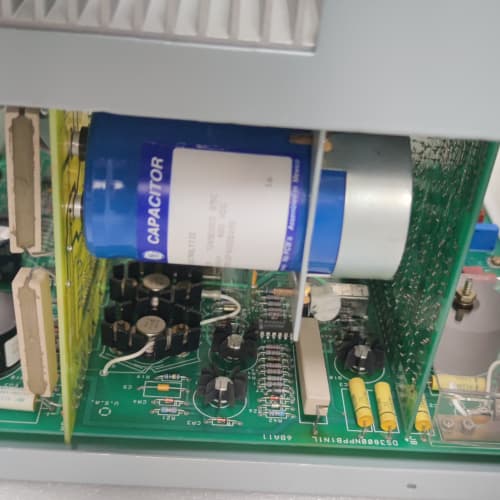
Description
Key Parameters
-
Input Channels: 4 independent counter/encoder channels
-
Input Types: Magnetic pickup (variable reluctance), proximity (inductive), TTL (5V), or 24V DC (jumper-selectable per channel)
-
Maximum Input Frequency: 100 kHz per channel
-
Counter Resolution: 32-bit (up/down counter)
-
Encoder Support: Incremental (A/B/Z) with quadrature decoding (x1, x2, x4)
-
Speed Measurement: Calculates RPM with <0.01% accuracy
-
Input Isolation: 1500V RMS channel-to-backplane
-
Diagnostics: Per-channel LED status, input signal loss detection, frequency threshold alarms
-
Temp Range: –30°C to +70°C
-
Power Supply: +5V (logic), +24V (field inputs) from backplane
-
Physical: 6U VME single-slot board
-
Key Features: 4 counter channels, encoder support, 100 kHz max frequency, quadrature decoding, speed calculation
Advantages
-
High-speed counting – the DS3800XCIA accepts frequencies up to 100 kHz, making it suitable for high-speed turbine speed pickups and flowmeter pulse inputs.
-
Encoder support – quadrature decoding (x1, x2, x4) provides precise position and direction information for actuator feedback or shaft position monitoring.
-
Flexible input types – each channel can be independently configured for magnetic, proximity, TTL, or 24V DC inputs, accommodating diverse field sensors.
-
Built-in speed calculation – the General Electric DS3800XCIA can calculate RPM directly from input frequency, reducing main processor load.
-
Input signal diagnostics – loss-of-signal detection and frequency threshold alarms provide early warning of sensor or wiring issues.
-
High accuracy – 32-bit counters with <0.01% speed accuracy for critical overspeed protection and speed control.
-
Drop-in compatible – works with all Mark IV backplanes and processor configurations.
Applications
-
Turbine overspeed protection – measures speed from multiple magnetic pickups and provides data to the overspeed trip logic.
-
Speed control (governing) – provides feedback for speed setpoint control during startup, synchronization, and load operation.
-
Flow measurement – counts pulses from turbine flowmeters for fuel gas or liquid fuel totalization.
-
Shaft position monitoring – uses quadrature encoders to track valve position or shaft angular position for timing control.
-
Synchronization – provides speed and phase information for grid synchronization of generators.
vs Competitors & Related Variants
| Feature | DS3800XCIA | DS3800TIMC (Timer/Counter) | Generic VME Counter Board |
|---|---|---|---|
| Counter channels | 4 | 4 | 2–4 |
| Max frequency | 100 kHz | 50 kHz | 10–50 kHz |
| Encoder support | Yes (A/B/Z, quadrature) | No (pulse only) | Rarely |
| Speed calculation | Built-in (RPM) | No (requires processor) | No |
| Input types | Magnetic, prox, TTL, 24V | TTL or 24V | Fixed |
| Input isolation | 1500V | 1000V | 500–1000V |
| Loss-of-signal detect | Yes | No | Rarely |
| Frequency threshold alarms | Yes | No | No |
| Temp range | –30°C to +70°C | –30°C to +70°C | 0°C to +60°C |
Key Differentiators:
-
The DS3800XCIA supports quadrature encoders, while the DS3800TIMC is limited to simple pulse counting.
-
Higher frequency capability (100 kHz vs 50 kHz) makes it suitable for high-speed turbine pickups.
-
Built-in RPM calculation and threshold alarms reduce main processor workload.
Selection Tips
-
Overspeed protection systems – use the DS3800XCIA for high-speed turbine speed monitoring due to its 100 kHz capability and loss-of-signal detection.
-
Encoder feedback – if your system uses quadrature encoders for valve position or shaft timing, this is the required board.
-
Flow pulse counting – the General Electric DS3800XCIA can also be used for high-frequency flowmeter pulses, but consider the DS3800TIMC for lower-frequency (<50 kHz) applications.
-
Input type verification – confirm your field sensors match the jumper-selectable input types; magnetic pickups require different conditioning than proximity sensors.
-
Spare strategy – keep one DS3800XCIA per 5 installed units, especially in applications where speed monitoring is critical (gas turbines, large steam turbines).
Critical Precautions
-
Input voltage limits – never apply voltage above 30V to the DS3800XCIA inputs; magnetic pickups can generate high voltages at high speeds – use the appropriate attenuation or conditioning.
-
Cable shielding – use shielded twisted-pair cables for all inputs to the DS3800XCIA, especially for magnetic pickups and encoders. Ground the shield only at the board end to prevent ground loops.
-
Sensor compatibility – verify that the General Electric DS3800XCIA input impedance and threshold levels match your specific sensors; some magnetic pickups may require external conditioning.
-
Encoder wiring – for quadrature encoders, ensure A, B, and Z signals are correctly wired and that the Z (index) pulse is properly connected for synchronization functions.
-
Grounding – ensure a single-point ground for all field devices connected to the DS3800XCIA to avoid ground-loop noise that can cause false counts.
-
Hot-swap – never insert or remove the DS3800XCIA while the rack is powered; this can cause counter corruption or damage to the board.
-
ESD handling – always use a grounded wrist strap when handling the DS3800XCIA; sensitive input stages can be damaged by static discharge.
-
Firmware compatibility – confirm your Mark IV main processor firmware supports the quadrature decoding and RPM calculation features of the DS3800XCIA; older firmware may require configuration updates.
-
Storage – store spare DS3800XCIA boards in anti-static bags in a dry, temperature-controlled environment to prevent connector corrosion.
A-B 1756-BA2
A-B 1756-BA2
A-B 1756-BA2


Reviews
There are no reviews yet.