
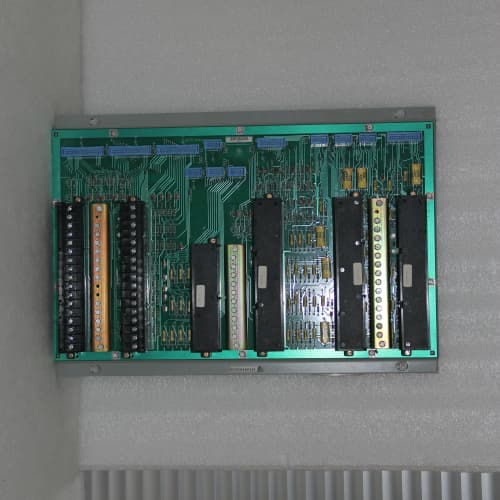
Description
Key Parameters
-
Function: High-speed sequence control and state-machine execution
-
Sequencing Steps: Up to 256 programmable steps stored in onboard EPROM
-
Timers: 8 independent hardware timers (1ms resolution)
-
Counters: 4 high-speed counters (up to 10kHz)
-
Inputs: 16 dedicated digital inputs (optically isolated, 24/48V DC)
-
Outputs: 16 dedicated digital outputs (open-collector, 24V DC, 0.5A)
-
Response Time: <1ms from input change to output action (deterministic)
-
Diagnostics: Onboard LED status, watchdog timer, sequence step indicator
-
Temp Range: –30°C to +70°C
-
Power Supply: +5V (logic), +24V (I/O) from backplane
-
Physical: 6U VME single-slot board
Advantages
-
Deterministic response – the DS3800SCG executes sequences in hardware, not software, ensuring sub-millisecond response times that cannot be achieved by the main processor alone.
-
Independent operation – continues functioning even if the main processor communication is disrupted, providing a failsafe layer for critical trips.
-
Dedicated I/O – 16 isolated inputs and 16 outputs are mapped directly to sequence steps, reducing load on other I/O boards.
-
Field-programmable EPROM – sequence logic can be updated in the field without replacing the General Electric DS3800SCG.
-
Watchdog protection – internal watchdog timer forces a safe state if the sequence execution stalls.
-
Drop-in compatible – works with all Mark IV backplanes and processor configurations.
Applications
-
Turbine startup sequencing – executes purge cycles, ignition, warm-up, and acceleration ramps in a precise time-controlled manner.
-
Emergency shutdown (ESD) – handles overspeed, over-temperature, and loss-of-flame trip sequences with deterministic timing.
-
Load rejection and runback – executes load-shedding and runback logic when grid disturbances occur.
-
Inlet guide vane (IGV) scheduling – controls IGV position changes based on speed and load setpoints.
-
Fuel transfer logic – manages automatic transfer between gas and liquid fuel during startup or operational changes.
vs Competitors & Related Variants
| Feature | DS3800SCG | Generic VME Sequence Board |
|---|---|---|
| Native Mark IV firmware | Yes (proprietary instruction set) | No (custom coding required) |
| Hardware timers | 8 (1ms resolution) | 2–4 (typically 10ms) |
| Response time | <1ms deterministic | 5–20ms (software-dependent) |
| Independent operation | Yes (auto-failsafe) | No (requires processor) |
| Dedicated I/O | 16 in / 16 out | Varies (often shared) |
| Watchdog timer | Yes (hardware) | Software-only |
| Temp range | –30°C to +70°C | 0°C to +60°C |
Selection Tips
-
Sequence verification – before deploying, verify that the EPROM on the DS3800SCG contains the correct sequence logic for your specific turbine model (e.g., Frame 5 vs. Frame 7).
-
EPROM backup – always keep a backup copy of the sequence EPROM data for each General Electric DS3800SCG in your facility; a corrupted EPROM requires reprogramming with the correct hex file.
-
I/O mapping – confirm that the inputs and outputs on the DS3800SCG are wired to the correct field devices; miswiring can result in sequence stalls or incorrect trips.
-
Timer settings – verify that the hardware timer presets match your turbine’s startup and shutdown time requirements; these are stored in the EPROM and may need adjustment during commissioning.
-
Spare strategy – keep one DS3800SCG per 5 installed units; sequence boards are mission-critical and should be available for immediate replacement.
Critical Precautions
-
EPROM handling – use proper ESD precautions when handling EPROMs on the DS3800SCG; static discharge can corrupt or destroy the sequence data.
-
EPROM programming – use only GE-approved programmers and software; incorrect programming can produce unpredictable sequence behavior.
-
Watchdog testing – periodically test the watchdog timer by temporarily disabling the sequence; the DS3800SCG should force outputs to a safe state within 100ms.
-
Power stability – ensure the backplane +24V supply is stable; voltage dips can cause the General Electric DS3800SCG to reset or latch incorrectly.
-
Input filtering – if using the digital inputs for noisy signals (e.g., from mechanical switches), install external RC filters to avoid false triggering; the DS3800SCG has minimal built-in debounce.
-
Hot-swap – never insert or remove the DS3800SCG while the rack is powered; this can cause sequence corruption or damage to the backplane.
-
Firmware compatibility – confirm that the main processor firmware version supports the DS3800SCG; older Mark IV versions may not recognize all sequence steps.
-
Sequence documentation – maintain up-to-date documentation of the sequence logic stored on each DS3800SCG; this is critical for troubleshooting and for replacement programming.
A-B 1756-TBNH
A-B 193-KB13
SICK GRTE18-P1147
A-B 1756-TBCH


Reviews
There are no reviews yet.