
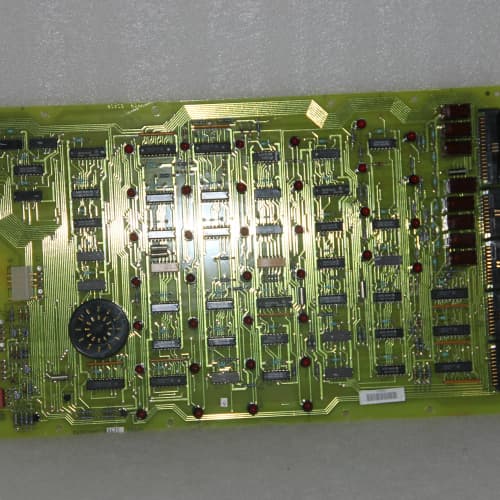
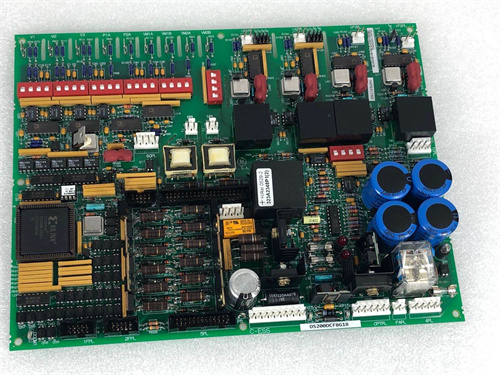
Description
Key Parameters
-
Output Channels: 16 independent form-C (SPDT) relay outputs
-
Contact Rating: 5A at 250V AC / 30V DC (resistive load)
-
Coil Voltage: 24V DC from backplane
-
Isolation: 2500V RMS coil-to-contact, 1500V RMS channel-to-channel
-
Diagnostics: Coil status LED per channel, fuse status indication
-
Mechanical Life: >10 million operations
-
Electrical Life: >100,000 operations at rated load
-
Temp Range: –30°C to +70°C
-
Power Supply: +5V (logic), +24V (relay coils) from backplane
-
Physical: 6U VME single-slot board
Advantages
-
High current capability – 5A contacts can directly drive most solenoid valves and alarm devices without external interposing relays.
-
Form-C contacts – provides both NO and NC outputs per channel for flexible wiring (fail-safe or non-fail-safe configurations).
-
Full isolation – channel-to-channel and coil-to-contact isolation prevents noise coupling and ground loops.
-
Visual status indication – individual LEDs show coil energization for quick troubleshooting.
-
Fused outputs – each channel has a replaceable fuse to protect against field wiring shorts.
-
Drop-in compatible – works with all Mark IV processor and I/O boards.
Applications
-
Turbine trip and shutdown – drives emergency stop solenoid valves for fuel, steam, and lube oil.
-
Alarm annunciation – activates panel lamps, horns, and DCS alarm inputs.
-
Motor control – starts/stops auxiliary pumps, fans, and cooling water valves.
-
Valve actuation – controls on/off isolation valves and purge valves.
-
Generator breaker control – initiates trip and close commands to the main generator circuit breaker.
vs Competitors & Related Variants
| Feature | DS3800NVRC | Generic VME Relay Board |
|---|---|---|
| Native Mark IV integration | Yes (direct mapping) | No (requires custom addressing) |
| Channels | 16 form-C | 8–16 (usually form-A) |
| Contact rating | 5A | 2–3A typical |
| Fused outputs | Yes (per channel) | No (external fuses required) |
| Isolation | 2500V | 1500V typical |
| Visual diagnostics | LEDs per channel | Usually none |
| Temp range | –30°C to +70°C | 0°C to +60°C |
Selection Tips
-
Load verification – confirm the inrush current of solenoid valves does not exceed the 5A rating of the DS3800NVRC; use an external contactor for higher loads.
-
Fail-safe wiring – use the NC contact for critical trip circuits so that the valve actuates on power loss or board removal.
-
Fuse replacement – stock spare fuses (specification: 5A slow-blow, 250V) for each General Electric DS3800NVRC installed.
-
Channel mapping – verify that the main processor is configured to send the correct output commands to the DS3800NVRC; incorrect mapping can cause unintended operations.
-
Spare strategy – keep one DS3800NVRC per 5 installed units; relay contacts wear out over time, especially under inductive loads.
Critical Precautions
-
Inductive loads – always install a flyback diode (for DC loads) or RC snubber (for AC loads) across solenoid coils to prevent voltage spikes from damaging the DS3800NVRC relay contacts.
-
Fuse rating – do not exceed the specified fuse rating; using a higher-rated fuse can result in PCB trace damage during a short circuit.
-
Wiring inspection – check for shorts in field wiring before energizing the DS3800NVRC; a short can blow the fuse or weld the contacts.
-
Contact wear – for high-cycle applications (frequent switching), consider using an external solid-state relay to extend the life of the DS3800NVRC contacts.
-
Hot-swap – never insert or remove the General Electric DS3800NVRC while the rack is powered; relay coils may latch unexpectedly.
-
Grounding – use separate grounding for the relay common and the logic ground to avoid noise coupling into the backplane.
-
Storage – store spare DS3800NVRC boards in anti-static bags in a dry, temperature-controlled environment to prevent contact oxidation.
GE IC697ACC701
A-B 1756-TBNH
A-B 1756-TBCH


Reviews
There are no reviews yet.