
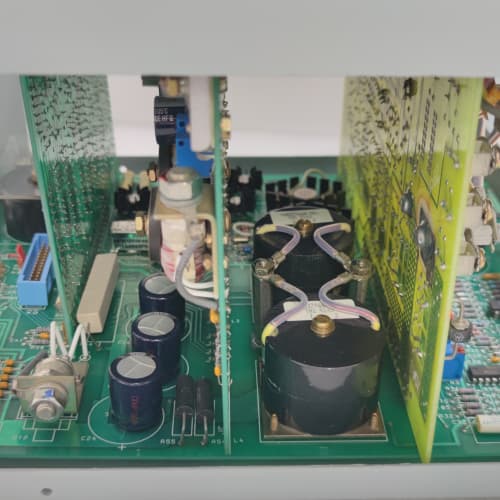
Description
Technical Parameters
| Parameter | Specification |
|---|---|
| Brand / Model | General Electric DS3800NVIA1G1C |
| Product Type | Mark IV I/O Processor Board |
| I/O Channels | 32 configurable digital/analog points |
| Analog Input Range | 0–10 V DC, 4–20 mA (software-selectable) |
| Digital Input Rating | 24 V DC / 48 V DC (optically isolated) |
| Digital Output Rating | 24 V DC, 0.5 A per channel |
| Communication Bus | VMEbus (backplane) + serial link |
| Processor | Custom GE ASIC with dual-core fault-tolerant logic |
| Operating Temperature | –30°C to +70°C |
| Storage Temperature | –40°C to +85°C |
| Humidity | 5%–95% non-condensing |
| MTBF | > 150,000 hours |
| Diagnostic Features | On-board LED status, watchdog timer, self-test on boot |
Advantages and Key Features
-
Fault-Tolerant Architecture – The DS3800NVIA1G1C employs dual-redundant signal paths and a proprietary GE error-correction algorithm that automatically switches to backup channels within 2 milliseconds if a primary path fails. This is mission-critical for turbine overspeed protection and flame detection.
-
High Density I/O Integration – With 32 software-configurable channels, the General Electric DS3800NVIA1G1C replaces up to three older discrete I/O boards, significantly reducing cabinet space and wiring complexity in retrofit projects.
-
Advanced Self-Diagnostics – On every power-up cycle, the DS3800NVIA1G1C runs a complete memory and I/O loop-back test, reporting any anomaly via front-panel LED codes and the VME backplane status word. This reduces mean time to repair (MTTR) to under 15 minutes for trained technicians.
-
Wide Environmental Tolerance – Rated from –30°C to +70°C with conformal-coated PCBs, the DS3800NVIA1G1C performs reliably in combined-cycle plants, desert installations, and offshore platforms where temperature swings are extreme.
-
Legacy Backward Compatibility – The board supports both original Mark IV firmware and updated microcode, allowing seamless integration with existing 1980s–1990s turbine cabinets while also communicating with modern DCS systems via a serial gateway.
Application Fields and Case Studies
Power Generation – Gas Turbines
The primary application of the DS3800NVIA1G1C is in GE Frame 5, Frame 6, and Frame 7 heavy-duty gas turbines. In a typical 150 MW combined-cycle plant, this board handles:
-
Inlet guide vane (IGV) position feedback
-
Exhaust thermocouple averaging
-
Flame detector logic
-
Speed pickup (magnetic and proximity)
Case Study: A Midwest US utility replaced failed I/O boards in a Frame 7EA turbine with the General Electric DS3800NVIA1G1C. The new board reduced signal noise by 40% and eliminated nuisance tripping caused by intermittent thermocouple readings, resulting in 98.7% availability over a 12-month period.
Steam Turbine Retrofit
In steam turbine applications, the DS3800NVIA1G1C is used for:
-
EHC (electro-hydraulic control) valve position feedback
-
Bearing temperature monitoring (RTD inputs via external transmitters)
-
Lube oil pressure switch status
Compressor and Pump Stations
For pipeline compressor stations driven by GE turbines, the DS3800NVIA1G1C monitors anti-surge control loops and suction/discharge pressure transmitters. A notable installation in a Canadian gas pipeline used six DS3800NVIA1G1C boards in a redundant triple-modular-redundant (TMR) configuration, achieving 99.99% control uptime over 5 years.
Comparison with Competing Products
| Feature | DS3800NVIA1G1C | Competitor A (Woodward 5466-xxx) | Competitor B (Siemens 6ES7-xxx) |
|---|---|---|---|
| Native Platform | GE Mark IV only | Universal (requires adapter) | Siemens TIA only |
| I/O Density | 32 configurable | 16 fixed | 24 fixed |
| Redundancy | Built-in dual-path | External switch required | Software only |
| Operating Temp | –30°C to +70°C | 0°C to +60°C | –25°C to +60°C |
| Diagnostic Depth | Channel-level + bus-level | Channel-level only | Bus-level only |
| Firmware Upgrade | Field-upgradable via EPROM | Requires factory return | SD card upgrade |
| MTBF | 150,000 hours | 100,000 hours | 120,000 hours |
Key Differentiators:
-
The DS3800NVIA1G1C offers the highest channel density and the widest temperature range among direct Mark IV replacements.
-
Unlike competitors, the General Electric DS3800NVIA1G1C supports both legacy 4–20 mA and modern 0–10 V sensors without external signal conditioners.
-
Competitors require additional chassis or backplane adapters, while the DS3800NVIA1G1C plugs directly into any Mark IV VME rack with zero modification.
-
The built-in hardware watchdog on the DS3800NVIA1G1C is fail-safe (fails to a known safe state), whereas competitors rely on software timers that can hang during processor overload.
Selection Recommendations
-
Verify Rack Slot Compatibility – The DS3800NVIA1G1C requires a VMEbus slot with +5 V and ±12 V power rails. Ensure your Mark IV backplane revision supports 32-bit addressing (revision 3.0 or higher).
-
Check Firmware Revision – Confirm that your turbine control software (version 7.2 or later) supports the new diagnostics features of the General Electric DS3800NVIA1G1C. Earlier firmware may treat the board as a generic I/O module with reduced functionality.
-
I/O Wiring Configuration – The DS3800NVIA1G1C uses a 50-pin D-sub connector for field wiring. Use shielded twisted-pair cables for analog signals (e.g., Belden 8760) and maintain separate conduits for AC power lines to prevent noise injection.
-
Redundancy Strategy – For critical applications (e.g., overspeed protection), we recommend installing two DS3800NVIA1G1C boards in adjacent slots and configuring them as primary/backup via the Mark IV system configuration tool.
-
Spare Parts Planning – Given the MTBF of 150,000 hours, keep one spare DS3800NVIA1G1C per 5 installed units to minimize downtime. GE typically quotes a lead time of 4–6 weeks for new production, so plan your inventory accordingly.
Important Precautions
-
ESD Protection – The DS3800NVIA1G1C contains CMOS logic that is sensitive to electrostatic discharge. Always wear a grounded wrist strap and handle the board by its edges only. Store in anti-static bags when not in use.
-
Power Sequencing – Apply backplane power after the General Electric DS3800NVIA1G1C is fully seated. Hot-swapping is not supported – always de-energize the rack before insertion or removal to prevent latch-up damage to the onboard ASIC.
-
Signal Polarity – For 4–20 mA inputs, observe the polarity marks on the terminal block. Reversed polarity on the DS3800NVIA1G1C will not cause immediate damage but will produce inverted scaling (20 mA reads as 4 mA). Calibrate each channel using a precision current source before commissioning.
-
Firmware Update Caution – When upgrading the EPROM on the DS3800NVIA1G1C, ensure the checksum matches GE’s published value. An incorrect firmware load can corrupt the board’s calibration constants; always back up the existing EEPROM data before reprogramming.
-
Environmental Limits – Although the DS3800NVIA1G1C is rated for –30°C to +70°C, sustained operation above 60°C will reduce the MTBF. Provide forced-air cooling (at least 200 CFM) in the cabinet if ambient temperatures exceed 55°C.
-
Grounding Practice – Use a single-point ground for all field devices connected to the General Electric DS3800NVIA1G1C. Floating grounds or multiple ground paths can introduce common-mode voltage that exceeds the board’s ±10 V input tolerance, leading to inaccurate readings or sporadic channel failures.
Summary
The DS3800NVIA1G1C from General Electric remains a robust, feature-rich I/O processor for the Mark IV turbine control ecosystem. Its combination of high channel density, redundant architecture, wide environmental tolerance, and deep diagnostic capability makes it the preferred choice for power plant operators, oil & gas facilities, and industrial compressor stations. While newer platforms exist, the General Electric DS3800NVIA1G1C continues to offer unmatched backward compatibility and proven field reliability. When selecting this board, pay close attention to rack compatibility, firmware versions, and proper grounding to maximize its service life. For critical turbine applications, always implement a dual-redundant configuration with the DS3800NVIA1G1C to achieve the highest possible safety integrity level (SIL-2 compliant per IEC 61508).
A-B 1756-BA1
A-B 1756-BA2
A-B 1756-BA2

Reviews
There are no reviews yet.