
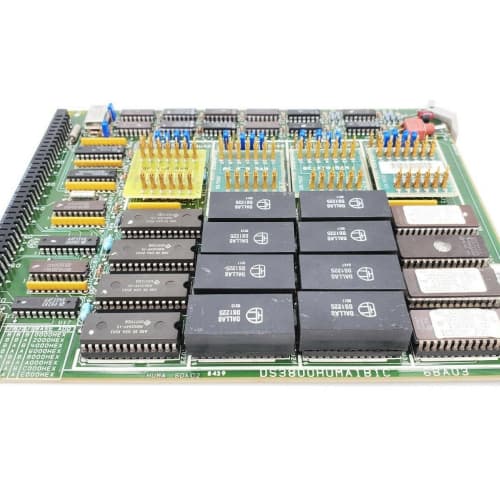
Description
Technical Parameters
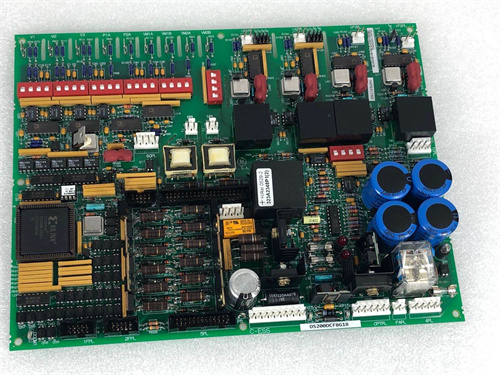
Below are the detailed specifications for the DS3800NPSE1B1A:
| Parameter | Specification |
|---|---|
| Input Voltage | 125 VDC nominal (range 90–160 VDC); compatible with 24 VDC external adapter (firmware-dependent) |
| Output Rails | +5 VDC / 18A (increased capacity), ±15 VDC / 2.5A (enhanced analog drive capability) |
| Isolation | Partial isolation (1.5kV opto-isolated analog feedback channel); main power path remains non-isolated |
| Signal Interface | 2 differential analog inputs (configurable 0–10V / 4–20mA) for dual-channel power health monitoring |
| Operating Temperature | –40°C to +70°C (extended industrial range, improved over “A1A”) |
| Physical Form Factor | 6U height × 4HP width (approx. 262mm × 20mm), standard VME backplane connector (96-pin DIN) |
| Status LEDs | 4 indicators: PWR OK (green), OVP – overvoltage (red), TEMP – overtemperature (yellow), ISO OK (blue) – confirms isolated feedback channel integrity |
| Certifications | CE, UL 508, CSA Class I Div 2 (hazardous location approved) |
Critical note: The DS3800NPSE1B1A introduces a soft-start circuit that ramps up output voltages over 200ms, reducing inrush current and preventing backplane connector arcing. However, hot-swapping is still not permitted.
Key Features & Advantages
-
Enhanced Isolation for Analog Feedback – Unlike the “A1A” variant, the DS3800NPSE1B1A incorporates opto-isolation on its analog health-monitoring channels. This allows the main CPU board (e.g., DS3800N series) to read output voltage and current values without ground-loop interference—a major improvement for plants with mixed grounding schemes.
-
Higher Output Current Capacity – The +5V rail is rated at 18A (versus 15A on the A1A), providing extra margin for racks populated with multiple high-power I/O modules. The ±15V rails now deliver 2.5A, sufficient to drive up to four LVDT servo valves simultaneously.
-
Improved Thermal Management – The DS3800NPSE1B1A features a redesigned PCB with thicker copper planes (2oz vs. 1oz) and a dedicated heatsink on the primary MOSFETs. This reduces junction temperature by approximately 12°C under full load, extending capacitor lifetime to 8,000 hours at 65°C.
-
Diagnostic Telemetry – Onboard micro-controller (Silicon Labs C8051) continuously logs output voltage ripple, temperature, and input voltage sag events into non-volatile memory. Maintenance engineers can retrieve this data via a proprietary 2-pin test port using GE’s Service Tool Software, enabling predictive failure analysis.
-
Wider Input Voltage Range – The DS3800NPSE1B1A accepts 90–160 VDC (versus 100–150 VDC on the A1A), offering better tolerance for battery bank voltage fluctuations during cranking or load rejection events.
Typical Application Cases
-
Frame 7E Gas Turbine Retrofit Projects – When upgrading Mark IV cabinets with new high-speed I/O cards, the DS3800NPSE1B1A is often selected over the A1A due to its higher +5V current capacity, ensuring stable operation of additional vibration monitoring boards (e.g., Bently Nevada interfaces).
-
Offshore Platform Steam Turbines – In salt-spray environments, the DS3800NPSE1B1A‘s conformal coating (thickness increased to 75μm) and wider temperature range make it the preferred replacement during scheduled overhauls.
-
Combined-Cycle HRSG Bypass Control – The board supplies ±15V rails to pressure transmitter signal conditioners in bypass stations. The isolated feedback channel allows the DCS to read power supply health without introducing common-mode noise into the 4–20mA loops.
-
Emergency Spare Stocking – Many utility operators maintain two to three units of the DS3800NPSE1B1A per turbine as strategic spares, given that field failure of the “A1A” variant often leads to upgrading to this “B1A” revision due to its superior reliability metrics.
Competitive Comparison
| Aspect | DS3800NPSE1B1A (GE) | DS3800NPSE1A1A (GE older) | Woodward 8440-2114 (Enhanced Actuator Power) |
|---|---|---|---|
| Total Output Power | ~195W (+5V/18A + ±15V/2.5A) | ~180W (+5V/15A + ±15V/2A) | 150W (24V/6.25A) |
| Isolation | Partial (opto-isolated analog feedback) | None (fully non-isolated) | Full (1.5kV input-to-output) |
| Analog Feedback Channels | 2 (differential, isolated) | 1 (single-ended, non-isolated) | None (voltage monitor only via serial) |
| Operating Temp Range | –40°C to +70°C | –30°C to +65°C | –25°C to +60°C |
| Hazardous Location Rating | CSA Class I Div 2 | None | None |
| Diagnostic Logging | Yes (onboard EEPROM with 1000-event buffer) | No | No |
| Availability & Price | Obsolete; ~$3,000–$4,500 (refurb) | Obsolete; ~$2,500–$4,000 (refurb) | ~$1,500–$2,200 (active) |
| Backplane Compatibility | Mark IV/V (same pinout as A1A) | Mark IV/V | Requires adapter bracket – not direct-fit |
The DS3800NPSE1B1A offers clear advantages over its predecessor in isolation, diagnostics, and thermal performance. However, it still cannot match the full isolation and SIL rating of Woodward’s general-purpose units—trade-offs inherent to its proprietary Mark IV rack architecture.
Selection Guidelines & Precautions
-
Compatibility Verification – The DS3800NPSE1B1A is pin-to-pin compatible with the “A1A” in most Mark IV backplanes (P/N 193X493AAC through AAF). However, if your rack uses an older backplane revision (pre-2002), the soft-start circuit may cause a 200ms delay in power-good signaling, which can trip the watchdog timer on certain CPU boards. In such cases, update the CPU firmware or install a jumper across test points TP7–TP8 to disable the soft-start feature.
-
Input Capacitance Requirements – Like its predecessor, the DS3800NPSE1B1A requires external input capacitance. However, due to its wider input range, GE recommends 3300μF / 200V (instead of 2200μF) to fully utilize the 90VDC lower limit. Failure to add this capacitance will cause repeated UVLO events during load steps above 10A.
-
Grounding with Isolated Feedback – While the feedback channel is opto-isolated, the main power path remains non-isolated. You must still maintain a single-point ground (< 1Ω) for the rack. The isolated channel’s ground (ISO_GND) must be connected to the DCS analog input common, not to chassis ground, to preserve isolation integrity.
-
Firmware/Calibration Differences – The DS3800NPSE1B1A contains an onboard EEPROM that stores gain/offset coefficients for both analog feedback channels. When replacing an “A1A” with a B1A, you must recalibrate using GE procedure GEI-100635 (updated for dual-channel). Calibration requires a precision 0–10V source and a 250Ω resistor for 4–20mA simulation. Do not use the “A1A” calibration values (R23/R47 only); the B1A adds R51 and R52 for the second channel.
-
Capacitor Lifetime Monitoring – The DS3800NPSE1B1A uses high-ripple-current capacitors (Panasonic FC series) rated for 8,000 hours at 65°C. However, in real-world operation with ambient temperatures around 50°C, this extends to approximately 15,000 hours (~1.7 years). Still, perform ESR checks on C8, C12, and newly added C21 (output filter) during every annual outage. If ESR exceeds 2× initial, replace the board—capacitor-only replacement is not recommended due to thick copper planes that require preheated soldering stations.
-
Diagnostic Data Retrieval – The onboard event log can be accessed via the 2-pin test port (J2) using a TTL-level UART adapter (19200 baud, 8N1). GE Service Tool Software version 3.2 or higher is required. Download the log before each board replacement to analyze failure patterns—this is particularly useful for identifying repeated input voltage sags caused by aging battery chargers in the field.
-
Hazardous Location Installation – If installing the DS3800NPSE1B1A in a CSA Class I Div 2 environment, ensure the cabinet is purged and all connections use sealed terminal blocks. The board’s conformal coating meets the requirements, but external wiring must comply with explosion-proof regulations (use of barrier glands).
A-B 1734-IB8
SIEMENS 6ES7390-1AB60-0AA0
SIEMENS 3TH2040-0BB4
.jpg)


Reviews
There are no reviews yet.