
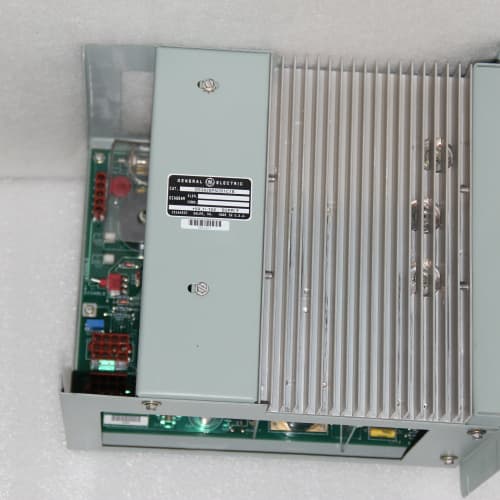
Description
Key Technical Parameters
| Parameter | Specification |
|---|---|
| Manufacturer | General Electric (GE) |
| Series | Mark V (Speedtronic) |
| Full Model | DS3800NHVN |
| Power Supply | +5V DC @ 6.5A, +15V DC @ 1.8A, -15V DC @ 1.5A |
| Temperature Inputs | 8 thermocouple + 8 RTD = 16 total channels (24-bit ADC, ±0.5°C / ±0.3°C) |
| Relay Outputs | 8 mechanical relays, 4A continuous @ 125VDC (surge 8A) with predictive maintenance |
| SS Outputs | 4 solid-state relays, 4A continuous @ 24–48VDC with individual current monitoring |
| Tachometer Inputs | 2 channels with enhanced filtering (up to 10 kHz) |
| Communication | Mark V proprietary parallel backplane bus |
| Operating Temperature | -40°C to +85°C |
| Vibration Resistance | 5g RMS (MIL-STD-810G) |
| Fault Log | 500 events |
| LED Indicators | Power, Relay Run (8x amber), SS Run (4x green), SS Overcurrent (flashing red), Tach Fail (red x2), RTD Fault (yellow), Relay Degradation (orange), Predictive Model Active (blue), Model Learning (flashing blue), Over-Temp Alarm, Backplane Active, Bus Fault |
Advantages and Distinctive Features
-
Highest Relay Current (4A @ 125VDC): Delivers 4A continuous (8A surge)—the highest current capacity of any high-voltage DC fan board in the Mark V lineup, supporting the largest 125VDC exhaust fans.
-
Highest Solid-State Outputs (4A): The highest current rating for solid-state auxiliaries in the high-voltage lineup, with individual current monitoring and overcurrent detection.
-
Full 16 Temperature Channels (8 T/C + 8 RTD): Comprehensive temperature monitoring without compromise.
-
Predictive Thermal Modeling: Learns cabinet thermal response during 24-hour initial period, reducing temperature overshoot by up to 50%.
-
24-Bit Ultra-High Precision ADC: ±0.5°C for thermocouples, ±0.3°C for RTDs.
-
Predictive Relay Maintenance: Real-time contact resistance monitoring with relay degradation warning.
-
Hybrid Output + Tachometer Feedback: Combines 8 high-voltage DC relay outputs, 4 high-current solid-state outputs, AND 2 tachometer inputs.
-
RTD Fault Detection: Continuous monitoring for open-circuit, short-circuit, or lead-wire degradation.
-
Extended +85°C Operation: Surpasses the +75°C limit for extreme environments.
-
500-Event Fault Log: Comprehensive diagnostics.
Typical Application Fields
-
High-Power 125VDC Cooling Systems: Where 4A @ 125VDC capacity is required for the largest exhaust fans.
-
Mixed Sensor Cabinets: Where both thermocouple and RTD sensors are used (16 total channels).
-
Extreme Desert Solar-Thermal Plants: +85°C ambient environments.
-
Offshore Oil & Gas Platforms: Extreme temperature and vibration environments.
-
Arctic Installations: -40°C low-temperature tolerance.
-
Nuclear Auxiliary Turbines: High reliability with redundant temperature sensing and predictive maintenance.
-
Large Auxiliary Fan Systems: Where 4A solid-state outputs are needed.
Comparison with Related Models
| Feature | DS3800NHVN | DS3800NHVM1E1D | DS3800NHVM1E1C | DS3800NHVL |
|---|---|---|---|---|
| Relay Current | 4A @ 125VDC | 3A @ 125VDC | 3A @ 125VDC | 2A @ 125VDC |
| Relay Surge | 8A | 6A | 6A | 4A |
| SS Output Current | 4A | 4A | 3A | 3A |
| SS Current Monitoring | Yes | Yes | No | No |
| T/C + RTD Inputs | 8 + 8 = 16 | 8 + 8 = 16 | 4 + 8 = 12 | 8 + 8 = 16 |
| Predictive Thermal Modeling | Yes | Yes | Yes | No |
| ADC Resolution | 24-bit | 24-bit | 24-bit | 24-bit |
| Predictive Maintenance | Yes | Yes | Yes | Yes |
| Operating Temp | -40°C to +85°C | -40°C to +85°C | -40°C to +85°C | -40°C to +75°C |
| Vibration | 5g RMS | 5g RMS | 5g RMS | 5g RMS |
| Fault Log | 500 events | 500 events | 500 events | 500 events |
| Cost | Ultra-Premium++++ | Ultra-Premium+++ | Ultra-Premium++ | Ultra-Premium |
Selection Recommendations
-
Choose the DS3800NHVN if:
-
You need the highest 125VDC relay current (4A) for the most powerful exhaust fans.
-
You need 4A solid-state outputs with individual current monitoring for larger auxiliary fans.
-
You require both thermocouple and RTD inputs (16 total channels).
-
You require tachometer feedback for fan speed verification.
-
You want predictive thermal modeling for proactive temperature management.
-
You want predictive relay maintenance .
-
You need 24-bit ADC accuracy.
-
Your installation operates in extreme heat up to +85°C with high vibration.
-
You need 500-event fault logging.
-
-
Choose the DS3800NHVM1E1D if: You need 3A relay current with the same advanced features (4A SS, 16 channels, predictive modeling).
-
Choose the DS3800NHVM1E1C if: You need 3A relay current and predictive modeling but only require 4 T/C + 8 RTD inputs (12 channels).
Critical Precautions
-
ESD Protection: Always wear a grounded wrist strap. Static damage to the 24-bit ADC degrades accuracy.
-
High-Voltage Hazard: Relay outputs switch 125VDC—lethal voltage present on terminals. Observe all high-voltage safety procedures. Use wiring rated for ≥125VDC.
-
RTD Wiring: Use 3-wire Pt100 RTDs. All three wires must be connected. Open/short circuits trigger RTD Fault LED.
-
RTD Lead Resistance: Use wire with resistance ≤10Ω per lead.
-
DC Polarity (Relay): Relay outputs are DC only—observe correct polarity.
-
DC Polarity (SS): Solid-state outputs are DC-only and polarity-sensitive—reverse polarity destroys the MOSFET.
-
SS Overcurrent Protection: If an output exceeds 4.5A, the green LED flashes red. Persistent overcurrent triggers a bus fault and disables the output.
-
SS Derating: At 85°C, derate to 3.0A per solid-state output.
-
Tachometer Wiring: Use shielded twisted-pair cable. Connect shield to designated terminal.
-
Relay Current Limitation: Rated at 4A continuous @ 125VDC. Verify fan current does not exceed this limit.
-
Inductive Load Derating (Relay): For inductive fan motors, derate to 3A or use external RC snubbers (rated for 125VDC).
-
Predictive Model Learning: Requires 24-hour initial learning period—do not interrupt power.
-
Model Reset: Reset via Mark V software if cabinet configuration changes.
-
No Hot-Swap: Always depower the rack before insertion/removal.
-
Slot Assignment: Install in slots 8–10 (auxiliary I/O).
-
CPU Dependency: If backplane communication is lost, the board defaults to 100% fan speed—all advanced features disabled in fallback mode.
-
Firmware Compatibility: The DS3800NHVN requires Mark V CPU firmware v5.5 or higher for full predictive modeling, predictive maintenance, RTD support, 24-bit ADC, and SS current monitoring. For v5.0–v5.4, predictive modeling disabled. For v4.x, reverts to 16-bit mode.
-
Power Supply: Draws 6.5A on +5V rail—the highest of any Mark V fan board. A power supply upgrade is mandatory for all installations.
OMRON E5CN-R2MT-500
Schneider? XS7G12PC9DW
SEW MCS41A0015-5A3-4-00

.jpg)

Reviews
There are no reviews yet.