
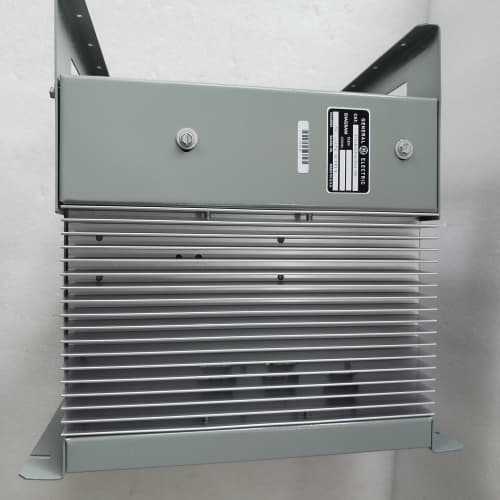
Description
Key Technical Parameters
| Parameter Category | Specification |
|---|---|
| Brand & Series | GE Speedtronic Mark IV / Mark V |
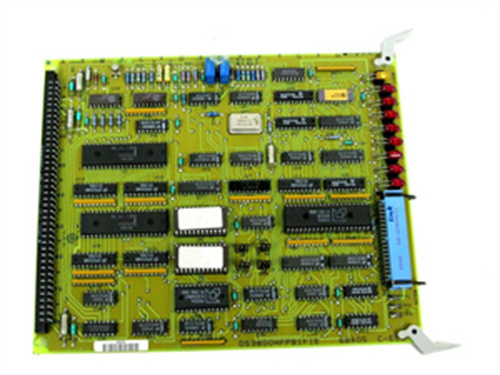
| Model | GE DS3800HLSC1C1B |
| Supply Voltage | 24V DC ±10% (derived from backplane) |
| I/O Channel Count | 16 differential analog inputs + 8 configurable isolated digital I/O channels |
| Analog Input Ranges | ±10V, 0–10V, ±5V, 0–5V, 0–20mA, 4–20mA (jumper-selectable per channel with 1C anti-aliasing) |
| Anti-Aliasing Filter | 100Hz low-pass, 4th-order Bessel (1C-specific feature) |
| Analog Resolution | 16-bit ADC, 1 kHz sampling rate per channel |
| Communication Protocol | Proprietary GE Genius serial bus (153.6 kbps) + auxiliary serial data port (RS-485, 115.2 kbps) |
| Isolation Withstand | 1500Vrms (channel-to-channel and to ground) |
| Operating Temperature | -40°C ~ +85°C (industrial extended range) |
| Certifications | CE, UL, Class I Div 2 (hazardous locations) |
| Serial Co-Processor | Dedicated 16-bit MCU with 1024-sample FIFO per channel (SC feature) |
| Thermocouple Support | Types J, K, T, S with cold-junction compensation and redundant pairing (1B firmware) |
Advantages & Key Features
-
Combined High-Level and Thermocouple Capability: The 1C extended range of GE DS3800HLSC1C1B accepts ±10V, 0–20mA, and 4–20mA signals directly, while the 1B firmware simultaneously enables thermocouple linearization on a per-channel basis. This means a single GE DS3800HLSC1C1B can monitor vibration sensors (±10V), pressure transmitters (4–20mA), and exhaust thermocouples (Type K) within the same module, reducing spare parts inventory and cabinet space.
-
Anti-Aliasing Protection: The 1C-specific 100Hz 4th-order Bessel low-pass filter on GE DS3800HLSC1C1B ensures that high-frequency electrical noise (from VFDs, switching power supplies, or radio transmitters) does not alias into the 1kHz sampling band. This is critical for accurate steady-state measurements in electrically noisy turbine environments.
-
Redundant Thermocouple Voting: The 1B firmware variant of GE DS3800HLSC1C1B enables cross-channel voting logic for paired thermocouple inputs. In turbine exhaust temperature monitoring, adjacent channel pairs are compared; if deviation exceeds a user-configurable threshold (e.g., ±5°C), the module flags the alarm and defaults to the higher-confidence reading, preventing spurious turbine trips.
-
High-Speed Transient Buffering: The SC co-processor in GE DS3800HLSC1C1B manages a 1024-sample FIFO buffer per channel. This allows the module to capture pre-trigger and post-trigger data during compressor surge, valve step-response, or emergency shutdown events at full 1kHz sampling rate, without overloading the main Genius bus. The buffered data can be retrieved via the auxiliary RS-485 port for forensic analysis.
-
Flexible Input Configuration: Each of the 16 analog channels on GE DS3800HLSC1C1B can be independently configured via DIP switches for voltage, current, or thermocouple mode. This flexibility eliminates the need for multiple specialized I/O modules, simplifying design and maintenance.
-
Built-in Diagnostics: Each channel on GE DS3800HLSC1C1B has individual open-wire, short-circuit, over-range, and thermocouple burnout detection LEDs. The SC firmware adds statistical reports (min/max/mean per channel) accessible via the auxiliary port, and the 1B firmware includes redundant-pair health indicators.
-
Firmware Field-Upgradable: Both the main processor and SC co-processor firmware of GE DS3800HLSC1C1B can be updated via the Genius bus or the auxiliary RS-485 port, allowing adaptation to newer turbine control logic revisions without hardware replacement. The 1C/1B features are software-selectable after firmware update.
Application Cases in Target Industries
-
Power Generation – Combined-Cycle Turbine Monitoring: In a 300MW combined-cycle plant, GE DS3800HLSC1C1B is installed in a Mark V cabinet to simultaneously acquire: (a) 8 Type K thermocouples (exhaust temperature, using 1B redundant pairing), (b) 4 ±10V piezoelectric accelerometers (bearing vibration, using 1C high-level range), and (c) 4 4–20mA pressure transmitters (fuel gas and lube oil, using 1C current mode). The anti-aliasing filter ensures vibration data is not contaminated by 50Hz/60Hz power-line harmonics, while the SC buffer captures 10-second pre-trigger data during any sudden load rejection.
-
Oil & Gas – LNG Compressor Surge Prevention: A natural gas liquefaction train uses GE DS3800HLSC1C1B to monitor high-speed dynamic pressure sensors (±10V output) at compressor inlet and discharge. The 1B thermocouple mode additionally monitors bearing temperatures on the same module. During surge events, the SC buffer on GE DS3800HLSC1C1B captures 100ms pre-trigger and 900ms post-trigger data at 1kHz, enabling engineers to refine anti-surge control algorithms. The Class I Div 2 rating allows direct installation in the compressor skid’s hazardous area.
-
Marine Propulsion – Dual-Fuel Turbine Control: Naval vessels equipped with GE LM2500 turbines operating on both gas and diesel fuel rely on GE DS3800HLSC1C1B for redundant monitoring of: (a) Type T thermocouples (fuel temperature, 1B redundant mode), (b) ±10V LVDT position sensors (fuel control valve stroke, 1C voltage mode), and (c) 4–20mA flow meters. The module’s extended -40°C rating proves critical during Arctic-deployment operations, and the anti-aliasing filter prevents radar interference from corrupting vibration channels.
-
Hydroelectric – Gate Servo Performance Testing: A large hydro plant uses GE DS3800HLSC1C1B to test wicket gate servo response during emergency closure. The ±10V LVDT feedback (1C mode) and thermocouple monitoring of servo-oil temperature (1B mode) are captured by the SC buffer during triggered events. The 1C anti-aliasing filter ensures accurate position measurement despite nearby high-current generator cables inducing 50Hz noise.
Comparison with Competing Products
| Feature | GE DS3800HLSC1C1B | Competitor A (e.g., Woodward 5466-xxx) | Competitor B (e.g., Siemens 6ES7-xxx) |
|---|---|---|---|
| Native Protocol | GE Genius bus + RS-485 auxiliary | Modbus RTU | PROFIBUS DP |
| Analog Input Ranges | ±10V, 0–10V, 0–20mA, 4–20mA, T/C J/K/T/S | 0–10V only (external divider needed) | 0–10V, 4–20mA only |
| Anti-Aliasing Filter | Yes (100Hz Bessel, 1C feature) | No | No |
| Thermocouple Support | Yes (onboard, with redundant pairing) | External transmitter required | Only T/C type K (limited) |
| High-Speed Buffering | Yes (1024-sample FIFO per channel, SC) | No | No (requires external DAQ) |
| Hot-Swap Capability | Yes (full) | No (rack power-down required) | Yes (partial) |
| Operating Temp Range | -40°C to +85°C | 0°C to +60°C | -25°C to +70°C |
| Mixed I/O Types Per Module | Yes (voltage, current, T/C on same module) | No (separate modules required) | No (separate modules required) |
| Diagnostic Depth | Per-channel LEDs + statistical reports + redundant health | Global status only | Per-channel via software |
| Typical Cost Factor | Premium (most feature-rich variant) | Medium | Medium-High |
The key differentiator is that GE DS3800HLSC1C1B is purpose-built for high-vibration, high-temperature turbine environments with built-in anti-aliasing, thermocouple redundancy, and high-speed transient capture—all in a single module. Competitors are general-purpose industrial modules that require multiple separate signal conditioners, external thermocouple transmitters, and dedicated data acquisition systems, increasing cabinet space, wiring complexity, and failure points.
Selection Guidelines
-
Compatibility Verification: Confirm that your existing controller rack is Mark IV or Mark V. GE DS3800HLSC1C1B is not backward-compatible with Mark II/III systems due to different backplane pinouts. For Mark IV systems, the 1B redundant thermocouple mode requires firmware revision 3.2 or higher, and the 1C anti-aliasing filter requires toolkit version 4.0 or higher.
-
Suffix Selection: Choose GE DS3800HLSC1C1B only if your application requires two or more of the following: (a) ±10V sensor inputs, (b) high-speed buffering (SC), (c) thermocouple redundancy (1B), or (d) anti-aliasing filtering (1C). For standard 0–10V/4–20mA applications without high-speed needs, the basic GE DS3800HLOC is more cost-effective. For thermocouple-only redundancy, consider GE DS3800HLOC1A1B. For vibration-only monitoring with ±10V and buffering but without thermocouples, GE DS3800HLSC suffices. The full 1C1B combination is best for mixed-signal mission-critical turbines.
-
I/O Count Planning: If your application requires more than 16 analog inputs, consider using two GE DS3800HLSC1C1B modules, but note that the Genius bus limits total nodes to 32 per master. When using 1B redundant thermocouple mode, each redundant pair consumes two physical channels, reducing effective channel count to 8 pairs for those channels. However, non-thermocouple channels (voltage/current) can still operate independently.
-
Cabling & Termination: Use shielded twisted-pair cables for all analog inputs, with the shield grounded only at the GE DS3800HLSC1C1B side to avoid ground loops. For thermocouple connections in 1B mode, use dedicated isothermal terminal blocks (GE part number DS3800HTER-R) to maintain accurate cold-junction reference. For current loops (4–20mA or 0–20mA), ensure the loop power supply is externally sourced, as GE DS3800HLSC1C1B does not provide loop power.
-
Firmware Version: Check the firmware revision of GE DS3800HLSC1C1B against your Mark V toolkit version; mismatch may cause communication timeouts or disable the 1C/1B features. Upgrade both main and SC firmware via the Genius interface or the RS-485 port using GE’s firmware loader utility. The 1C anti-aliasing filter is enabled through firmware—not hardware—so ensure the correct filter coefficients are loaded.
-
Buffer & Trigger Configuration: The FIFO buffer on GE DS3800HLSC1C1B can be configured for pre-trigger/post-trigger ratios (e.g., 30% pre / 70% post) via DIP switches. For surge monitoring with mixed sensors, GE recommends using the highest-amplitude channel (typically vibration) as the trigger source, with a 50/50 split to capture both pre-event and post-event data. For thermocouple-only event monitoring, a 20/80 split (longer post-trigger) is more suitable to observe temperature decay after trip.
Precautions & Critical Warnings
-
ESD Protection: The front panel of GE DS3800HLSC1C1B contains exposed test points and an auxiliary RS-485 port. Always wear an ESD strap before handling. Static discharge can damage the 16-bit ADC front-end, the Bessel filter capacitors, or the SC co-processor memory, which are not field-repairable.
-
Power Sequencing: Always insert GE DS3800HLSC1C1B into the rack with backplane power off unless the system explicitly supports hot-swap (Mark V does; Mark IV does not). For Mark IV systems, power-down is mandatory to prevent backplane transients. The SC co-processor initialization and the 1C filter settling require a clean power-on sequence; do not cycle power rapidly (wait at least 15 seconds between off/on to allow filter capacitors to discharge).
-
Environmental Constraints: Do not operate GE DS3800HLSC1C1B in condensing humidity environments. Although rated for -40°C to +85°C, rapid thermal cycling (ΔT > 30°C/min) can degrade solder joints on the BGA package of the SC co-processor and shift the Bessel filter cutoff frequency. Ensure cabinet airflow is sufficient to keep the SC processor’s heat sink below 80°C.
-
Input Overvoltage Protection: Although GE DS3800HLSC1C1B has built-in clamping diodes, do not apply voltages exceeding ±30V or currents exceeding 50mA on any analog input. Sustained overvoltage will damage the input multiplexer and the anti-aliasing filter network. For high-voltage sensors (> ±10V), use an external voltage divider before connecting to GE DS3800HLSC1C1B. For current loops, never open-circuit the loop while GE DS3800HLSC1C1B is powered, as this can induce transient overvoltages that may damage the current-sense resistor.
-
Thermocouple Cold-Junction Compensator: The cold-junction reference sensor on GE DS3800HLSC1C1B is located at the terminal block connector. If you replace the terminal block, ensure the replacement has the matching thermistor calibration (GE part number DS3800HTER-R). Using a non-calibrated terminal block will introduce up to ±5°C errors in 1B thermocouple readings. The cold-junction compensator must be allowed to thermally stabilize for 10 minutes after power-up before accurate readings are achieved.
-
Anti-Aliasing Filter Limitations: The 100Hz Bessel filter on GE DS3800HLSC1C1B is effective for steady-state and slowly varying signals. Do not use the 1C filtering for signals with frequency content above 100Hz that you wish to measure (e.g., high-frequency vibration analysis above 100Hz). For such applications, disable the 1C filter via DIP switch and rely on external filtering. The filter introduces a phase delay of approximately 5ms at 100Hz—account for this in control-loop timing if using GE DS3800HLSC1C1B for closed-loop regulation.
-
Output Configuration: When using the 8 digital I/O channels as outputs, ensure the external load does not exceed 0.5A per channel. GE DS3800HLSC1C1B has built-in PTC fuses, but these are non-replaceable – sustained overload will permanently disable the channel.
-
Auxiliary Port Usage: The RS-485 port on GE DS3800HLSC1C1B is not isolated from the backplane. When connecting to an external PC, ensure the PC is galvanically isolated or use an isolated RS-485 converter to prevent ground potential differences that could damage both GE DS3800HLSC1C1B and the PC’s serial port.
-
Buffer Readback Timing: Reading the FIFO buffer via the auxiliary port consumes SC co-processor cycles. If you query GE DS3800HLSC1C1B at intervals shorter than 10 ms, the module will prioritize the auxiliary port and may reduce the main Genius bus sampling rate from 1 kHz to 500 Hz. GE recommends a minimum query interval of 50 ms for sustained data streaming, especially when using both 1C filtering and 1B redundancy simultaneously.
-
Redundancy Mode Activation: The 1B redundant thermocouple mode must be enabled via DIP switch S1-4 before power-up. Changing this setting while GE DS3800HLSC1C1B is powered will not take effect and may corrupt the channel pairing table. Always power-cycle after mode changes. When 1B mode is active, paired channels are automatically averaged; individual channel data is still available via the auxiliary port but flagged as “redundant pair member.”
-
Disposal: At end-of-life, GE DS3800HLSC1C1B contains trace amounts of lead in solder, cadmium in certain relay components, and nickel in the co-processor package. Dispose per local WEEE regulations; do not incinerate.
Summary Recommendation
For operators maintaining legacy GE Speedtronic Mark IV/V systems, GE DS3800HLSC1C1B represents the ultimate drop-in replacement for local I/O acquisition when mixed-signal monitoring (voltage, current, and thermocouple) combined with high-speed transient capture, anti-aliasing protection, and thermocouple redundancy is required. Its unique combination of 1C filtering, 1B redundancy, and SC buffering makes it the most versatile module in the DS3800 series—ideal for mission-critical turbine applications requiring SIL-2 capable sensor voting, post-event forensic analysis, and electrically noisy environments. The ability to handle all sensor types on a single module reduces cabinet space, spare parts inventory, and engineering complexity.
For new greenfield projects, consider GE’s newer Mark VIe platform, which uses Ethernet-based I/O with similar integrated features, as GE DS3800HLSC1C1B will eventually face obsolescence in the next 5–7 years. However, for existing fleets with high-value assets where mixed-signal monitoring and redundancy are non-negotiable, stocking at least one spare GE DS3800HLSC1C1B per turbine unit is strongly advised, given this 1C1B combination is a custom factory configuration with significant lead times (typically 14–18 weeks). For critical units, GE recommends maintaining a hot-standby GE DS3800HLSC1C1B in the rack, as the module’s field-replacement time is under 2 minutes with the hot-swap capability. Ensure your maintenance team is trained on the DIP switch configurations for 1C, 1B, and SC features, as misconfiguration is the most common field error encountered with this advanced variant.
FESTO FRC-1-D-DI-MAXI-A
A-B 1771-IB
SIEMENS 6ES7421-1BL01-0AA0



Reviews
There are no reviews yet.