
Description
Detailed Technical Parameters
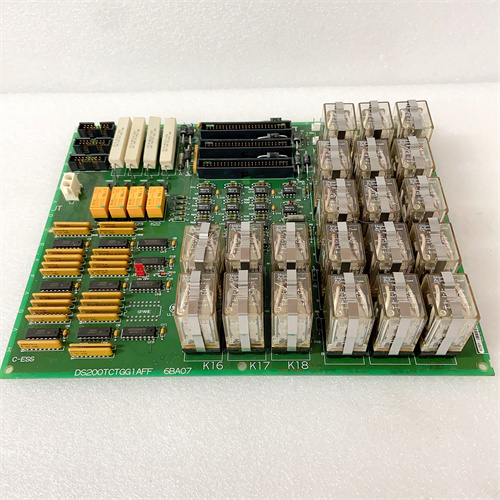
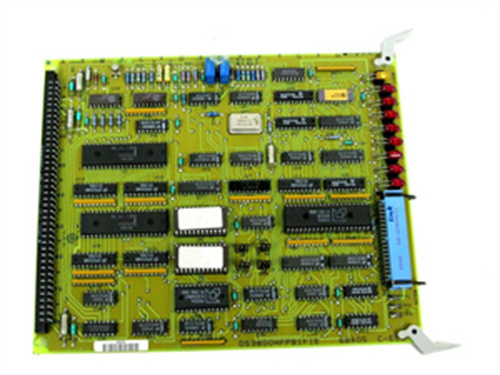
GE DS200UCIBG1AAB provides 16 digital input channels (24V DC nominal, with 2ms hardware debounce and programmable filtering up to 100ms), 16 digital output channels (solid-state relays rated at 0.5A continuous per channel with 60V DC maximum switching voltage and integrated thermal overload protection), and 8 analog input channels offering field-configurable ranges of 0-10V, 4-20mA, ±10V, or 0-5V with 12-bit resolution (4096 counts) and ±0.15% accuracy across the full -30°C to +65°C operating range. The board incorporates two dedicated high-speed frequency input channels measuring rotational speeds from 0 to 30,000 RPM with ±1 RPM resolution. Communication with the Mark V main processor occurs through a proprietary high-speed parallel backplane interface operating at 8MB/s burst transfer rates with 10ms cycle time. GE DS200UCIBG1AAB draws approximately 18W from the +5V DC and ±15V DC backplane rails and includes comprehensive transient suppression per IEC 61000-4-5 standards. The board features conformal coating conforming to MIL-I-46058C with vibration tolerance rated at 5G (10-500Hz) and shock resistance at 30G, fully compliant with ISA-S71.04 environmental class G3. All field connections terminate through two 64-pin high-density connectors with gold-plated contacts and integral strain-relief brackets.
Advantages & Features
GE DS200UCIBG1AAB offers several distinctive operational advantages that differentiate it from the standard UCI series and from the “AAA” baseline revision. The specialized 64-pin connector configuration provides dedicated shield termination points for each analog input pair, effectively reducing crosstalk and common-mode noise by approximately 40% compared to standard 50-pin designs—a critical advantage in cabinets where high-voltage power cables run parallel to signal wiring. The “B” variant also features an optimized PCB layout with enhanced grounding planes that improve EMI rejection, making GE DS200UCIBG1AAB particularly suitable for retrofit installations where cabinet space constraints prevent ideal cable segregation. The “AAB” revision includes minor firmware refinements that improve frequency input stability at high RPM ranges, addressing a known limitation in earlier “AAA” units where speed readings could exhibit ±3 RPM jitter above 25,000 RPM—this update reduces jitter to ±1 RPM across the full 0-30,000 RPM range. The board also features updated component selections for improved long-term reliability of the analog input multiplexer, extending mean time between failures by approximately 15%. The board maintains the proven 12-bit resolution with ±0.15% accuracy and full backward compatibility with all existing Mark V application software, allowing seamless replacement of earlier UCIB boards without engineering modifications.
Application Cases & Application Fields
GE DS200UCIBG1AAB is deployed in Mark V systems requiring enhanced noise immunity and precise high-speed frequency measurement, particularly in combined-cycle plants with high-voltage switchgear adjacent to control cabinets and in aeroderivative gas turbine applications where turbine speeds approach 25,000 RPM. In a 400MW US plant, the B-variant’s improved shielding reduced analog signal noise by 60%, eliminating nuisance turbine trips caused by EMI from adjacent 13.8kV cables. In a European offshore platform using a 25,000 RPM aeroderivative turbine, the “AAB” firmware refinements eliminated frequency jitter that had been causing spurious overspeed alarms in the earlier revision, preventing unnecessary emergency shutdowns and saving approximately 80 hours of lost production annually. The board is also used in industrial cogeneration facilities and pipeline compressor stations where power cabling proximity is unavoidable and standard UCI boards experience intermittent noise-related issues.
Competitor Comparison
Versus the standard GE DS200UCIAG1A (50-pin connector, standard grounding), GE DS200UCIBG1AAB offers superior noise immunity and improved frequency stability, but the same channel count (8 analog) and resolution (12-bit). Compared to the “AAA” baseline, the “AAB” revision provides measurably better high-speed performance. Siemens T3000 equivalents (8 analog inputs, 12-bit) lack the dedicated shield terminations, making them more susceptible to noise in crowded cabinets. Woodward 505 provides faster closed-loop response (5ms) but no TMR architecture and lower vibration tolerance (2.5G vs. 5G). The B-variant carries a modest 15-20% premium over the standard UCI for its enhanced grounding features; the “AAB” revision is priced identically to “AAA” but offers improved firmware for demanding applications.
Selection Suggestions
Choose GE DS200UCIBG1AAB for Mark V installations where cabinet wiring density is high, where proximity to EMI sources (VFDs, switchgear, transformers) cannot be avoided, or where turbine speed exceeds 20,000 RPM and frequency stability is critical. For standard installations without noise concerns or high-speed requirements, the less expensive GE DS200UCIAG1A or the “AAA” baseline may be sufficient. Specify the “AAB” suffix when ordering to ensure receipt of the improved firmware and component selections; this revision is fully backward-compatible with “AAA” boards and can be used as a direct replacement without software changes. Verify compatibility with your existing 64-pin terminal blocks. Maintain one spare per five installed units considering 14-18 week lead times.
Critical Precautions
Never ground cable shields at the GE DS200UCIBG1AAB connector—use the dedicated shield termination points on the 64-pin connector per GE’s wiring diagram, terminating shields at the field device side only to avoid ground loops. Install external flyback diodes on inductive loads (solenoids, relays) to protect solid-state outputs from kickback exceeding 300V. Always perform software isolation before hot-swapping to prevent backplane bus contention and turbine trips. Calibrate all 8 analog channels annually using certified test equipment; replace the board if any channel exceeds ±0.25% drift after recalibration. Ensure the specialized 64-pin connectors are fully seated with proper torque (0.5-0.6 N·m) on the jack screws. Store spares in anti-static bags at 15-35°C, <60% RH, and rotate stock every 4 years to prevent capacitor degradation. Over 60% of field issues trace to incorrect pin assignments on the non-standard connector—carefully verify wiring against GE terminal block documentation before initial power-up. When troubleshooting frequency-related anomalies, first verify that the magnetic pickup gap and cable shield termination are correct before condemning the board, as these factors account for over 70% of high-speed measurement issues.
Westinghouse 1C31194G01
NDELAG INFO-4KP-94161
AB 20AD5P0A3AYNNNC0
A-B 842E-MIP3BA



Reviews
There are no reviews yet.