
Description
Detailed Technical Parameters
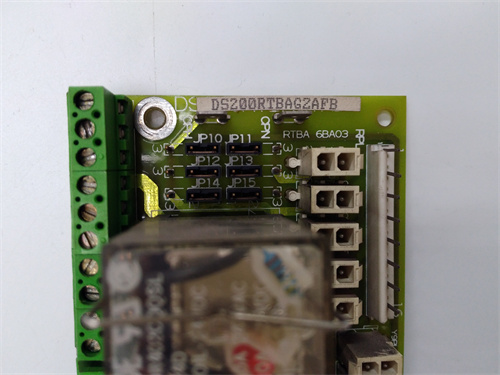
GE DS200UCIAG1A typically provides 16 digital input channels (24V DC sinking/sourcing, with 2ms debounce filtering), 16 digital output channels (solid-state relays rated at 0.5A per channel, 60V DC maximum), and 8 analog input channels (configurable for 0-10V, 4-20mA, or ±10V ranges with 12-bit resolution). Additionally, the board incorporates two dedicated frequency input channels for magnetic pickup or proximity probe signals, capable of measuring rotational speed from 0 to 25,000 RPM with ±1 RPM accuracy—a critical feature for turbine start-up sequencing and overspeed protection. Communication with the Mark V main processor occurs via a proprietary high-speed parallel backplane interface operating at 5MB/s, ensuring synchronous data exchange across all three redundant controller boards. The board draws approximately 15W from the +5V DC and ±15V DC backplane rails, and features a wide operating temperature range of -30°C to +65°C with conformal coating for humidity and chemical resistance, fully compliant with ISA-S71.04 environmental class G3 for harsh industrial environments. All field wiring connections are made through three high-density 50-pin D-sub connectors, each with integral strain-relief brackets and screw-lock retention mechanisms to maintain integrity under severe vibration conditions up to 5G (10-500Hz).
Advantages & Features
GE DS200UCIAG1A offers several distinctive advantages that make it indispensable for turbine automation applications. Foremost among these is its integrated signal conditioning capability—unlike competitor modules that require separate terminal blocks and signal converters, GE DS200UCIAG1A includes programmable gain amplifiers, precision voltage references, and software-selectable input filters directly on board, eliminating the need for external signal isolation amplifiers for most common transducer types. This “all-in-one” design simplifies cabinet wiring, reduces panel space requirements by approximately 40%, and minimizes potential failure points in the signal chain. Secondly, the board features firmware-level channel health monitoring with automatic diagnostic routines that execute every scan cycle; each input and output channel undergoes continuous open-circuit/short-circuit detection, and any fault condition triggers an immediate alert to the Mark V operator interface while simultaneously isolating the affected channel from voting logic to prevent spurious trips. Thirdly, GE DS200UCIAG1A supports online replacement in TMR-configured systems—you can extract and insert a new board while the turbine remains operational, with the Mark V system automatically synchronizing the replacement unit to the current state of the two redundant partners within 100ms, effectively providing zero-downtime maintenance capability that is virtually unheard of in traditional PLC architectures. Fourth, the board’s non-volatile memory retains configuration parameters, calibration factors, and custom scaling tables for each channel, so field replacement does not require reconfiguration via the engineering workstation—simply plug in a spare GE DS200UCIAG1A, and the Mark V processor uploads the saved dataset from the board’s own EEPROM, slashing recommissioning time from hours to minutes.
Application Cases & Application Fields
GE DS200UCIAG1A is extensively deployed across GE’s installed fleet of over 100,000 heavy-duty gas turbines (Frame 3/5/6/7/9 series), steam turbines (D11/D16), and centrifugal compressor trains in oil and gas pipeline service. In a typical 500MW combined-cycle power plant, each gas turbine employs three GE DS200UCIAG1A boards (one per redundant controller leg) to aggregate all auxiliary process signals—including fuel gas pressure, lube oil temperature, hydraulic actuator position feedback, and inlet bleed valve status—into the core control algorithm. The board’s high-speed frequency inputs are particularly valued for capturing shaft rotational speed from variable reluctance pickups, enabling precise synchronization of the gas turbine generator to the utility grid within ±0.5Hz accuracy. In petrochemical refinery applications, GE DS200UCIAG1A frequently appears in propane dehydrogenation (PDH) unit expander-compressor trains, where its rugged digital outputs directly drive solenoid valves for emergency shutdown (ESD) systems, achieving SIL-2 rated functional safety integrity when paired with the Mark V controller’s certified logic solver. Offshore platforms in the Gulf of Mexico utilize GE DS200UCIAG1A for platform generator control, leveraging its wide temperature range and salt spray resistance to maintain reliable operation in unheated offshore engine rooms. Beyond traditional power and oil/gas sectors, this board has found adoption in large-scale data center standby generator fleets, where its rapid frequency measurement and generator breaker control capabilities provide seamless transfer switching between utility and emergency power sources within 50ms of a grid disturbance.
Competitor Comparison
When compared against equivalent universal I/O controllers from competing turbine control platforms, GE DS200UCIAG1A holds both strengths and limitations relative to alternatives such as Siemens T3000’s I/O interface module (6ES7332 series), Woodward 505’s I/O expansion boards, and Bachmann electronic’s FM221 I/O units. In terms of integrated functionality, GE DS200UCIAG1A combines digital, analog, and frequency inputs on a single board, whereas the Siemens 6ES7332 series requires separate modules for each signal type, increasing rack footprint and backplane bandwidth consumption by roughly 50%. The Woodward 505 platform offers superior governor-specific speed control features, but lacks the TMR voting architecture native to GE DS200UCIAG1A, making it less suitable for safety-critical shut-down applications that demand fault tolerance. Regarding isolation ratings, GE DS200UCIAG1A provides 1500V AC channel-to-channel isolation, comparable to Bachmann’s FM221, but surpasses the 1000V isolation offered by Siemens SM331 modules—an important differentiator in high-voltage generator environments where ground potential differences can exceed 100V. However, GE DS200UCIAG1A is completely reliant on the proprietary Mark V backplane protocol; unlike the Siemens and Bachmann units, it cannot communicate via Profibus, CANopen, or EtherCAT, effectively locking users into the GE ecosystem. Additionally, the configuration software for GE DS200UCIAG1A (GE’s ToolboxST) is considered less intuitive than Siemens’ TIA Portal or Emerson’s Ovation engineer tools, resulting in steeper learning curves for maintenance teams transitioning from other platforms. Cost-wise, GE DS200UCIAG1A typically commands a 20-35% price premium over comparable non-redundant third-party modules, but this premium is justified by the board’s proven 15-year average field life and GE’s expansive global service network that offers 24-hour on-site support in most industrial regions.
Selection Suggestions
When evaluating GE DS200UCIAG1A for a new or retrofit turbine control application, several key factors should guide your decision. First, confirm that your control system architecture is explicitly a GE Mark V (or early Mark VI) platform, as the physical connector pinout and communication protocol of GE DS200UCIAG1A are incompatible with Mark VIe, Mark VII, or any non-GE controller without extensive signal remapping and third-party gateway adapters—such conversions typically add $5,000-$15,000 in engineering costs and introduce potential latency issues. Second, carefully audit your field signal inventory: if your application involves exclusively thermocouple or RTD inputs, GE DS200UCIAG1A may be over-specified, and the more dedicated thermocouple terminal board (such as DS200TCTGG) would be more cost-effective; however, if you have a diverse mix of 4-20mA transmitters, digital proximity switches, speed probes, and valve position feedback, the all-in-one versatility of GE DS200UCIAG1A delivers the lowest total installed cost. Third, consider the revision level—while the base GE DS200UCIAG1A remains functional, subsequent hardware revisions like DS200UCIAG1B and DS200UCIAG1C introduced enhanced EMC filtering and improved analog-to-digital converter linearity, so always prioritize newer revisions when procuring spares or building new cabinets. Fourth, evaluate your safety integrity requirements: GE DS200UCIAG1A alone is not SIL-rated; its SIL capability derives from the overall Mark V TMR architecture. If you require SIL-3 certified I/O, you must combine GE DS200UCIAG1A with the redundant controller configuration and certified software libraries—do not assume the board itself provides functional safety. Fifth, if your site operates multiple GE turbines, standardizing on GE DS200UCIAG1A across the fleet simplifies spare parts management and technician training, potentially reducing inventory holding costs by 25-30% compared to maintaining diverse module types for different turbine vintages. Finally, when purchasing from third-party suppliers, always verify that the board has passed GE’s original factory test procedures and includes a detailed test certificate showing channel performance across the full operating temperature range; avoid sellers who cannot provide this documentation, as counterfeit or improperly stored GE DS200UCIAG1A units have been linked to mysterious intermittent faults in field operations.
Critical Precautions
Deploying and maintaining GE DS200UCIAG1A requires rigorous attention to several engineering best practices to maximize reliability and prevent unexpected outages. First, ensure that all field wiring to the 50-pin connectors uses shielded twisted-pair cables, with shields terminated at the field device side only—never ground the shield at the GE DS200UCIAG1A connector, as this creates a low-impedance path for ground fault currents that can overwhelm the board’s common-mode rejection circuitry and corrupt analog measurements by 5-10% full scale. Second, for digital outputs driving inductive loads such as relay coils or solenoid valves, install external flyback diodes (1N4007 or equivalent) directly across the load terminals to suppress inductive kickback voltages that can exceed 200V, as GE DS200UCIAG1A‘s onboard solid-state relays lack built-in snubbing circuits for cost and size optimization. Third, during online replacement procedures, always follow the Mark V maintenance manual’s prescribed sequence: navigate to the operator interface, disable the affected channel bank through software, remove the faulty GE DS200UCIAG1A, insert the replacement board, wait for the automatic synchronization handshake (approximately 2 seconds), and then re-enable the channels after verifying that all input readings match the redundant partner boards within ±2% tolerance. Attempting to hot-swap without the software disable step can cause bus contention and potentially trip the entire turbine due to watchdog timeouts. Fourth, schedule a comprehensive calibration verification every 18 months using a precision signal generator and a calibrated digital multimeter—apply known voltages, currents, and frequency signals to each input channel, and record deviations from expected values; if any channel exceeds ±0.25% of span after recalibration, replace GE DS200UCIAG1A rather than attempting software-based offset compensation, as drifting performance often indicates failing electrolytic capacitors or aging optocouplers that will degrade further under thermal stress. Fifth, be aware that the board’s ambient temperature sensor (used for drift compensation) is located near the upper-right corner; ensure cabinet cooling airflow does not directly impinge on this area, as rapid temperature fluctuations from poorly positioned cooling vents can cause the compensation algorithm to overcorrect, introducing transient reading errors of up to 0.5°C equivalent. Sixth, always store spare GE DS200UCIAG1A units in anti-static bags within a climate-controlled environment (15-35°C, <60% relative humidity), and rotate stock on a first-in-first-out basis to prevent long-term storage degradation of electrolytic capacitors, which have a typical shelf life of 5-7 years before ESR values rise beyond acceptable limits. Seventh, when troubleshooting intermittent faults, remember that field statistics from GE’s service bulletins indicate that over 65% of reported GE DS200UCIAG1A anomalies originate from loose connector screws, contaminated edge connectors, or improperly terminated wires, rather than from internal component failures—therefore, before condemning the board, perform a thorough physical inspection and torque verification on all connection points to GE’s specified 0.5-0.6 N·m for the D-sub jack screws and 0.8-1.0 N·m for the terminal strip screws. Finally, if the board is being decommissioned from service, handle it as electronic waste in accordance with local environmental regulations; the board contains small amounts of beryllium copper in connector contacts and barium titanate in ceramic capacitors, which require specialized recycling to avoid environmental contamination and potential regulatory fines.
HMS AB7006-B
EM GFD/DFD 1000554
A-B 1756-OF8
SST SST-PB3-CLX


Reviews
There are no reviews yet.