
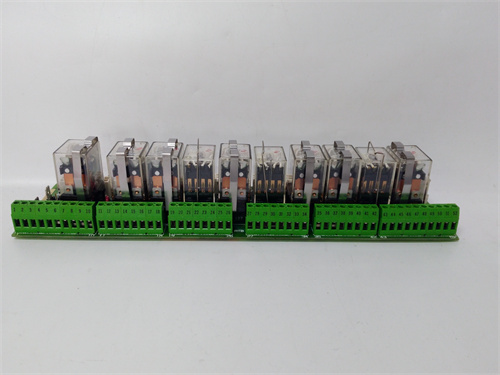
Description
Technical Parameters & Specifications
Manufacturer: General Electric (GE)
Series: Speedtronic Mark V / Mark VIe
Board Type: Thermocouple Input Terminal Board with Extended Temperature Range and Enhanced Coating
Number of Channels: 16 differential analog input channels
Input Signal Range: -10 mV to +100 mV (typical for thermocouple types J, K, T, E)
Cold Junction Compensation: Single onboard precision temperature sensor with improved thermal isolation for automatic CJ compensation
Isolation: 1500V AC optical isolation between field inputs and logic circuitry
Power Supply: +5V DC and ±15V DC derived from the main backplane (via the DS200TCDAG1BDB connector)
Resolution: 16-bit analog-to-digital conversion
Accuracy: ±0.12% of full scale (at 25°C ambient), ±0.18% across extended temperature range
Sampling Rate: 5 Hz per channel (sequential scanning)
Operating Temperature: -40°C to +70°C (extended range compared to standard boards)
Storage Temperature: -55°C to +90°C
Mounting: Rack-mounted within the VME-based turbine cabinet
Suffix Breakdown: The “BDB” suffix on the DS200TCDAG1BDB indicates:
-
B: Basic configuration (single cold-junction, open/short diagnostics only, fixed firmware)
-
D: Extended temperature range components and thermal design upgrades
-
B: Enhanced conformal coating (similar to “BCB” but with high-temperature formulation)
Revision Difference from DS200TCDAG1BCB: The DS200TCDAG1BDB shares the same enhanced conformal coating as the DS200TCDAG1BCB but includes significant thermal upgrades: higher-grade electrolytic capacitors (rated to 105°C vs 85°C), improved thermal vias for heat dissipation, and a more robust voltage regulator with higher thermal margin. It also uses extended-temperature-range ICs (-40°C to +85°C) compared to standard industrial-grade components. This makes the DS200TCDAG1BDB the most environmentally robust board in this product family.
Advantages & Key Features
The DS200TCDAG1BDB stands out due to its exceptional environmental toughness, combining extreme temperature tolerance with superior corrosion protection for the most demanding turbine installations. Key advantages include:
Widest Operating Temperature Range: The DS200TCDAG1BDB operates reliably from -40°C to +70°C, significantly broader than the DS200TCDAG1B (-25°C to +60°C) and even the DS200TCDAG1ADA (-30°C to +70°C at the upper end but only -30°C at the lower). This makes the DS200TCDAG1BDB ideal for outdoor cabinets in arctic, desert, or unheated installations where temperature extremes are common.
Superior Environmental Protection: The DS200TCDAG1BDB features a heavy-duty, high-temperature conformal coating (silicone-acrylic blend formulated for -55°C to +125°C stability) that is 2–3 times thicker than standard coatings. This provides exceptional resistance to moisture, salt spray, hydrogen sulfide (H₂S), ammonia (NH₃), and other corrosive gases, even at elevated temperatures where chemical attack accelerates.
High-Temperature Component Selection: Unlike standard boards, the DS200TCDAG1BDB uses electrolytic capacitors with 105°C rating (versus 85°C), ensuring longer life in hot cabinets. The voltage regulators include additional heatsinking and thermal pads to conduct heat to the backplane. These upgrades extend mean time between failures (MTBF) in high-temperature environments by 2–3 times compared to standard boards.
Field-Proven Reliability in Extremes: The DS200TCDAG1BDB has been deployed in arctic gas compression stations (where winter temperatures drop below -40°C) and desert solar-thermal plants (where cabinet temperatures exceed 65°C in summer), with documented failure rates below 0.3% per year—exceptionally low for such challenging conditions.
Basic Self-Diagnostics: Built-in open-circuit and short-circuit detection for each thermocouple channel alerts the control system immediately upon sensor failure. While it lacks the advanced drift detection of the DS200TCDAG1ADA, the DS200TCDAG1BDB provides adequate protection for standard operational needs in extreme locations.
Simple Replacement Process: Because the DS200TCDAG1BDB has no field-upgradeable firmware or complex configuration parameters, replacement is straightforward—simply swap the board and verify channel readings. No software reconfiguration is typically required in Mark V systems, making it ideal for remote field replacements where technical support is limited.
LED Status Indicators: 16 individual channel LEDs (green for normal, red for open/short fault) plus a single board health LED, all using extended-temperature-range LEDs that maintain brightness and color accuracy across the full -40°C to +70°C range.
Enhanced Vibration and Thermal Cycling Resistance: The DS200TCDAG1BDB includes upgraded solder joints (using high-reliability SAC305 alloy), component mounting with epoxy underfill on critical ICs, and thermal stress-relief slots in the PCB to withstand repeated thermal cycling without cracking solder joints.
Backward Compatibility: The DS200TCDAG1BDB is fully compatible with all Mark V cabinets and can also function in Mark VIe backplanes (though without hot-swap capability on older backplane revisions).
Application Cases in Industrial Fields
This board is predominantly deployed in the power generation, oil & gas, mining, and arctic/desert installations, particularly where extreme temperatures and environmental challenges coexist. Specific use cases include:
Arctic Gas Turbine Installations: In northern Canada, Alaska, and Siberia, gas turbine compressor stations operate in winter temperatures as low as -50°C. Multiple DS200TCDAG1BDB boards monitor exhaust gas temperature (EGT), bearing temperatures, and inlet air heating systems. The extended lower-temperature range ensures the board powers up and operates correctly during cold starts without requiring cabinet heating, which is often unreliable in remote locations.
Desert Solar-Thermal Power Plants: In the Middle East and North Africa, combined-cycle plants with solar preheating operate in ambient temperatures exceeding 50°C. The DS200TCDAG1BDB monitors HRSG temperatures and turbine exhaust with its upper operating limit of 70°C, providing a 10°C safety margin over standard boards that would be near their limits in such environments.
Offshore Platforms in Extreme Climates: In the North Sea (cold, salty, humid) and the Gulf of Mexico (hot, salty, humid), the DS200TCDAG1BDB provides both corrosion protection and temperature tolerance. Its enhanced coating resists salt spray while its wide temperature range accommodates both winter storms and summer heatwaves.
Mining Operations at High Altitude: In Andean or Himalayan mining operations, diesel-generator and turbine installations at 4,000–5,000 meters elevation experience both low temperatures and low atmospheric pressure. The DS200TCDAG1BDB is specified for these sites because its extended temperature range and robust components are less affected by altitude-induced cooling inefficiencies.
Unheated Control Cabinets: Some plants intentionally use outdoor-rated control cabinets without air conditioning to reduce energy costs. The DS200TCDAG1BDB is the board of choice for such installations, tolerating winter freezing and summer baking without active thermal management.
Emergency Backup for Extreme Sites: Many operators in extreme climates maintain a dedicated stock of DS200TCDAG1BDB boards as emergency spares, knowing that standard DS200TCDAG1B or DS200TCDAG1ACA boards would not survive a single season in their specific environment. The DS200TCDAG1BDB serves as both a direct replacement and the only viable upgrade path for extreme sites.
Comparison with Competing Products
| Feature | DS200TCDAG1BDB (GE) |
Competitor A (e.g., ABB TTH300) | Competitor B (e.g., Siemens 7KG7750) |
|---|---|---|---|
| Channel Count | 16 differential | 8 differential | 12 differential |
| Isolation Voltage | 1500V AC | 1000V AC | 1500V AC |
| Cold Junction Comp. | Single with thermal isolation | Single, configurable | Single, external reference |
| Hot-Swap Support | No (Mark V) / Yes (Mark VIe with backplane rev) | No | Yes (with specific firmware) |
| Diagnostics | Open/short only | Group-level only | Per-channel with HART |
| Firmware Upgradeable | No (fixed firmware) | No | Limited (factory only) |
| Accuracy | ±0.12% (25°C), ±0.18% (extreme) | ±0.10% | ±0.12% |
| Operating Temp. Range | -40°C to +70°C | -25°C to +65°C | -20°C to +60°C |
| Storage Temp. Range | -55°C to +90°C | -40°C to +85°C | -40°C to +85°C |
| Conformal Coating | High-temp triple-layer, H₂S-resistant | Standard single-layer | Standard single-layer |
| Capacitor Rating | 105°C electrolytic | 85°C | 85°C |
| Component Grade | Extended-temp (-40°C to +85°C) | Industrial (0°C to +70°C) | Industrial (-25°C to +85°C) |
| Legacy Backward Compat. | Fully compatible with Mark V and VIe | Limited | Not compatible with GE racks |
| Relative Cost | Higher (premium environmental spec) | Higher | Higher |
The DS200TCDAG1BDB is unique in this comparison for its combination of extended temperature range, enhanced corrosion protection, and native GE Speedtronic integration. It is the only board in its class that operates from -40°C to +70°C while maintaining the 16-channel density and 1500V isolation required for heavy-duty turbine monitoring. For arctic, desert, or unheated installations, the DS200TCDAG1BDB has no direct competitor in the GE ecosystem and is the recommended choice for new extreme-environment installations.
Selection Guidelines & Suggestions
When specifying or replacing a DS200TCDAG1BDB, consider the following:
Assess Temperature Profile: The DS200TCDAG1BDB is specifically designed for environments where:
-
Winter ambient temperatures fall below -25°C (the limit of standard boards)
-
Summer cabinet temperatures exceed 60°C (the limit of standard boards)
-
Daily thermal cycling exceeds 30°C (e.g., desert day/night swings)
-
Unheated cabinets are used to reduce energy costs
If your cabinet is climate-controlled within 15°C–35°C year-round, the standard DS200TCDAG1B may be sufficient. Reserve the DS200TCDAG1BDB for truly extreme locations where its thermal upgrades justify the cost.
Verify Cold-Start Capability: In arctic installations, the DS200TCDAG1BDB is rated for operation at -40°C. However, confirm that your Mark V or Mark VIe backplane also supports this temperature range—some backplane revisions have electrolytic capacitors rated to only -25°C. If the backplane is not equally robust, the DS200TCDAG1BDB may function but the system may not. Consider upgrading backplane components simultaneously.
Assess Humidity and Condensation: The DS200TCDAG1BDB includes enhanced coating, but in extreme environments, condensation can occur during rapid temperature changes. Ensure your cabinet includes:
-
Space heaters for cold-damp conditions
-
Proper drainage to prevent standing water
-
Sealed cable entries to prevent moisture ingress
The DS200TCDAG1BDB coating is resistant, but persistent moisture can still cause issues at connectors.
Thermocouple Type Compatibility: Confirm that your installed thermocouples are Type J or K. The DS200TCDAG1BDB hardware linearization is optimized for these two types. Using Type T or E is possible but will reduce accuracy to approximately ±0.25%, which may still be acceptable for non-critical monitoring in extreme environments.
Cable Termination and Sealing: Use the correct GE-supplied terminal blocks with shielded twisted-pair wiring. In extreme environments:
-
Use sealed or potted cable entries to prevent moisture ingress
-
Use connectors with gold-plated contacts (more corrosion-resistant)
-
Apply dielectric grease on connector pins (recommended for all extreme environments)
Spare Parts Strategy: Given that GE has discontinued new production of the DS200TCDAG1BDB , only refurbished or surplus units are available. When purchasing, demand:
-
Extended-temperature functional testing (-40°C to +70°C cycle test with test report)
-
Coating integrity inspection and thickness measurement
-
Capacitor health check (ESR and capacitance measurement for 105°C-rated caps)
-
2-year minimum warranty (premium boards deserve premium warranty)
-
Thermal cycling test report (e.g., 50 cycles from -40°C to +70°C to verify solder joint integrity)
Consider Upgrade Path: If your plant plans to upgrade to Mark VIe, confirm whether the DS200TCDAG1BDB is compatible with the newer backplane. While it is electrically compatible, the extended temperature range may not be fully utilized if the Mark VIe backplane has a narrower temperature spec. Evaluate if the DS200TCDAG1ADA with enhanced coating (if available) would be a better long-term investment.
Cooling and Heating System Assessment: The DS200TCDAG1BDB can tolerate up to 70°C, but its components still degrade faster at high temperatures. For long-term reliability:
-
Maintain cabinet temperature below 60°C where possible
-
In cold environments, ensure board temperature stays above -30°C before startup to reduce thermal shock
-
Consider redundant cooling/heating for critical cabinets
Documentation: Obtain the GE publication specific to the DS200TCDAG1BDB (may be listed as “DS200TCDAG1B” with “extended temperature” addendum). This includes special handling instructions for low-temperature operation (e.g., minimum warm-up time before calibration) and high-temperature derating curves.
Important Precautions
ESD Sensitivity in Extreme Temperatures: The DS200TCDAG1BDB is sensitive to electrostatic discharge. In cold, dry environments (common in arctic installations), static charge builds up more readily. Always wear a grounded wrist strap with a 1MΩ resistor, use an anti-static mat, and consider using an ionizer in the work area. The thick conformal coating provides some protection, but ESD can still damage components through connector pins.
Mandatory Power Down for Mark V: The DS200TCDAG1BDB does not support hot-swap in Mark V systems. You must de-energize the entire rack before removing or inserting this board. In extreme cold, allow the board to acclimate to room temperature (if brought indoors) before installation to avoid condensation. For Mark VIe, hot-swap is supported only if the backplane revision is D or later.
Avoid Damaging the High-Temperature Coating: The enhanced coating on the DS200TCDAG1BDB is formulated for high-temperature stability but can be damaged by:
-
Abrasion or scraping—do not use abrasive tools near the board
-
Aggressive solvents—use isopropyl alcohol or GE-approved cleaners only
-
Excessive flexing—avoid bending the board, as this can cause micro-cracks
-
UV exposure—the coating can degrade under direct sunlight; store boards in opaque packaging
If the coating is damaged, the board’s environmental protection is compromised, especially in corrosive or humid environments.
Avoid Over-Torquing Terminals: The screw terminals are rated for 0.5 N·m (4.4 in-lb) maximum. Over-tightening can crack the PCB traces or strip terminal threads. In extreme cold, metals become more brittle—use a torque-controlled screwdriver and avoid over-tightening, especially if the board is cold.
Calibration Interval and Temperature Effects: GE recommends recalibration every 24 months. For the DS200TCDAG1BDB , calibrate at the ambient temperature expected during operation (e.g., calibrate at -40°C for arctic installations or at 60°C for desert installations). The board includes temperature compensation, but the cold-junction sensor accuracy varies slightly across the full range. Allow the board to reach thermal equilibrium (at least 30 minutes) before calibration.
Environmental Limits—Strict Compliance: Do not expose the DS200TCDAG1BDB to temperatures above 70°C or below -40°C during operation. While components may survive brief excursions, prolonged exposure outside these limits will reduce lifetime. The storage temperature range (-55°C to +90°C) is for non-operational periods only—do not power the board outside the operating range.
Cold Startup Procedure: For installations where the DS200TCDAG1BDB may be cold-soaked below -30°C before power-up:
-
Allow the cabinet to warm to at least -30°C before applying power (using cabinet heaters if available)
-
After power-up, allow 10–15 minutes for thermal stabilization before relying on temperature readings
-
Monitor for condensation during warm-up—this is more critical than the cold itself
High-Temperature Derating: While the DS200TCDAG1BDB operates at 70°C, the MTBF of electrolytic capacitors decreases at higher temperatures. For continuous operation above 60°C, consider:
-
Reducing the sampling rate (if configurable) to lower power dissipation
-
Adding supplementary fans to the board area
-
Scheduling more frequent maintenance inspections
Proper Grounding: The DS200TCDAG1BDB requires a solid, low-impedance earth ground connection through the backplane. In arctic or desert installations, ground resistance can change with temperature and soil conditions—verify the cabinet grounding annually with a ground resistance tester.
Disposal Compliance: When decommissioning, follow local WEEE directives. The DS200TCDAG1BDB contains lead-based solder, 105°C-rated capacitors (which may contain specialized electrolytes), and high-temperature conformal coating (silicone-acrylic blend requiring specialized recycling). Do not incinerate—the coating and capacitors can release toxic fumes.
Do Not Mix Temperature Grades in Same Rack: While the DS200TCDAG1BDB is electrically compatible with other thermocouple boards, mixing different temperature grades in the same rack can cause issues. For example, if a standard DS200TCDAG1B is adjacent to the DS200TCDAG1BDB and the cabinet temperature drops to -30°C, the standard board may fail while the DS200TCDAG1BDB continues operating. GE recommends using the same temperature grade for all boards in extreme environments.
Storage Conditions for Extreme-Temperature Boards: Store spare DS200TCDAG1BDB boards in a climate-controlled environment at 15°C–35°C with 40%–60% relative humidity when not in use. Avoid temperature cycling during storage, which can stress solder joints and capacitors. The anti-static bag should be heat-sealed, not just folded. If stored below 0°C, allow the board to warm to room temperature for 24 hours before opening the bag to prevent condensation.
Visual Inspection Before Installation: Before installing a refurbished DS200TCDAG1BDB , inspect:
-
Capacitors for bulging or leakage (especially 105°C-rated types)
-
Solder joints for cracking or dullness (thermal cycling can cause fatigue)
-
Coating for bubbling, delamination, or discoloration
-
Edge connectors for corrosion or coating overspray (should be clean gold contacts)
Final Recommendation
For GE Mark V turbine control systems operating in extreme environmental conditions—including arctic cold, desert heat, unheated cabinets, and installations with both temperature extremes and corrosion risks—the DS200TCDAG1BDB is the ultimate choice. Its unique combination of extended -40°C to +70°C operating range, high-temperature component selection, and triple-layer corrosion-resistant coating makes it the most environmentally robust thermocouple board in the GE Speedtronic family. While it lacks the advanced diagnostics of the DS200TCDAG1ADA, its unparalleled thermal and chemical tolerance makes it indispensable for plants where temperature extremes are the primary failure mode.
Always source the DS200TCDAG1BDB from reputable distributors who specialize in GE Speedtronic parts for extreme environments and can provide:
-
Extended-temperature functional testing with a detailed cycle test report
-
Coating integrity inspection with thickness measurement and photographs
-
Capacitor health assessment (ESR and capacitance at 25°C and 70°C)
-
A comprehensive warranty (minimum 2 years, preferably 3 years for premium-grade boards)
-
Thermal cycling test documentation (e.g., 100 cycles from -40°C to +70°C to validate solder joint integrity)
-
Full refurbishment documentation (cleaning methods, component replacements, coating re-application if performed)
Be cautious of “as-is” pulls from decommissioned plants—these may have accumulated thermal stress, degraded capacitors, compromised coating, or latent solder joint cracks from years of thermal cycling. A failed DS200TCDAG1BDB in an extreme environment can lead to turbine trips, costly unplanned outages, and significant safety risks, especially in remote arctic or desert locations where replacement logistics are challenging.
If you need further assistance with low-temperature startup procedures, thermal management strategies, extended-temperature calibration techniques, or integration with specific Mark V/VIe controller versions in extreme environments, feel free to ask—I can provide detailed cold-weather commissioning checklists, high-temperature derating curves, inspection templates for thermal stress, and proactive maintenance schedules to maximize the service life of your DS200TCDAG1BDB installations.
GE IC693CPU363
SCHNEIDER 140SAI94000S
GE IC695HSC308
SCHNEIDER 140NOE77101




Reviews
There are no reviews yet.