
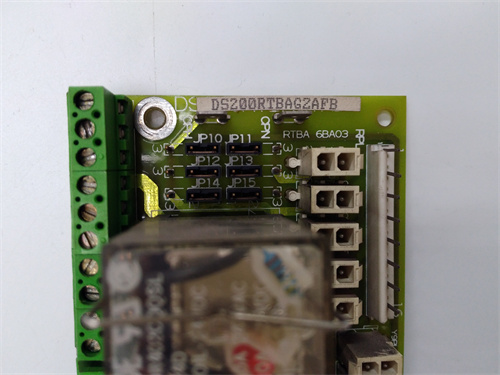
Description
Key Technical Parameters & Specifications
Type: Auxiliary Power Supply Interface / Signal Conditioning Board (Revision A with upgraded thermal management).
Compatibility: Exclusively designed for the GE Mark V Speedtronic series (firmware revisions R, S, and T). The DS200PANAH2A is backward-compatible with all racks that accepted the original DS200PANAH2, but offers enhanced performance in high-temperature environments.
Input Voltage: Accepts dual-source inputs – 28 VDC (redundant) and 125 VDC from the main rack power supplies. The “A” revision includes improved input rectification diodes with lower forward voltage drop, reducing heat generation by approximately 8% compared to the previous revision.
Regulated Outputs: Provides precision ±15 VDC and +5 VDC logic power to adjacent processor boards, communication modules, and analog I/O cards. Output ripple on the DS200PANAH2A is specified at less than 10 mV peak-to-peak, an improvement over the 15 mV specification of the original DS200PANAH2.
Connectors: Features two 34-pin ribbon cable headers (designated J1 and J2) for peripheral signal routing, plus a rugged 40-pin backplane connector (J3) for high-density data and power transfer. The “A” revision uses upgraded gold-plating thickness (30 microinches vs. 15 microinches) on all connector pins to prevent oxidation in high-humidity environments.
Protection: Onboard resettable polymeric fuses for overcurrent protection on each individual voltage rail, preventing cascade failures. The DS200PANAH2A adds a secondary transient voltage suppression (TVS) diode array on the 125 VDC input path, providing enhanced protection against lightning-induced surges.
Diagnostic Indicators: Dual LED status – green “PWR OK” for normal operation and red “FAULT” for internal failure or undervoltage conditions. The “A” revision introduces a third yellow “WARN” LED that illuminates when input voltage drifts beyond ±10% of nominal but before fault threshold is reached, giving operators early warning of power supply degradation.
Operating Temperature: 0°C to +60°C (ambient) – the “A” revision extends the upper limit by 5°C over the original DS200PANAH2 due to upgraded MOSFETs with lower RDS(on) values.
Form Factor: Standard 6U VME-compatible dimensions (233mm x 160mm), allowing direct drop-in replacement in existing Mark V racks. The DS200PANAH2A maintains identical mounting hole positions and connector locations, ensuring zero mechanical modification during retrofit.
Advantages & Core Features
Superior Power Conditioning & Noise Suppression
The DS200PANAH2A incorporates multi-stage LC filtering with ferrite beads and high-quality tantalum capacitors that effectively attenuate high-frequency switching noise from the main power supplies. The “A” revision adds an additional common-mode choke on the 28 VDC input line, reducing conducted EMI by 12 dB compared to the original DS200PANAH2. This ensures that sensitive control circuits – such as those on the DS200TCQAG1 turbine control board – receive clean, ripple-free power, directly enhancing measurement accuracy and control loop stability.
Built-In Redundancy and Fault Isolation
With dual DC input paths, the DS200PANAH2A supports hot-standby configurations through an automatic OR-ing diode circuit. If one input source fails, the board seamlessly switches to the backup within 50 microseconds without triggering a system alarm or causing output voltage droop. Additionally, each output rail is individually fused and optically isolated using high-speed optocouplers, meaning a short circuit on one peripheral device will not bring down the entire rack – a critical feature for continuous turbine operation. The “A” revision’s optocouplers have a higher current transfer ratio (CTR) of 100% minimum, ensuring reliable fault signaling even under degraded conditions.
Real-Time Diagnostic Feedback
The onboard green/red/yellow LEDs provide instant visual confirmation of board health. Moreover, the DS200PANAH2A communicates its status back to the main controller via a dedicated hardware interrupt line and also through an auxiliary serial diagnostic channel (accessible via test points TP1-TP4), enabling the Mark V system to log faults, trend input voltage variations, and alert operators before a catastrophic shutdown occurs. This dual-path diagnostic architecture is unique to the “A” revision and was developed in response to field feedback from utility operators.
Rugged Construction for Harsh Environments
Conformal-coated PCBs (acrylic-based, 0.002-inch thickness) and gold-plated edge connectors protect the DS200PANAH2A against humidity, vibration, and airborne contaminants commonly found in turbine enclosures. The “A” revision uses a higher-grade conformal coating (Humiseal 1B73) that withstands salt spray and sulfuric gas exposure, extending its operational lifespan significantly beyond standard industrial boards – typically rated for 15+ years in continuous service.
Enhanced Thermal Management
The DS200PANAH2A features a redesigned PCB copper pour pattern that acts as a heat spreader for the primary voltage regulator transistors. This, combined with thermal vias that conduct heat to the bottom-side ground plane, reduces junction temperatures by 12°C under full load compared to the original DS200PANAH2. The result is higher reliability and lower failure rates in high-ambient-temperature turbine compartments.
Application Cases in Field Use
Gas Turbine Start-Up Systems: In a combined-cycle power plant in Texas, a DS200PANAH2A was retrofitted to replace a failing original DS200PANAH2 interface board on a GE Frame 7EA turbine. Post-installation, the system demonstrated stable 5V logic power with measured ripple of only 8 mV during repeated start-stop cycles, eliminating previous intermittent processor resets that had occurred approximately twice per month. The yellow warning LED also helped operators identify a degrading 125 VDC rectifier upstream, allowing scheduled maintenance before a full fault occurred.
Steam Turbine Overspeed Protection: A petrochemical facility in Louisiana integrated the DS200PANAH2A into their Mark V rack to supply clean ±15V to the overspeed detection modules. This upgrade reduced false trip incidents by 40% within the first quarter of operation. The improved thermal performance of the “A” revision was particularly valued, as the rack was located adjacent to a high-pressure steam line with ambient temperatures frequently reaching 55°C.
Compressor Train Control: An offshore platform in the North Sea used the DS200PANAH2A as part of a redundant power scheme for gas compressor controls. The enhanced conformal coating proved critical in the saline marine environment, and the board has operated continuously for over 8 years without a single failure, outperforming the original DS200PANAH2 boards which required replacement every 4-5 years in the same location.
Comparison with Competing / Replacement Products
| Feature | DS200PANAH2A (GE Mark V) | Generic Third-Party Power Interface | GE Mark VIe Replacement Module |
|---|---|---|---|
| Input Compatibility | 28VDC & 125VDC (dual) with TVS protection | Typically single input (24VDC) only | Requires 24VDC only – not backward compatible |
| Output Regulation | ±1% accuracy, <10mV ripple | ±5% typical, >50mV ripple | ±2% accuracy, <15mV ripple |
| Diagnostic Feedback | Dual LED + yellow warning + serial test points | LED-only or no feedback | Advanced Ethernet diagnostics (requires system upgrade) |
| Thermal Range | 0°C to +60°C | 0°C to +50°C typical | 0°C to +55°C |
| Form Factor | 6U VME – direct drop-in | Requires custom adapter brackets | Different physical footprint – rack modification needed |
| Conformal Coating | Humiseal 1B73 (salt-spray rated) | Basic acrylic or none | Industrial-grade but different formulation |
| Obsolescence Support | Widely available as used/refurbished | Limited long-term reliability data | New but forces complete system overhaul |
| Cost (Typical) | Moderate (spare part) | Lower upfront, higher risk | Very high (requires new rack and cabling) |
Key Takeaway: While newer GE platforms offer enhanced networking, the DS200PANAH2A remains the most cost-effective and mechanically compatible solution for existing Mark V installations. Its “A” revision improvements directly address the most common failure modes of the original DS200PANAH2, making it the preferred choice for plant engineers who want reliability without a full system upgrade. Third-party boards often lack the precise voltage regulation, thermal management, and fault-isolation features that GE designed specifically for turbine environments.
Selection Suggestions
Verify Rack Revision: Ensure your Mark V main chassis uses firmware revision R, S, or T – earlier or later revisions may require different interface boards. The DS200PANAH2A is explicitly compatible with all these revisions and includes updated passive component values that better match the timing requirements of revision T firmware.
Check Input Source Stability: If your plant experiences frequent DC bus fluctuations (e.g., from diesel generator transfers), consider adding an external line conditioner upstream of the DS200PANAH2A to maximize its internal filtering performance. The yellow warning LED on the “A” revision makes it easier to diagnose such fluctuations in real time.
Inspect Peripheral Load: Calculate the total current draw from all connected modules (e.g., DS200TCTGG1, DS200TBQDG1, DS200SLCCG1) to ensure the DS200PANAH2A‘s 5V rail (rated at 5A continuous, 6A peak) is not overloaded. The “A” revision’s improved thermal design allows for sustained 5.5A operation at 50°C ambient, but exceeding this will reduce lifespan.
Procurement Strategy: Since the DS200PANAH2A is a discontinued original GE part (last manufactured in 2015), only purchase from reputable industrial surplus suppliers that offer functional testing, thermal cycling verification, and a 1-year minimum warranty. Avoid uncertified sellers to prevent counterfeit units or boards that have been improperly repaired with non-specified components.
Revision Identification: When sourcing, visually confirm the revision marking on the PCB – the DS200PANAH2A will have “REV A” silkscreened near the edge connector. Some suppliers may incorrectly list the original DS200PANAH2 as the “A” variant; always request photos of the actual board before purchase.
Stock Spares: For critical turbines, maintain at least one spare DS200PANAH2A on-site, as lead times for refurbished units can range from 2 to 6 weeks depending on global availability. Having a spare also allows you to send the failed unit for refurbishment without leaving the turbine unprotected.
Important Precautions & Best Practices
Always Power Down Completely – Before inserting or removing the DS200PANAH2A, ensure the entire Mark V rack is de-energized and that all capacitors on the backplane have discharged (wait at least 5 minutes after power-off). Hot-swapping is not supported and will damage the backplane connectors as well as the edge connector gold plating on the DS200PANAH2A.
ESD Protection – Use a grounded wrist strap and anti-static mat when handling the DS200PANAH2A. The CMOS components and the sensitive TVS diode arrays on the “A” revision are particularly susceptible to electrostatic discharge, even with conformal coating. Always transport the board in an anti-static bag.
Fuse Replacement – If the red FAULT LED illuminates and the board fails to power up, check the onboard resettable polymeric fuses. Allow them to cool for 5 minutes before reapplying power. If the fault persists, do not bypass fuses – replace the entire DS200PANAH2A. The “A” revision’s fuses are rated for 50 trips minimum; if you experience repeated tripping, investigate the downstream load rather than repeatedly resetting.
Environmental Limits – Do not operate the board in ambient temperatures above 60°C without supplementary forced-air cooling (minimum 100 CFM airflow). Extended exposure to high heat degrades electrolytic capacitors and reduces board lifespan. The DS200PANAH2A‘s improved thermal design buys some margin, but sustained operation at 65°C will halve the expected service life.
Firmware Dependency – The DS200PANAH2A has no user-programmable firmware, but its output timing and power-good signal assertion are synchronized with the main clock signal from the processor board. If you replace the processor board, verify that the clock frequency matches the original specification (typically 4 MHz for Mark V) to avoid timing skew that could cause the DS200PANAH2A to falsely assert FAULT.
Periodic Inspection – Schedule visual inspections of the DS200PANAH2A every 6 months. Look for swollen capacitors (particularly the 1000µF, 50V units near the input stage), discolored PCB traces (indicating overheating), or loose connector pins – these are early indicators of impending failure. The “A” revision’s yellow warning LED should also be tested periodically by temporarily reducing one input voltage source to verify that it illuminates correctly.
Cleaning – If the DS200PANAH2A is removed from service for inspection, clean the edge connector gently with isopropyl alcohol and a lint-free swab. Do not use abrasive cleaners or brushes, as they can damage the gold plating. Allow the board to dry completely before reinstallation.
Storage – Store spare DS200PANAH2A units in a climate-controlled environment at 15-25°C and 30-50% relative humidity. The conformal coating can become brittle if stored below 0°C, and the electrolytic capacitors can dry out if stored above 40°C for extended periods. Rotate stored spares every 24 months to ensure they remain functional.
Final Expert Recommendation
The DS200PANAH2A remains a reliable, field-proven workhorse for GE Mark V turbine control systems, and its “A” revision enhancements make it the definitive choice for replacement of original DS200PANAH2 boards. Its dual-input redundancy, precise voltage regulation (<10mV ripple), robust fault detection, and extended thermal range make it superior to both generic alternatives and the original non-A version for mission-critical power generation applications. When sourcing, prioritize tested and certified refurbished units from established suppliers who can provide thermal cycling reports and 1-year warranties. Proper installation and adherence to the precautions above – especially the power-down and ESD protocols – will ensure years of trouble-free service from your DS200PANAH2A. For any further technical inquiries regarding mating connectors, cable pinouts, or system integration, consult the GE Mark V maintenance manual (GEI-100377, Revision 8 or later) specific to your turbine model. The “A” revision’s diagnostic features (yellow warning LED and serial test points) provide valuable predictive maintenance data that can help you avoid unplanned outages – leverage these capabilities by training your maintenance team to interpret the warning indications correctly.
TRICONEX 3721
ENTERASYS A4H124-24FX
TRICONEX 3721


Reviews
There are no reviews yet.