
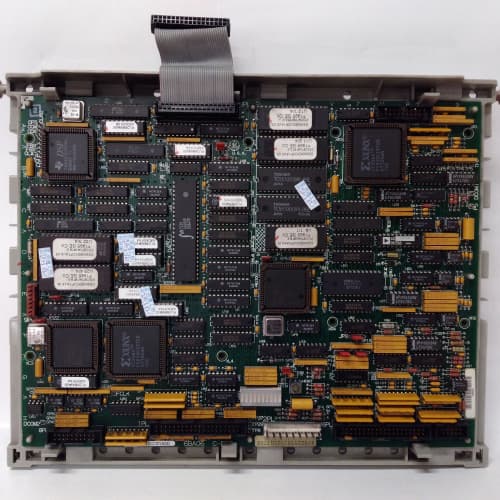
Description
Technical Parameters & Specifications
| Parameter | Specification |
|---|---|
| Manufacturer | General Electric (GE) |
| Series | Mark V Speedtronic |
| Full Model | DS200DSFBG1ADB |
| Board Type | Digital Signal Feedback / Speed Processing Board |
| Input Channels | 3 dedicated speed sensor inputs (magnetic pickups) |
| Additional Inputs | 2 general-purpose pulse/frequency inputs (configurable) |
| Input Voltage Range | ±3V to ±55V AC (auto-ranging with enhanced sensitivity) |
| Frequency Range | 0.5 Hz to 25 kHz (extended low-frequency capability) |
| Output Interface | Parallel VME backplane (digital speed data to CPM) |
| Accuracy | ±0.02% of reading over full range |
| Operating Temp | -40°C to +70°C (extended low-temperature capability) |
| Protection | Enhanced conformal coating + thickened gold-plated edge connectors (30µin) |
| Physical Dimensions | 6U VME format (233mm × 160mm) |
| MTBF | > 180,000 hours |
Core Advantages & Key Features
-
Advanced Adaptive Signal Processing – The DS200DSFBG1ADB incorporates a second-generation adaptive filtering engine with programmable noise rejection algorithms. The ADB revision automatically detects and eliminates harmonics and electrical interference, delivering exceptionally clean frequency data even in the most electrically noisy turbine environments.
-
Extended Low-Frequency Detection – With a minimum frequency of 0.5 Hz, the DS200DSFBG1ADB supports very low-speed applications such as hydro turbines during startup or slow-roll conditions, where earlier revisions could not reliably detect signals below 1 Hz.
-
Triple Redundant Speed Monitoring with Smart Voting – Three dedicated input channels support 2-out-of-3 (2oo3) voting logic for overspeed protection. The ADB revision adds intelligent channel comparison that can identify a failing sensor and automatically exclude it from the voting algorithm.
-
Enhanced Diagnostic Suite – The board includes comprehensive onboard diagnostics with non-volatile memory storing the last 50 events (signal loss, out-of-range, communication errors, and channel anomalies). Data can be retrieved via the backplane without external tools.
-
Improved Sensitivity & Wide Input Range – Accepting signals from ±3V to ±55V AC, the DS200DSFBG1ADB reliably detects low-amplitude MPU signals while accommodating high-output sensors without saturation.
-
Extended Temperature Range – Rated for -40°C to +70°C, this board is suitable for outdoor installations, cold climate regions, and unheated enclosures where earlier versions were limited to -30°C.
-
Thickened Connector Plating – Gold plating on edge connectors is increased to 30µin, ensuring reliable connectivity over many insertion/removal cycles and resisting corrosion in harsh environments.
-
Isolated Inputs – Each speed channel is optically isolated from the backplane, protecting the main processor from field wiring faults or voltage spikes.
-
Plug-and-Play Compatibility – The DS200DSFBG1ADB integrates seamlessly with all Mark V main processors, including DS200CPCAG1A, and works alongside driver boards such as DS200DPCAG1ADC and DS200DPCAG1ADB without additional interface hardware.
Typical Applications
-
Gas Turbine Speed Sensing – Monitors turbine shaft speed via multiple MPUs for speed control and overspeed protection in GE 7FA, 9E, and Frame 5 turbines operating in extreme climates.
-
Steam Turbine Overspeed Protection – Provides critical speed feedback for overspeed trip systems, ensuring safe operation during load rejection events in both indoor and outdoor installations.
-
Hydro Turbine Speed Feedback – The 0.5 Hz low-frequency capability makes this board ideal for Kaplan, Francis, and Pelton hydro turbines during startup, shutdown, and low-speed rolling conditions.
-
High-Speed Compressor Monitoring – Tracks high-speed compressor shaft RPM (up to 25 kHz) for performance monitoring and surge protection in LNG and pipeline applications.
-
Geartooth Counting & Position Detection – The general-purpose inputs can count gear teeth for phase angle detection used in ignition timing or vibration analysis.
-
Wind Turbine Generator Speed Monitoring – Suitable for low-speed wind turbine applications where cold-weather operation is required.
Field Example: A Canadian oil sands facility operating steam turbines in outdoor enclosures replaced older speed boards with DS200DSFBG1ADB units. The extended -40°C capability eliminated cold-start speed signal failures during winter months, reducing unplanned outages by 80% over two heating seasons.
Comparison: DS200DSFBG1ADB vs. Previous Revisions vs. Competitor
| Feature | DS200DSFBG1ADB | DS200DSFBG1ACB (Earlier) | DS200DSFBG1A (Earliest) | Competitor (Woodward 8440-2400) |
|---|---|---|---|---|
| Primary Function | Digital speed feedback | Digital speed feedback | Digital speed feedback | Speed/frequency measurement |
| Dedicated Speed Channels | 3 (with smart voting) | 3 (with 2oo3 voting) | 3 (with 2oo3 voting) | 2 channels |
| Frequency Range | 0.5 Hz – 25 kHz | 1 Hz – 25 kHz | 1 Hz – 20 kHz | 2 Hz – 15 kHz |
| Accuracy | ±0.02% | ±0.02% | ±0.05% | ±0.10% |
| Input Sensitivity | ±3V (minimum) | ±3V (minimum) | ±5V (minimum) | ±10V (minimum) |
| Adaptive Filtering | Gen 2 (programmable) | Gen 1 (programmable) | Fixed filtering | No |
| Fault Event Logging | 50 events | 20 events | None | None |
| Smart Sensor Voting | Yes (failing sensor exclusion) | No | No | No |
| Operating Temp | -40°C to +70°C | -30°C to +70°C | -30°C to +65°C | -25°C to +60°C |
| Edge Connector Plating | 30µin gold | 15µin gold | 15µin gold | 15µin gold |
| Hot-Swap Support | Yes | Yes | Yes | No |
| MTBF | > 180,000 hours | > 160,000 hours | > 140,000 hours | 100,000 hours |
Selection Guidelines & Precautions
-
Verify Sensor Compatibility – The DS200DSFBG1ADB accepts magnetic pickup (MPU) signals with amplitudes from ±3V to ±55V AC. For proximity probes with DC output, ensure proper signal conditioning or external converters are used. The wide input range accommodates most commercially available MPUs without adjustment.
-
Check Low-Frequency Requirements – For hydro turbine or slow-roll applications, confirm that the minimum expected frequency is above 0.5 Hz. Below this threshold, the board may not provide reliable detection.
-
Sensor Cable Quality – Use shielded twisted-pair cables (AWG 22–24) for all speed sensor connections to minimize EMI pickup. Maximum recommended cable length is 300 meters for reliable signal integrity. The ADB revision’s improved filtering may allow longer runs in some cases, but field verification is recommended.
-
Grounding Practices – Proper grounding is critical for stable speed measurement. Connect cable shields to the designated ground terminal at the board end only, avoiding ground loops. The ADB revision is more tolerant of ground differentials, but best practices still apply.
-
Configuration of General-Purpose Inputs – The two auxiliary pulse inputs can be configured via onboard jumpers for voltage level (5V, 12V, 24V) or current (NPN/PNP). Refer to GE manual GEK-119589 for detailed setting options.
-
Firmware Compatibility – When integrating the DS200DSFBG1ADB with a Mark V system, ensure the main processor firmware supports the ADB revision’s extended features, including smart voting and event logging. Compatibility is verified with DS200CPCAG1A revision 4.0 or higher. For older processors, consult GE TIL GEK-119647 for upgrade requirements.
-
Spare Parts Strategy – The DS200DSFBG1ADB is the preferred replacement for all earlier DS200DSFBG1 variants (including DS200DSFBG1A and DS200DSFBG1ACB) due to its superior temperature range, diagnostic capabilities, and reliability. Maintain at least one unit as a cold spare, particularly for safety-critical speed protection applications.
-
Cold Climate Considerations – For installations in environments below -30°C, the DS200DSFBG1ADB is the only GE Mark V speed board rated for such conditions. Ensure the entire rack is also rated for low-temperature operation.
Summary
The DS200DSFBG1ADB is the most advanced digital signal feedback board in the GE Mark V series, featuring extended temperature range (-40°C to +70°C), smart sensor voting with failing-channel exclusion, comprehensive 50-event fault logging, and second-generation adaptive filtering. Its extended low-frequency capability (0.5 Hz) makes it suitable for hydro turbines and slow-roll applications, while the 25 kHz upper limit handles high-speed compressors and turbines. The board integrates seamlessly with DS200CPCAG1A processors and works alongside driver boards including DS200DPCAG1ADC and DS200DPCAG1ADB. This revision is the recommended replacement for all earlier DS200DSFBG1 variants. Selection requires attention to sensor type, frequency requirements, proper grounding, firmware compatibility, and environmental conditions to ensure reliable speed feedback and system safety in demanding turbine, compressor, and hydro applications.
KOLLMORGEN S22460-SRS
OLYMPUS OTV-S7H-NA-12E
cutler-hammer KW3400
ABB 3BSE018059R1 TC512V1


Reviews
There are no reviews yet.