
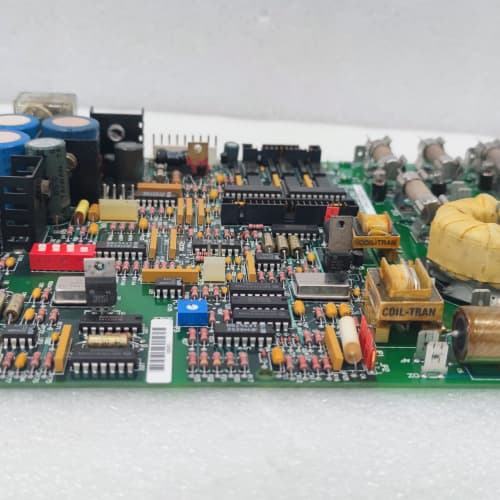
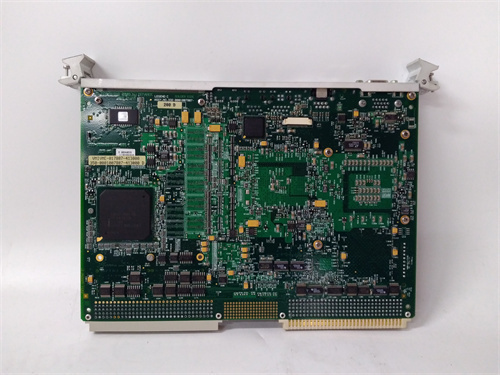
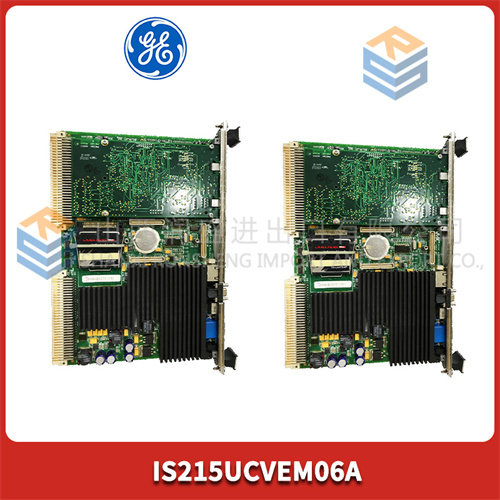
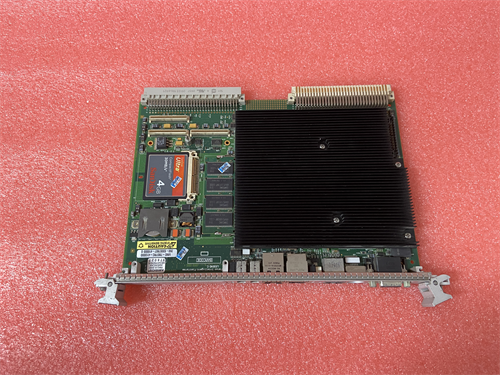
Description
Technical Parameters
-
Microcontroller: Custom GE ASIC at 16 MHz, 1.8 ms scan cycle
-
Analog Inputs: 4 differential channels, ±10V/0–10V/4–20mA, >22 MΩ impedance
-
Analog Outputs: 2 isolated, 0–10V/4–20mA, 1 kHz update rate with slew-rate limiter and clamping
-
Digital I/O: 8 inputs (24V DC), 6 transistor outputs (24V DC, 0.5A) with short-circuit protection
-
Encoder Input: Dedicated differential encoder channel (TTL/HTL, up to 2 MHz)
-
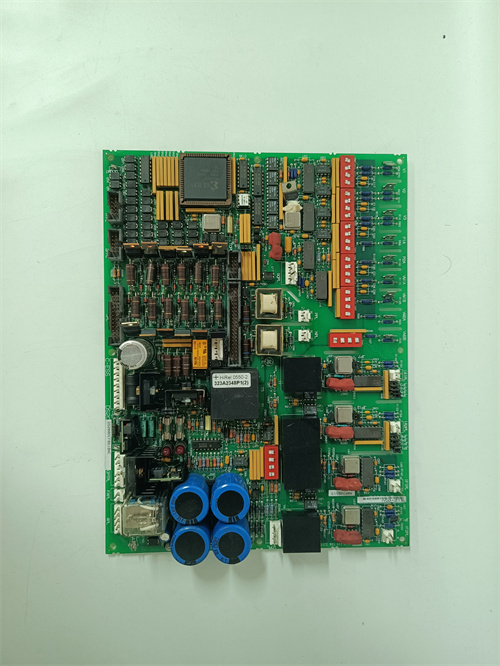
Onboard Pots: 12 trim-pots including gain, offset, servo stiffness, tachometer damping, current loop stability, encoder blending, high-speed filter, adaptive gain, analog offset nulling, inertia compensation, motor model adaptation, and power stage optimization
-
Status LEDs: Advanced red/green/yellow/blue/white array with 64 fault codes (6-bit)
-
Operating Temp: 0°C to +70°C
-
Humidity: 5–95% non-condensing with triple-conformal coating
Key Advantages
-
Power Stage Optimization: Dedicated potentiometer for optimizing firing pulse timing and power bridge commutation, reducing switching losses and improving efficiency
-
Regenerative Braking Control: Enhanced algorithm for smooth transition between motoring and regenerative modes, minimizing DC bus voltage rise
-
Energy Efficiency Management: Improved current loop response reduces power consumption during light-load conditions
-
Highest Analog Precision: >22 MΩ impedance with offset nulling for microvolt-level accuracy
-
Ultra-High-Speed Encoder: Supports up to 2 MHz for precise high-speed control
-
64 Fault Codes: Includes power stage mismatch, regenerative overvoltage, commutation failure, and efficiency degradation warnings
-
Enhanced Auto-Tuning: Includes power stage characterization and regenerative brake calibration
Applications
-
Energy-critical steel/aluminum rolling mills
-
High-efficiency paper/tissue machines
-
Regenerative mine hoists with energy recovery
-
Electric vehicle test dynamometers
-
Marine propulsion with regenerative braking
-
High-speed printing presses with energy savings
-
Crane and elevator systems with regenerative braking
-
Renewable energy storage test systems
Comparison with Alternatives
| Aspect | 531X133PRUAPG1 | 531X133PRUANG1 | Siemens 6RA80 | ABB DCS800 |
|---|---|---|---|---|
| Power Stage Optimization | Yes (dedicated pot) | No | Yes (software) | Yes (software) |
| Regenerative Control | Enhanced | Standard | Yes | Yes |
| Analog Impedance | >22 MΩ | >22 MΩ | Digital only | Digital only |
| Encoder Input | 2 MHz | 2 MHz | Yes | Yes |
| Fault Codes | 64 | 64 | 100+ | 100+ |
| Drop-in Fit | Late DC300 | Late DC300 | Full swap | Full swap |
| Availability | Extremely scarce | Extremely scarce | Active | Active |
Selection & Sourcing Precautions
-
Verify Revision: Confirm “PG1” suffix, firmware checksum, and comprehensive test report
-
Inspect Capacitors: Check for bulging/leaking on all electrolytic units, particularly bus-side capacitors
-
Check Pots: Ensure all 12 trim-pots rotate smoothly; power stage optimization pot is unique
-
Test Documentation: Demand linearity (<0.05%), output accuracy (<0.10%), regenerative brake verification, power stage characterization, 72-hour burn-in at 65°C
-
Warranty: Minimum 3 years; prefer 5 years
-
ESD Handling: Anti-static bags only; use grounded wrist strap
Installation Precautions
-
Discharge Bus: Confirm <5V on DC terminals before insertion; allow up to 15 minutes due to regenerative circuit capacitors
-
ESD Protocol: Wrist strap and ESD mat mandatory
-
Record Pot Settings: Transfer 12 pot values from old board; power stage pot requires special tuning
-
Power Stage Tuning: Adjust pot based on power bridge characteristics—observe firing pulses on oscilloscope; optimize for clean commutation
-
Regenerative Brake: Test with load to verify smooth transition; adjust if DC bus overvoltage occurs
-
Offset Nulling: With no input signal, adjust nulling pot until output reads zero
-
Encoder Wiring: Use shielded twisted-pair cable with proper termination
-
Tune Current Loop: Adjust stability pot using oscilloscope for critical damping
-
Auto-Tuning: Apply digital input sequence; uncouple motor from load; allow full cycle
-
Adaptive Gain: Set based on application; system will auto-adjust during operation
-
Tach Damping: Set based on cable length
-
Output Clamp: Do not set below 85% of max firing command
-
Gateway Module: Power off before connecting to 10-pin header
-
Firmware Lock: Do not attempt reprogramming
-
Regular Inspection: Visual check every 3 months; monitor regenerative circuit health
-
Spare Strategy: Purchase multiple units for critical lines; develop long-term migration plan
BENTLY NEVADA 330180-50-00
FOXBORO FBM215
A-B 1769-L31/A

Reviews
There are no reviews yet.