
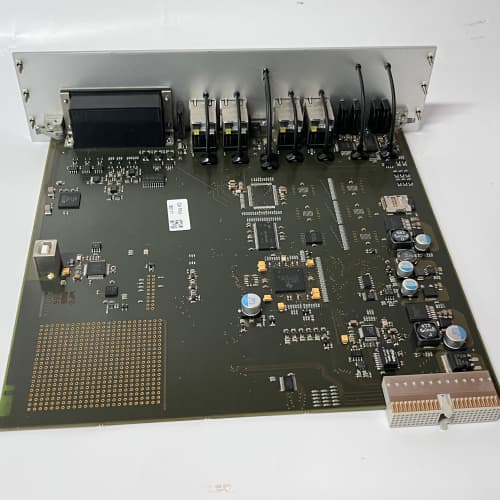
Description
Product Overview and Description
The FUJI NP1S-22 is a compact, programmable logic controller (PLC) from Fuji Electric’s established NOVA series, specifically designed as a cost-effective and space-saving solution for small-scale automation tasks. This micro-PLC model integrates the core functions of a CPU, power supply, digital inputs, and digital outputs into a single, streamlined unit. The primary role of the FUJI NP1S-22 is to replace traditional relay control panels, timers, and counters, offering programmable flexibility, enhanced functionality, and easier troubleshooting for simple machinery and standalone control applications. With its all-in-one design, the NP1S-22 simplifies cabinet layout, reduces wiring, and provides a user-friendly entry point into the world of automation. The model number “22” typically indicates a specific I/O configuration, commonly representing a unit with a defined number of inputs and outputs, such as 12 inputs and 8 outputs, making the FUJI NP1S-22 a self-contained control brain for applications like small conveyor systems, packaging machines, and environmental control units.
Product Parameters and Specifications
-
Product Type: Micro Programmable Logic Controller (All-in-One Unit)
-
Manufacturer Part Number (MPN): NP1S-22
-
Brand: FUJI Electric
-
Series: NOVA Series (NP1S)
-
I/O Configuration: Integral digital inputs and digital outputs. The “22” suffix often denotes a standard configuration, such as 12 DC inputs and 8 relay outputs.
-
Input Specifications: Typically 24V DC sinking/sourcing inputs with a common point.
-
Output Specifications: Typically relay contact outputs (e.g., 250V AC, 2A per point). Some variants may have transistor outputs.
-
Programming Language: Ladder Diagram (LD), typically programmed using Fuji’s dedicated software (e.g., NOVA-SOFT).
-
Program Memory Capacity: Sufficient for several hundred ladder logic steps, adequate for its intended scale.
-
Power Supply: Integrated, accepting a standard AC voltage range (e.g., 100-240V AC).
-
Communication: Often includes a built-in programming port (RS-422/485) for connection to a programming PC. Advanced communication options (like RS-485 for simple networks) may be available.
-
Expansion: As a basic micro-PLC, the FUJI NP1S-22 typically does not support hardware expansion modules, relying on its fixed I/O count.
-
Dimensions: Compact, designed for DIN rail mounting.
Key Advantages and Features
The key advantage of the FUJI NP1S-22 is its simplicity and cost-effectiveness for very specific, small-scale applications. Its all-in-one design eliminates the need for separate power supply, CPU, and I/O modules, significantly reducing initial hardware cost and cabinet space. The use of relay outputs provides flexibility in switching both AC and DC loads directly without additional interfaces. The PLC is known for its robustness and reliability, with strong noise immunity suitable for typical industrial environments. Programming is straightforward using familiar ladder logic, and the integrated design makes installation and wiring quick. For applications that fit precisely within its I/O and memory limits, the FUJI NP1S-22 offers a reliable, no-fuss automation solution that is easy to maintain and troubleshoot.
Application Scenarios and Use Cases
The FUJI NP1S-22 is ideal for simple, standalone machine control where I/O requirements are low and fixed. Typical applications include small packaging machines for sequencing sealing and stamping operations, control panels for industrial washing machines or clean-in-place (CIP) systems, material handling like a simple conveyor with photo-eye control and sorting gates, and building automation for controlling fans, pumps, and lights in a small mechanical room. It is also well-suited for modernizing old relay-based control panels in equipment such as small furnaces, mixers, or test stands, where its programmability allows for easy modification of sequences without rewiring.
Comparison with Competing Products
The FUJI NP1S-22 competes directly with other micro or nano PLCs in the market, such as the Mitsubishi FX1S, Siemens LOGO!, Omron CP1E, Allen-Bradley Micro800 series (e.g., 810), and Schneider Electric Zelio Logic. Compared to the more flexible modular micro-PLCs (like the Mitsubishi FX3S which can expand), the NP1S-22 is more limited due to its fixed I/O. Its main competitor is often the Siemens LOGO!, which is also an all-in-one logic module. The FUJI NP1S-22 differentiates itself through Fuji’s reputation for reliable electrical components, its specific I/O mix (often heavy on relay outputs), and its integration into Fuji’s broader ecosystem of drives and components. It is often selected based on regional availability, existing plant standards, or the specifier’s familiarity with the brand.
Selection Guidelines and Important Notes
Selection Advice:
-
Accurate I/O Counting: The most critical step is to confirm the exact I/O count (inputs and outputs) of the FUJI NP1S-22 variant matches your application’s needs, including a 10-20% spare capacity for future modifications.
-
Verify Output Type: Confirm that the output type (relay or transistor) is suitable for your loads (AC/DC, inrush current, switching frequency). Relay outputs are versatile but have a limited mechanical life.
-
Check Load Ratings: Ensure the relay output contact ratings (voltage and current) are adequate for the connected solenoids, contactors, or lamps. Exceeding ratings will quickly destroy the outputs.
-
Software Accessibility: Ensure you have access to the required programming software (NOVA-SOFT or similar) and a compatible programming cable.
-
Consider Future Needs: If there is any possibility of needing more I/O or special functions (analog, high-speed counter), consider selecting a slightly larger micro-PLC that supports expansion from the start.
Important Precautions:
-
Fused Outputs: Always protect relay outputs with appropriately sized external fuses for each inductive load (like solenoids or small motor contactors) to prevent contact welding from short circuits or high inrush currents.
-
Suppression for Inductive Loads: Use flyback diodes for DC inductive loads or RC snubbers for AC inductive loads across the load terminals to protect the relay contacts from voltage spikes and extend their life.
-
Secure Memory Backup: The program is typically stored in non-volatile memory, but always keep a backup of the ladder program on a PC. Some models may have a backup battery for volatile data registers.
-
Environmental Limits: Install the PLC within its specified temperature, humidity, and vibration limits. Provide adequate clearance for heat dissipation.
-
Correct Wiring: Follow the wiring diagram in the manual precisely, especially for the common terminals of inputs and outputs. Incorrect common wiring is a frequent source of malfunction.
-
Obsolescence Check: The NOVA series is a mature product line. Verify current availability and long-term support plans from suppliers.
TRICONEX?3636R.
TRICONEX?3664.
TRIC0NEX?3700.
TRICONEX?3701.
TRIC0NEX?3703E.

Reviews
There are no reviews yet.