
Description
Product Description
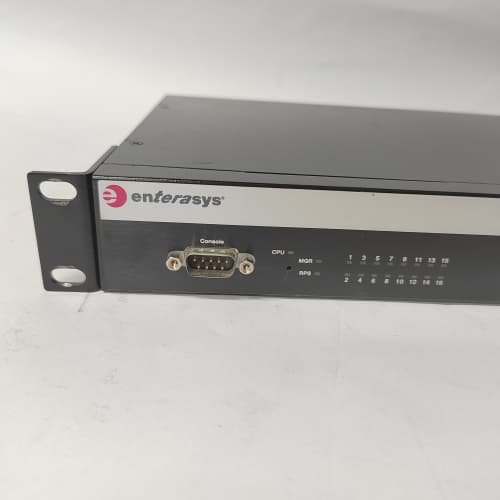
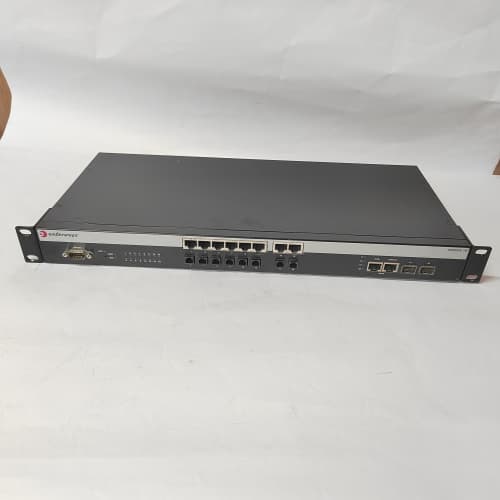
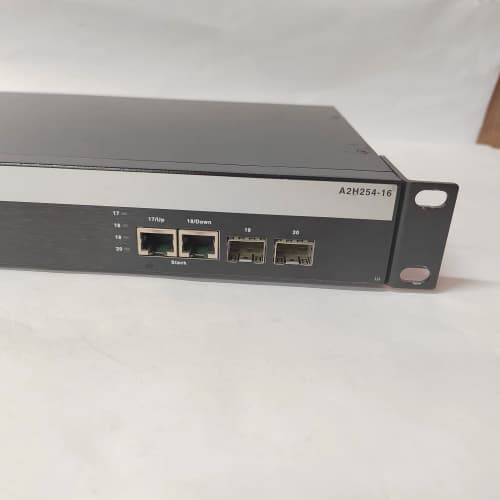
The ENTERASYS A2H254-16 is a hardened, Layer 2+ managed switch built to operate in conditions commonly found in industrial settings such as manufacturing floors, power substations, and transportation systems. This industrial switch A2H254-16 provides a set number of Ethernet ports (as indicated by the “16” in the model, likely 16 ports) with a combination of copper and fiber uplink options. It features a rugged metal enclosure, conformal coated circuitry for protection against moisture and contaminants, and a wide operating temperature range. The primary role of the A2H254-16 switch is to form the resilient, deterministic backbone of an industrial network, connecting programmable logic controllers (PLCs), human-machine interfaces (HMIs), drives, and other devices while offering advanced management and security features not found in standard commercial switches.
Technical Parameters
-
Device Type: Managed Industrial Ethernet Switch.
-
Port Configuration: Typically 16 10/100BASE-TX copper ports (RJ-45) and a number of optional or fixed fiber optic uplink ports (e.g., 100BASE-FX or 1000BASE-X SFP slots).
-
Switching Performance: Non-blocking switching fabric with a specific backplane bandwidth and packet forwarding rate.
-
Management: Full Layer 2 management with support for:
-
VLANs (IEEE 802.1Q)
-
Quality of Service (QoS – IEEE 802.1p)
-
Rapid Spanning Tree Protocol (RSTP/MSTP – IEEE 802.1w)
-
Link Aggregation (LACP – IEEE 802.3ad)
-
SNMP, CLI, Web Interface
-
-
Industrial Ruggedization:
-
Extended Temperature Range (e.g., -40°C to 75°C)
-
High Shock and Vibration Resistance
-
Dual, redundant power input options (often 12-48 VDC or 24 VAC)
-
-
Mounting: DIN-rail or panel mountable.
-
Agency Approvals: Typically carries certifications for hazardous locations (Class I Div 2), marine, rail, or other industry-specific standards.
Advantages and Features
-
Environmental Durability: The A2H254-16 switch is engineered to withstand extreme temperatures, vibration, and electrical noise, ensuring network stability where standard switches would fail.
-
Network Reliability and Recovery: Features like RSTP provide millisecond-level network recovery in case of a cable break or switch failure, which is critical for maintaining uninterrupted control system communication.
-
Deterministic Performance: Managed features such as QoS prioritize critical control traffic (e.g., PROFINET, EtherNet/IP I/O) over less time-sensitive data, ensuring predictable delivery times.
-
Enhanced Security: Provides network segmentation through VLANs, port security, and access control lists (ACLs) to protect sensitive automation cells from unauthorized access or broadcast storms.
-
Centralized Management: Can be integrated into network management systems (like Enterasys/Netsight) for simplified configuration, monitoring, and firmware updates across the entire industrial network.
Application Cases in Various Fields
-
Factory Automation: Connecting cells of robots, PLCs, and vision systems on a production line, using VLANs to segment traffic and RSTP for a resilient ring topology.
-
Power Utility Substations: Forming the SCADA and protection (IEC 61850) network within a substation, withstanding EMI and wide temperature swings.
-
Oil & Gas: Deploying on offshore platforms or pipelines in Class I Div 2 areas to network wellhead controllers, safety systems, and compressor controls.
-
Transportation Systems: Used in railway signaling or traffic management systems where reliability is safety-critical.
-
Water/Wastewater Treatment: Networking distributed RTUs, pump controls, and telemetry across a treatment plant.
Comparison with Competing Products
The ENTERASYS A2H254-16 competes with other brands of managed industrial Ethernet switches:
-
Cisco Industrial Ethernet (IE) Series: Such as the IE 2000 or 3000 series.
-
Siemens SCALANCE X: Specifically models like the X-200 series.
-
Belden (Hirschmann): OCTOPUS or EAGLE series switches.
-
Moxa: EDS-500A or IKS-6000 series.
-
GarrettCom: 6K or Magnum series.
The Enterasys (now part of Aruba/HPE) product line was historically strong in enterprise features applied to industrial hardware. Its advantage often lay in a rich feature set aligned with IT standards, making it suitable for converged IT/OT networks. Competitors like Siemens or Belden may have deeper integration with specific industrial protocols (PROFINET).
Selection Suggestions and Precautions
-
Assess Environmental Requirements: Confirm the switch’s temperature rating, ingress protection (IP), and any hazardous location certifications match the installation environment.
-
Plan Network Topology and Redundancy: Design the network using ring or mesh topologies with RSTP. Calculate the required number of copper and fiber ports, ensuring sufficient uplink capacity.
-
Prioritize Control Traffic: Utilize QoS settings to assign the highest priority to real-time I/O and control protocol traffic. Incorrect prioritization can lead to control system latency.
-
Implement Security Best Practices: Do not use default passwords. Segment the automation network from the enterprise network using VLANs and firewalls. Disable unused ports.
-
Ensure Proper Power Supply: Utilize the switch’s dual power inputs with separate, reliable power sources for redundancy. Ensure the voltage input matches your control panel supply.
-
Use Industrial-Grade Cabling and Connectors: Employ shielded, industrial Ethernet cables (e.g., PROFINET Cat 5e or better) with ruggedized connectors (M12 or coded RJ-45) for connections subject to vibration.
EMERSON VE4036P2
EMERSON CE4036P2
EMERSON VE4037PO
EMERSON CE4037PO
VE4050E1C0 EMERSON




Reviews
There are no reviews yet.