
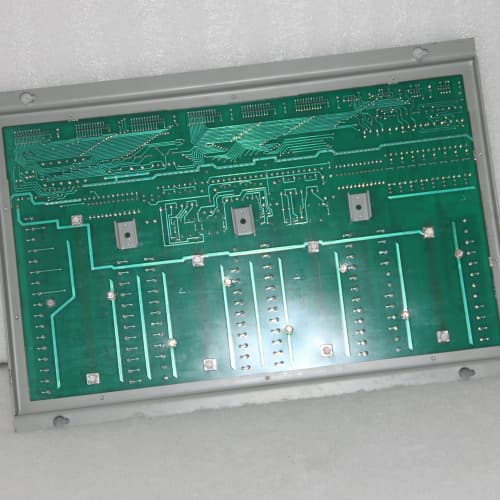
Description
Key Parameters
-
Channels: 16 analog (differential, simultaneous sampling) + 8 digital (configurable I/O)
-
Sampling Architecture: Simultaneous sample-and-hold on all 16 channels (XB inherits XA simultaneity)
-
Input Ranges: ±10V, 0–10V, ±5V, 0–5V, 4–20mA (jumper-selectable per channel)
-
Resolution: 14-bit ADC with 16-bit internal processing
-
Sampling Rate: 1 kHz per channel (simultaneous, configurable down to 10 Hz)
-
Phase Skew: <1µs between any two channels
-
FIFO Buffer: 16,384 samples per channel (XB feature – 16× standard)
-
Trigger Logic: Multi-condition (threshold, rate-of-change, digital edge, window comparator)
-
Hardware Timestamping: 1µs resolution with battery-backed RTC
-
Communications: GE Genius bus (153.6 kbps) + auxiliary RS-485 (115.2 kbps)
-
Isolation: 1500Vrms channel-to-channel/ground
-
Operating Temperature: -40°C ~ +85°C
-
Certifications: CE, UL, Class I Div 2
Advantages & Key Features
-
Deep Buffering (XB): The defining feature of GE DS3800HLXB is its 16,384-sample FIFO per channel. At 1kHz sampling, this captures 16.4 seconds of simultaneous data—compared to just 1.0 seconds on standard SC variants. At 100Hz, GE DS3800HLXB captures over 2.5 minutes, making it ideal for recording complete startup sequences, load ramp events, or extended surge oscillations without host intervention.
-
Simultaneous Sampling: Like the XA variant, GE DS3800HLXB captures all 16 channels at the exact same instant (<1µs skew), preserving phase relationships critical for orbit plots and wavefront analysis across long-duration events.
-
Advanced Trigger Logic: The XB firmware includes eight programmable trigger profiles combining threshold, rate-of-change (±dV/dt), window (inside/outside range), and digital input conditions with AND/OR logic. GE DS3800HLXB supports pre-trigger percentages from 0% to 99% in 1% increments.
-
Hardware Timestamping: Each sample in the GE DS3800HLXB buffer carries an absolute timestamp with 1µs resolution, synchronized to the Mark V system clock. This enables precise correlation with other turbine events (e.g., trip signals, valve commands) across long-duration captures.
-
Extended Recording at Lower Rates: By reducing sampling rate to 10Hz, GE DS3800HLXB can capture up to 27 minutes of data—sufficient for full turbine warm-up or cooldown transient analysis.
-
Built-in Diagnostics: Per-channel LEDs for open/short/over-range, plus “trigger armed,” “buffer x% full,” and “buffer overflow” indicators.
-
Firmware Field-Upgradable: Main, XB buffer, and trigger firmware can all be updated via Genius bus or RS-485.
Application Cases
-
Power Generation – Full Startup Sequence Recording: In a 300MW combined-cycle plant, GE DS3800HLXB monitors ±10V vibration probes, 4–20mA pressure transmitters, and 0–10V valve position feedback during turbine startup. The deep buffer captures all 16 channels for the entire 5-minute warm-up sequence at 100Hz (16,384 samples = 164 seconds; multiple triggers stitch events). When a vibration excursion occurs during startup, GE DS3800HLXB provides the complete pre- and post-event timeline, enabling engineers to diagnose thermal bow or rub conditions without external data loggers.
-
Oil & Gas – Extended Surge Oscillation Analysis: A pipeline compressor station experiences intermittent 10-second surge oscillations. GE DS3800HLXB monitors dynamic pressure transducers (±10V) at 500Hz, capturing 32.7 seconds per trigger. The XB trigger is set to “pressure rate-of-change exceeds threshold for 200ms.” Upon detection, GE DS3800HLXB records the entire oscillation cycle with 1µs timestamps, allowing engineers to analyze wavefront propagation and tune anti-surge valves.
-
Marine – Propulsion Load Rejection Testing: Naval vessels perform full-power load rejection tests (turbine goes from 100% to idle in under 2 seconds). GE DS3800HLXB monitors shaft speed, vibration, and lube-oil pressure at 1kHz, capturing 16.4 seconds of simultaneous data. The deep buffer ensures GE DS3800HLXB records not just the transient but also 10 seconds of pre-event steady-state and 6 seconds of post-event recovery—critical for validating control system response.
-
Hydroelectric – Gate Emergency Closure Characterization: A hydro plant uses GE DS3800HLXB to monitor LVDT gate position and servo pressure during 5-second emergency closure. At 200Hz, the module captures 81.9 seconds—more than enough for the full closure and rebound. The 1µs timestamping on GE DS3800HLXB allows precise calculation of closure rate and overshoot.
Competitor Comparison
| Feature | GE DS3800HLXB | GE DS3800HLXA (base XA) | GE DS3800HLSC | Woodward/Siemens alternatives |
|---|---|---|---|---|
| Simultaneous Sampling | Yes (<1µs skew) | Yes | No | No |
| FIFO Depth | 16,384 samples/channel | 1,024 samples/channel | 1,024 samples/channel | No FIFO |
| Max Capture Time at 1kHz | 16.4 seconds | 1.0 seconds | 1.0 seconds | N/A (no FIFO) |
| Max Capture Time at 10Hz | 27.3 minutes | 1.7 minutes | 1.7 minutes | N/A |
| Hardware Timestamping | Yes (1µs RTC) | No | No | No |
| Trigger Logic Complexity | 8 profiles (multi-condition) | 8 profiles (basic) | 8 profiles (basic) | External trigger required |
| Pre-Trigger Range | 0–99% (1% steps) | 0–99% (fixed) | 0–99% (fixed) | N/A |
| Cost | Premium (deepest buffer) | High | High | Medium-High |
The key differentiator is that GE DS3800HLXB provides 16× longer capture times than any other DS3800 variant, making it the only module capable of recording extended transient events without external DAQ systems.
Selection Guidelines
-
Compatibility: Mark IV/V only. Requires toolkit v4.0+ for XB deep-buffer configuration. The RTC battery is field-replaceable on Mark IV; Mark V provides system clock via backplane.
-
When to Choose: Select GE DS3800HLXB if your application requires (a) phase-coherent simultaneous sampling AND (b) capture durations exceeding 1 second at 1kHz (or proportional at lower rates). Typical use cases: full startup/shutdown sequences (30s–5min), load rejection tests (2–10s), extended surge oscillations (>5s), or any event where the standard 1024-sample buffer (1 second) is insufficient. For shorter events (<1 second), DS3800HLXA or DS3800HLSC are more cost-effective.
-
Sampling Rate vs. Duration Trade-off: Configure GE DS3800HLXB for the lowest sampling rate that captures your event’s highest frequency content:
-
1kHz → 16.4 seconds capture
-
500Hz → 32.8 seconds
-
200Hz → 81.9 seconds
-
100Hz → 163.8 seconds (2.7 minutes)
-
50Hz → 327.7 seconds (5.5 minutes)
-
10Hz → 1638 seconds (27.3 minutes)
-
-
Trigger Configuration: The 8 trigger profiles on GE DS3800HLXB can include up to 4 conditions (AND/OR logic). GE recommends using rate-of-change triggers for vibration/pressure events to avoid false triggers from steady-state drift. Set pre-trigger percentage to capture at least 20% of the buffer before the trigger event to ensure context.
-
I/O Planning: Genius bus limit 32 nodes. The deep buffer does not affect bus loading—data is stored locally and retrieved on-demand via RS-485.
-
Cabling: For phase-critical applications, match cable lengths within ±1% to preserve <1µs skew. For current loops, use shielded twisted-pair; ground at GE DS3800HLXB side only.
-
Timestamp Synchronization: The RTC on GE DS3800HLXB automatically syncs to Mark V system clock at power-up. For Mark IV, set RTC manually via RS-485 after battery installation.
-
Firmware: Verify XB firmware revision supports the full 16,384-sample buffer; earlier revs may limit to 8,192 samples.
Precautions
-
ESD: Handle with strap—sample-and-hold capacitors and 1µs RTC are sensitive and not field-repairable.
-
Power Sequencing: Mark IV requires power-off before insertion; Mark V supports hot-swap.
-
Cable Length Matching: For orbit/phase measurements, all analog cables to GE DS3800HLXB must be matched within ±1% length to avoid cable-induced phase skew.
-
Overvoltage: Do not exceed ±30V or 50mA on analog inputs. Sustained overvoltage can damage the deep-buffer front-end.
-
RTC Battery: The timestamping RTC uses a replaceable CR2032 battery. Replace every 5 years; loss of battery resets timestamp to epoch. GE DS3800HLXB provides a low-battery warning LED.
-
Buffer Management: The 16,384-sample buffer per channel is shared. Configure pre-trigger/post-trigger ratio before arming—do not change during capture. When buffer is full, GE DS3800HLXB stops recording until cleared (no wrap-around) to prevent data loss—schedule regular downloads or implement automatic readback.
-
Sampling Rate Impact: Reducing sampling rate below 100Hz on GE DS3800HLXB may cause the anti-aliasing filter (if present) to fold noise—use external filtering if capturing low-frequency trends.
-
Trigger Validation: Test triggers with simulated signals before commissioning. False triggers fill the deep buffer with nuisance data, and downloading 16,384 × 16 channels via RS-485 takes ~8 minutes—schedule carefully.
-
Digital Outputs: ≤0.5A per channel; PTC fuses non-replaceable.
-
RS-485: Not isolated—use isolated converter to prevent ground-loop damage.
-
Disposal: Contains lead, nickel, and lithium (battery)—dispose per WEEE and battery regulations; do not incinerate.
Summary Recommendation
For legacy GE Mark IV/V turbines requiring extended-duration transient capture with phase-coherent simultaneous sampling—specifically events longer than 1 second such as startups, load rejections, extended surge oscillations, or emergency shutdown sequences—GE DS3800HLXB is the only DS3800 series module that provides sufficient buffer depth (16,384 samples/channel) with hardware timestamping and advanced multi-condition triggering. Its 16× deeper buffer eliminates the need for external DAQ systems or segmented oscilloscopes, reducing setup time and wiring complexity. For events shorter than 1 second, DS3800HLXA or DS3800HLSC are more economical. For non-phase-critical logging, DS3800HLSD variants suffice. For new greenfield projects, consider GE Mark VIe with edge logging and Ethernet-based synchronized I/O, as GE DS3800HLXB will face obsolescence in 5–7 years. Stock at least one spare per critical turbine (lead time 14–18 weeks). The most common field failures with GE DS3800HLXB are: (1) misconfigured pre-trigger/post-trigger ratio causing loss of pre-event context, (2) RTC battery depletion corrupting timestamps, and (3) trigger thresholds set too low, filling the buffer with nuisance events. GE recommends a commissioning checklist specifically for GE DS3800HLXB covering buffer sizing, trigger logic, and timestamp verification—this is the most configuration-intensive module in the DS3800 family.
A-B 1756-OB32
SIEMENS 6ES7322-1BL00-0AA0
A-B 440G-T27255

Reviews
There are no reviews yet.