
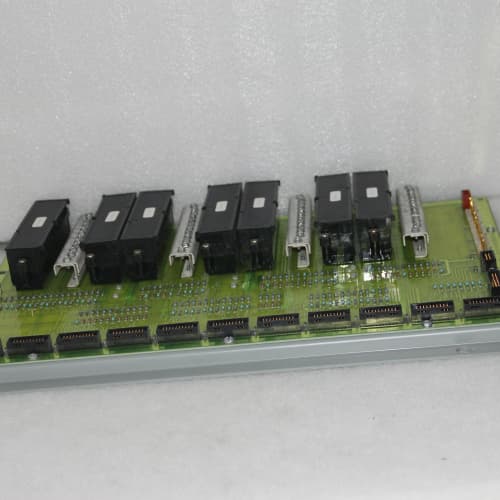
Description
Parameters
-
Input Type: Thermocouple J, K, T (default); E, S, R optional with L1 firmware support
-
Channels: 16 differential (fixed)
-
Resolution: 14-bit ADC, ±0.08°C accuracy (L1 adaptive compensation)
-
Cold Junction: Dual redundant sensors with L1 adaptive drift compensation
-
Isolation: 2500V RMS optical isolation
-
Power: +5V DC @ 1.0A, +15V DC @ 0.3A (requires both rails)
-
Scan Rate: 150ms per channel (L1 optimization)
-
Coating: Heavy conformal coating (suffix H) – multi-layer acrylic with enhanced chemical and moisture resistance (superior to G-grade)
-
Temp Range: -25°C to +80°C (widest range among HFX variants, enabled by H coating)
-
Mounting: 6U VME Eurocard, single-slot
-
Diagnostics: Enhanced onboard with per-channel historical data logging, trend analysis, and adaptive calibration alerts
Advantages & Features
-
Custom configuration (X suffix) allows for specialized firmware, custom scaling, or unique input mapping for non-standard turbine applications
-
L1 firmware offers improved accuracy (±0.08°C), faster scan (150ms), and adaptive cold-junction drift correction that self-calibrates during operation
-
Dual redundant cold-junction sensors with L1 adaptive compensation provide failover reliability and reduced long-term drift
-
H-grade coating provides the highest level of protection – superior resistance to humidity, salt spray, and corrosive chemicals (better than G-grade)
-
Widest temperature range (-25°C to +80°C) among all HFX and HFP variants – suitable for extreme environments
-
Higher isolation (2500V) protects against ground loops and transient surges
-
Front-panel LEDs for per-channel status, open-circuit, over-range, and adaptive calibration alerts
Application Cases
-
Offshore platforms with severe salt spray, high humidity, and corrosive atmospheric conditions requiring custom firmware
-
Chemical processing plants with corrosive gas exposure (sulfur, chlorine, ammonia) and specialized sensor requirements
-
Extreme environment turbine enclosures (desert heat, arctic cold) with custom temperature monitoring needs
-
Critical turbines where both custom configuration and maximum environmental protection are mandatory
-
Retrofit projects in demanding locations replacing older boards with H-coated variants for extended service life
Competitor Comparison
-
vs. DS3800HFXB1L1G (L1/G variant): Superior coating (H vs. G), wider temp range (-25°C vs. -20°C, +80°C vs. +75°C) – otherwise identical
-
vs. DS3800HFXB1K1G (K1/G variant): Better accuracy (±0.08°C vs. ±0.085°C), faster scan (150ms vs. 160ms), adaptive CJC (L1), and better coating (H vs. G)
-
vs. DS3800HFXB (standard X/B variant): Significant upgrades – better accuracy, faster scan, dual CJC, higher isolation, H coating, widest temp range
-
vs. DS3800HFPG1D1G (G variant): Fewer channels (16 vs. 32), but custom X firmware, L1 adaptive compensation, and superior H coating (vs. G) – best protection available
-
vs. DS3800HFPC1M1H (C/M1/H variant): Similar channel count, but custom firmware, adaptive CJC, and H coating – X variant offers unique customization; M1 has faster scan (120ms vs. 150ms) and slightly better accuracy (±0.07°C vs. ±0.08°C)
-
vs. ABB TB711 : Similar channel count, but HFXB1L1H offers custom firmware, adaptive CJC compensation, superior H-grade protection, higher isolation, and wider temp range
-
vs. Siemens 7MH410 : Custom firmware capability and superior H-grade coating, but lacks digital communication interfaces
-
vs. Woodward 8440-2015 : Best-in-class environmental protection (H-grade), adaptive compensation, and custom configuration options, but Woodward offers more flexible software configuration
-
vs. Honeywell 51304638 : Superior H-grade coating, widest temp range, adaptive CJC, and custom firmware capability
Selection Suggestions
-
Critical: Obtain the exact firmware specification for the “X” variant – this is a custom configuration; standard documentation may not fully apply
-
Confirm your backplane provides both +5V and +15V – this board requires both rails
-
Verify thermocouple type and scaling requirements match the custom L1 firmware configuration
-
Assess if L1 firmware’s adaptive cold-junction drift correction is beneficial – particularly valuable in environments with fluctuating ambient temperatures
-
Select H-grade coating if your environment has: severe salt spray, chemical exposure (sulfur, chlorine, ammonia), continuous high humidity, or extreme temperature fluctuations
-
Check scan rate requirement – 150ms is suitable for most time-critical temperature monitoring
-
Order mating front connector (verify p/n with GE – custom X variants may have different pinouts)
-
For critical applications, request the firmware revision, calibration data, and custom configuration sheet from the supplier
Precautions
-
Critical: “X” suffix indicates custom configuration – do not assume standard parameters apply; verify all specifications with the manufacturer or supplier
-
Critical: Requires both +5V and +15V – do not install in slots without +15V supply
-
Critical: Verify firmware compatibility with your turbine control logic – custom firmware may require specific logic updates
-
Allow 45–60 minute warm-up before calibration (H coating significantly affects thermal equilibrium; allow 60 minutes for best accuracy)
-
L1 adaptive compensation requires a stabilization period – allow several hours of operation before relying on calibrated readings
-
H coating provides the highest level of protection but is not suitable for direct immersion, heavy chemical spills, or continuous liquid exposure – consult GE for extreme conditions
-
Use thermocouple-grade extension wire – copper wire causes significant measurement errors
-
Store in ESD-safe packaging – edge connector is static-sensitive
-
Periodically check CJC sensor accuracy every 2 years (dual sensors should agree within 0.5°C)
-
Do not hot-swap – Mark IV backplanes require power-off for insertion/removal
-
If replacing a standard DS3800HFPB or DS3800HFPC board, verify pinout compatibility – X variants may have different wiring assignments
-
For R-type sensors, ensure extension wire is R-type compatible (platinum-rhodium alloy) – using copper wire causes significant errors
-
H coating makes component-level repairs extremely difficult or impossible – consider board replacement instead of repair
SIEMENS 6ES7307-1KA02-0AA0
SCHNEIDER 140CPS12400
GE IC694MDL753
A-B 1756-OB32

Reviews
There are no reviews yet.