
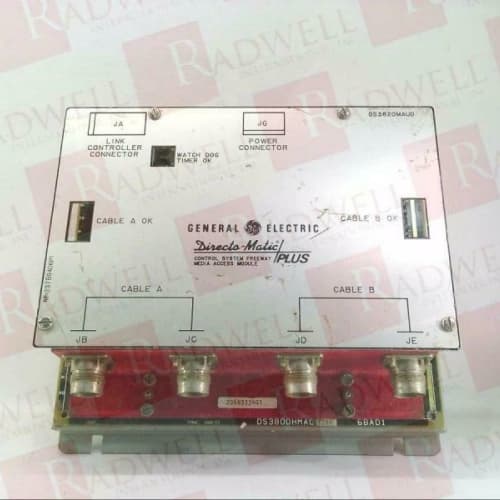
Description
Parameters
-
Input Type: Thermocouple J, K, T (default); E, S, R optional with factory configuration
-
Channels: 32 differential (highest density in HFP family)
-
Resolution: 14-bit ADC, ±0.09°C accuracy
-
Cold Junction: Dual redundant sensors with D1 drift compensation
-
Isolation: 2500V RMS optical isolation
-
Power: +5V DC @ 1.5A, +15V DC @ 0.5A (higher consumption due to 32 channels)
-
Scan Rate: 280ms per channel (D1 optimization)
-
Coating: Heavy conformal coating (suffix G) – multi-layer acrylic with enhanced chemical and moisture resistance (superior to C and D)
-
Temp Range: -20°C to +75°C (widest among HFPG variants)
-
Mounting: 6U VME Eurocard, single-slot
-
Diagnostics: Enhanced onboard with per-channel historical data logging
Advantages & Features
-
32-channel capacity provides maximum I/O density – significantly reduces board count in large turbine cabinets
-
D1 firmware balances accuracy, speed, and stability – better than older revisions without the complexity of M1 adaptive algorithms
-
G-grade coating offers superior resistance to humidity, salt spray, and mild chemical exposure – ideal for challenging indoor and semi-outdoor environments
-
Dual redundant cold-junction sensors provide failover reliability
-
Broad thermocouple support (J/K/T default; E/S/R optional) – flexible for mixed-sensor installations
-
Higher isolation (2500V) protects against ground loops and transient surges
-
Widest temperature range (-20°C to +75°C) among HFPG variants – suitable for extreme ambient conditions
-
Front-panel LEDs for per-channel status, open-circuit, and over-range detection
Application Cases
-
Large-frame gas turbines (Frame 9E/9F/9H) in coastal or industrial areas with salt spray and chemical exposure
-
Combined-cycle plants with frequent humidity, steam leaks, or mild chemical contaminants
-
Upgrade projects replacing multiple DS3800HFPC or DS3800HFPE boards with one DS3800HFPG1D1G to free up backplane slots
-
Semi-outdoor turbine enclosures with temperature fluctuations and environmental exposure
-
Retrofit from DS3800HFPG1D1C or DS3800HFPG1D1D where superior environmental protection is needed
Competitor Comparison
-
vs. DS3800HFPG1D1D (D coating): Superior chemical and moisture resistance, wider temp range (-20°C vs. -15°C, +75°C vs. +70°C) – otherwise identical
-
vs. DS3800HFPG1D1C (C coating): Significantly better environmental protection, wider temp range, and superior chemical resistance
-
vs. DS3800HFPG (standard G variant): Better accuracy (±0.09°C vs. ±0.1°C), faster scan (280ms vs. 300ms), G coating (vs. basic), wider temp range, and redundant CJC
-
vs. DS3800HFPG1B1B (B1/B variant): Better accuracy, faster scan, G coating, wider temp range, and broader type support
-
vs. DS3800HFPE1D1C (E variant): More channels (32 vs. 24), broader type support (R-type optional), superior coating, but slower scan (280ms vs. 180ms) and higher power consumption
-
vs. DS3800HFPC1M1H (C/M1/H variant): More channels (32 vs. 16), broader type support, higher isolation, redundant CJC, better coating, but requires +15V and slower scan (280ms vs. 120ms)
-
vs. ABB TB711 : Much higher channel density (32 vs. 16), broader type support, superior coating, but significantly slower scan (280ms vs. 100ms)
-
vs. Siemens 7MH410 : More channels, flexible multitype support, and superior environmental protection, but lacks digital communication interfaces
-
vs. Woodward 8440-2021 : Better channel density, broader type support, and superior coating protection
-
vs. Honeywell 51304731 : Higher channel count, multitype support, and superior chemical/moisture resistance
Selection Suggestions
-
Confirm your backplane provides both +5V and +15V with sufficient current capacity (+5V @ 1.5A, +15V @ 0.5A)
-
Verify thermocouple types – D1 supports J/K/T natively; E/S/R require factory or jumper configuration
-
Assess channel count – if you need >24 channels, DS3800HFPG1D1G is the most cost-effective GE Mark IV solution with maximum environmental protection
-
Evaluate environmental conditions – G coating is suitable for frequent humidity, salt spray, and mild chemical exposure; choose H coating (if available) for offshore, heavy chemical, or continuous condensation environments
-
Check scan rate requirement – 280ms is acceptable for most temperature monitoring (alarms typically need <1s)
-
Ensure isolation level – 2500V is recommended for severe ground loop conditions
-
Order mating front connector (p/n 531X180SPAANG7 – specific to 32-channel HFPG pinout)
-
For critical applications, purchase with a calibration certificate and 12-month warranty
Precautions
-
Critical: Requires both +5V and +15V with higher current – verify power supply capacity before installation
-
Critical: 32-channel configuration may exceed addressing limits of older Mark IV cabinets – verify turbine control logic supports 32-input boards
-
Critical: Verify thermocouple type configuration – E/S/R require specific linearization tables; confirm settings before commissioning
-
Allow 30-minute warm-up before calibration (G coating may affect thermal equilibrium; allow 45 minutes for best accuracy)
-
G coating provides excellent protection but is not suitable for direct immersion, heavy chemical spills, or continuous condensation – consult GE for extreme conditions
-
Use thermocouple-grade extension wire – copper wire causes significant measurement errors
-
Store in ESD-safe packaging – edge connector is static-sensitive
-
Periodically check CJC sensor accuracy every 2 years (dual sensors should agree within 0.5°C)
-
Do not hot-swap – Mark IV backplanes require power-off for insertion/removal
-
If replacing multiple DS3800HFPC or DS3800HFPE boards, rewire front connector carefully (pinout differs for 32 channels)
-
For R-type sensors, ensure extension wire is R-type compatible (platinum-rhodium alloy) – using copper wire causes significant errors
-
G coating may make component-level repairs difficult – consider board replacement instead of repair
Phoenix Contact QUINT-PS-3AC/24DC/10 – 2866705
OMRON DRT1-DA02

Reviews
There are no reviews yet.