
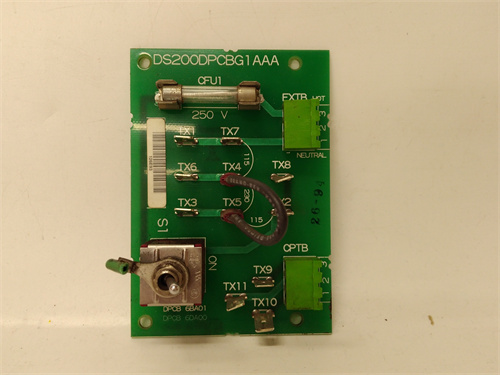
Description
Detailed Technical Parameters
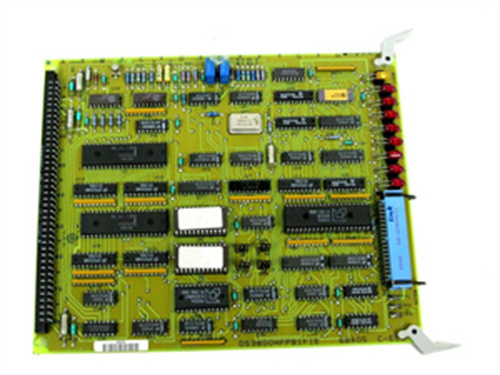
GE DS200TVCOG1A typically offers 9 individually configurable input channels, each selectable via onboard jumpers or DIP switches for either thermocouple types (J, K, T, or E) or high-level voltage signals (0–10V DC, or 4–20mA with an external 250Ω shunt resistor). The onboard high-precision cold junction compensation sensor (a PT100 RTD) combined with a dedicated ASIC achieves full-scale measurement accuracy of ±0.1%, significantly outperforming general-purpose PLC modules which typically hover around ±0.5%. Input impedance reaches 10MΩ in voltage mode and 100kΩ in thermocouple mode, minimizing signal loading on weak millivolt-level sources. The board interfaces with field wiring through two rugged 37-pin D-sub military-grade connectors and incorporates 1500V optical isolation along with transient voltage suppression (TVS) diodes, providing robust protection against industrial surges, ESD events, and common-mode interference common in turbine environments. Operating temperature spans -30°C to +65°C with 95% non-condensing humidity tolerance, fully complying with IEC 60721-3-3 class 3K5 harsh environment ratings. Power consumption is approximately 12W drawn from +5V DC and ±15V DC rails supplied by the Mark V backplane, with a default channel scan cycle of 100ms that can be accelerated to 10ms via software configuration for fast-responding thermal protection loops.
Advantages & Features
GE DS200TVCOG1A possesses several distinct advantages that set it apart in the turbine control arena. First and foremost, it inherits the triple-redundant fault-tolerant philosophy of the Mark V platform—each channel features independent fault detection logic that identifies open thermocouple, short-circuit, or out-of-range conditions, immediately flags the anomaly in the operator workstation, and automatically excludes the faulty channel from voting algorithms without disrupting adjacent channels. This is absolutely critical in gas turbine exhaust temperature monitoring, where 24 or more thermocouples are typically arranged in radial sectors, and the Mark V controller computes average sector temperatures as well as exhaust temperature spread (ETS) to protect against flame-out or hot spots. Secondly, GE DS200TVCOG1A incorporates intelligent digital filtering with a 50/60Hz notch filter and adjustable sampling rates (10ms to 1s) via the CIMPLICITY or Toolbox engineering software, allowing engineers to fine-tune the trade-off between noise suppression and response speed. Thirdly, the onboard EEPROM stores individual calibration coefficients and cold junction offset values for each channel, meaning that when you replace a failed GE DS200TVCOG1A with a new spare, you do not need to perform a cumbersome field recalibration—simply plug in the new board, and the Mark V processor automatically restores the stored parameters from the board’s memory, slashing maintenance downtime from hours to minutes. Additionally, the PCB is manufactured with FR-4 flame-retardant material and features gold-plated edge connectors, with vibration resistance rated at 5G (10–500Hz) and shock tolerance at 30G, ensuring stable electrical connections even in the high-vibration environment adjacent to a 200-ton rotating turbine shaft.
Application Cases & Industry Fields
GE DS200TVCOG1A is deployed in over 100,000 GE Frame 3/5/6/7/9 series heavy-duty gas turbines and D11/D16 steam turbines globally. In one typical 2×400MW combined-cycle power plant, each gas turbine utilizes four GE DS200TVCOG1A boards providing 36 total channels to monitor turbine exhaust temperature (TET). The Mark V controller executes a 2-out-of-3 voting logic across redundant TMR channels, calculating exhaust temperature spread and average values to precisely modulate fuel control valves, ensuring combustion stability and meeting stringent NOx emission limits below 25ppm. Beyond power generation, this board finds extensive use in refinery FCC units (Fluid Catalytic Cracking) where flue gas expanders and main air blowers require continuous bearing metal temperature surveillance—the rapid response of GE DS200TVCOG1A prevents rotor thermal bowing and catastrophic bearing seizure events. In the oil and gas pipeline sector, GE DS200TVCOG1A is frequently applied to capture inlet guide vane (IGV) position feedback signals, feeding into the Mark V anti-surge control algorithm that dynamically adjusts compressor speed and inlet flow to avoid damaging surge conditions. Nuclear auxiliary systems, such as feedwater heaters and main steam bypass stations, also rely on GE DS200TVCOG1A for multi-point temperature scanning, leveraging its high channel-to-channel isolation to maintain electrical separation between safety-grade and non-safety-grade signal paths. Offshore platforms in the North Sea have documented average operational lifetimes of 8 to 10 years for GE DS200TVCOG1A units, thanks to the conformal coating applied to protect against salt spray corrosion and the wide-temperature performance that withstands both arctic winters and tropical engine room heat.
Competitor Comparison
When benchmarked against competing turbine I/O solutions, GE DS200TVCOG1A faces direct rivals such as Siemens S7-400 SM331 (6ES7331-7KF02-0AB0), Emerson Ovation 1C31234G01, and Honeywell FSC TC-IAO1H. In raw thermocouple accuracy, GE DS200TVCOG1A‘s ±0.1% surpasses the Siemens SM331’s ±0.3% and the Emerson unit’s ±0.25%, making it the preferred choice for high-precision temperature differential calculations like exhaust spread monitoring. In terms of redundancy architecture, GE DS200TVCOG1A natively supports TMR channel-level voting without requiring external multiplexers or relay switching, whereas the Siemens and Honeywell alternatives rely on module-level redundancy (requiring duplicate entire I/O modules), which is more expensive and less granular. However, GE DS200TVCOG1A lags behind competitors in protocol flexibility—it is locked into the proprietary Mark V backplane communication and cannot directly interface with Profibus DP, Modbus TCP, or EtherNet/IP networks unless paired with expensive gateway converters. The Siemens SM331, by contrast, offers broader integration with standard industrial networks and is programmable via TIA Portal, appealing to users migrating away from legacy GE systems. Cost-wise, GE DS200TVCOG1A typically commands a premium in the aftermarket due to its specialized application, often priced 30–50% higher than a comparable new-generation universal thermocouple module, but its long field-proven track record and GE’s extensive global service network justify the investment for mission-critical turbine assets.
Selection Suggestions
When selecting GE DS200TVCOG1A for your application, first verify that your control system is indeed a GE Mark V or early Mark VI (pre-2010) platform, as the board is physically and electrically incompatible with Mark VIe or any third-party PLC such as Allen-Bradley ControlLogix or Schneider Modicon. If you are upgrading to Mark VIe, you will need the newer I/O pack series (e.g., IS200TBCIH or IS200TVBAH) instead. Second, confirm your signal types: if you have exclusively thermocouple inputs and require TMR voting, GE DS200TVCOG1A is the correct and most cost-effective choice; if you have mixed analog signals (e.g., 4–20mA transmitters plus thermocouples), consider adding external signal conditioners or selecting a different board variant like DS200TCQAG or DS200TCTGG. Third, pay attention to the revision suffix—while GE DS200TVCOG1A is the base model, later revisions such as DS200TVCOG1B or DS200TVCOG1C feature improved cold-junction compensation algorithms and updated firmware for faster startup initialization. These revisions are fully backward-compatible and can be used as direct replacements, so when sourcing spares, prioritize newer revision numbers to benefit from GE’s continuous improvement efforts. Fourth, always request a calibration certificate with traceable NIST standards when purchasing refurbished or surplus units, and verify that the board has been stored in a controlled environment (-40°C to +85°C) to prevent electrolytic capacitor degradation. Finally, maintain at least one spare GE DS200TVCOG1A in your critical spares inventory, as lead times for new manufacturing can extend to 12–16 weeks, while emergency exchanges through GE’s Rapid Response program are significantly more expensive.
Critical Precautions
Deploying GE DS200TVCOG1A requires strict adherence to several field-proven precautions to avoid premature failure or measurement errors. First, wiring discipline is paramount—thermocouple extension wires must use the correct compensating cable type (matching the thermocouple alloy), polarity must be observed (+ and – terminals), and the cable shield should be grounded at the sensor side only, never at the GE DS200TVCOG1A terminal side, to prevent ground loop currents that can introduce 50/60Hz hum and offset drift. Second, while the board supports hot-swapping in a Mark V chassis equipped with the optional live-maintenance backplane, standard practice is to de-energize the entire rack before insertion or removal. If you must perform online replacement, wait at least 30 seconds after power-down for internal capacitors to discharge, then reapply power and initiate a manual channel self-test via the engineering workstation to confirm all nine channels report valid status before returning the turbine to automatic mode. Third, the cold junction compensation sensor is physically located on the lower-right corner of the PCB—ensure that this area is not exposed to direct heat radiation from adjacent power resistors, transformers, or forced-air heater outlets inside the control cabinet. If cabinet thermal gradients exceed 5°C across the board, consider installing a thermal isolation shield or rerouting airflow to equalize temperatures, otherwise your measured cold junction temperature may deviate from the actual terminal block temperature, introducing systematic errors of up to ±1.5°C. Fourth, perform a five-point linearity calibration using a precision thermocouple simulator every two years, or more frequently if the turbine experiences frequent thermal cycling. If any channel exhibits a deviation exceeding ±0.3% of full scale after calibration, immediately replace GE DS200TVCOG1A rather than applying software offsets, as drifting performance often precedes catastrophic capacitor or optocoupler failure. Fifth, always handle the board by its edges to avoid ESD damage to the gold-plated edge connectors and onboard CMOS components—use a grounded wrist strap and anti-static bags for transportation and storage. Finally, when disposing of a failed GE DS200TVCOG1A, follow local WEEE regulations, as the board contains small amounts of lead in solder and rare-earth elements in the precision resistors; do not incinerate or landfill without proper treatment. Remember that over 80% of reported “board failures” in GE service records actually trace back to faulty field thermocouples, damaged extension cables, or poor termination practices—so before condemning GE DS200TVCOG1A, always test the entire sensor loop from the probe tip to the board connector using a handheld calibrator, and verify that the terminal screw torques meet GE’s specification of 0.5–0.6 N·m to prevent loose connections that mimic signal dropout.
RPSTECH DMP10.24
HIMA F7553
HIMA F7553
KOLLMORGEN CR06561-MZ


Reviews
There are no reviews yet.