
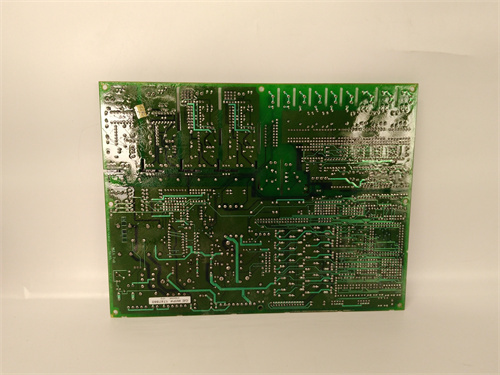
Description
Technical Parameters
Manufacturer: GE
Series: Mark V / Mark VIe
Channels: 16 differential
Input Range: -10 mV to +100 mV (Type J/K/T/E)
Cold Junction: Single onboard sensor with enhanced linearization and thermal isolation
Isolation: 1500V AC
Accuracy: ±0.08% at 25°C, ±0.15% across full temperature range
Sampling: 10 Hz sequential
Temp Range: -30°C to +65°C (operating), -40°C to +85°C (storage)
Mounting: VME rack
Suffix “G1A”: Enhanced accuracy + G1 wiring + extended diagnostics (including drift monitoring and sense-lead integrity) + fixed firmware
Key Features
Enhanced accuracy – ±0.08% for high-precision temperature monitoring
Extended diagnostics – includes drift monitoring, degradation prediction, and sense-lead integrity checks (beyond basic open/short detection)
Faster sampling – 10 Hz for responsive monitoring
Improved cold-junction compensation – stable readings across ambient temperature variations
Self-diagnostics – open-circuit, short-circuit, drift, and sense-lead fault detection
Simple swap – no firmware changes required in most Mark V systems
LED status per channel + board health, with extended diagnostic indicators
Standard conformal coating for moisture/dust resistance
Backward compatible with Mark V and Mark VIe (hot-swap only on VIe Rev D+)
Applications
Gas turbine EGT monitoring – tight accuracy with predictive diagnostics for early fault detection
Steam turbine bearing and casing temperatures – critical protection with drift monitoring to anticipate sensor degradation
Generator stator cooling monitoring – precision measurement with diagnostic assurance
HRSG temperature measurements – enhanced reliability for efficiency-critical points
Critical compressor applications – where sensor degradation cannot be tolerated
Comparison with Competitors
| Feature | DS200TCPDG1A |
ABB TTH300 | Siemens 7KG7750 |
|---|---|---|---|
| Channels | 16 | 8 | 12 |
| Accuracy | ±0.08% | ±0.10% | ±0.12% |
| Sampling | 10 Hz | 10 Hz (simultaneous) | 8 Hz (simultaneous) |
| Diagnostics | Drift + degradation + open/short | Group-level | Per-channel + HART |
| Temp Range | -30°C to +65°C | -25°C to +65°C | -20°C to +60°C |
| Hot-Swap | No (V) / Yes (VIe) | No | Yes |
| GE Native Integration | Yes | No | No |
Selection Tips
Choose the DS200TCPDG1A if you need high accuracy (±0.08%) with extended diagnostics (drift/degradation) but only require G1 wiring and standard temperature range
For the same diagnostics with extreme temperature range and/or enhanced coating, consider DS200TCDAH1BGD (4-wire) or DS200TCDAG1ADA (2-wire with extended diagnostics)
For basic accuracy with extended diagnostics, consider DS200TCDAG1ADA (±0.12% with drift monitoring)
For high accuracy without extended diagnostics, the DS200TCPAG1A is more economical
Source refurbished units with diagnostic test verification and drift calibration records
Precautions
ESD sensitive – use wrist strap
Power down for Mark V removal (no hot-swap)
Torque terminals to 0.5 N·m max
Do not exceed -30°C to +65°C operating range
Calibrate every 24 months – extended diagnostics depend on valid baseline calibration
Ground shields only at the board end
Verify thermocouple type – optimized for J/K (T/E reduces accuracy to ±0.15%)
Monitor diagnostic logs – drift warnings indicate sensor aging; plan proactive replacement
Label clearly – mark as “G1A EXTENDED DIAG” to ensure proper handling and maintenance tracking
CUTLER-HAMMER E111A12X3N
SCHNEIDER 140NOE77101
A-B SST-PFB-SLC
GE IC695CPU310-GV

Reviews
There are no reviews yet.