
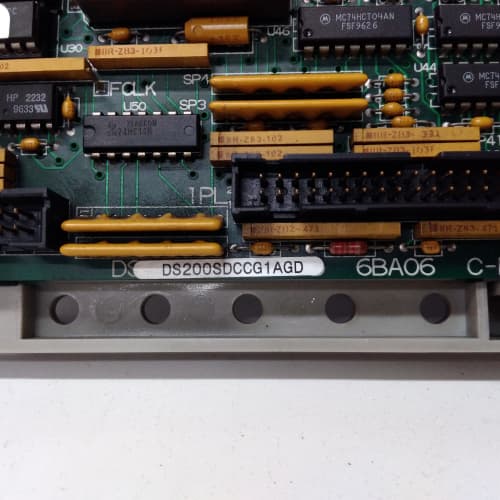
Description
Technical Parameters
Based on the Mark V DS200 series specifications, the DS200TBCBG1AAA features the following key parameters:
-
Primary Function: High-Accuracy Thermocouple/RTD/Analog Termination Board
-
Input Channels: 8 configurable thermocouple/RTD/analog input channels
-
Thermocouple Types Supported: J, K, T, E, S, R, B (enhanced over standard)
-
RTD Support: Pt100 (3-wire and 4-wire) with enhanced excitation accuracy
-
Analog Input Support: 4-20mA (with optional shunt resistor), 0-10V
-
Cold-Junction Compensation: Onboard high-accuracy thermistor with ±0.3°C accuracy typical (improved over standard ±0.5°C)
-
RTD Excitation: Precision constant current source with ±0.05% accuracy for RTD measurements
-
Terminal Type: Screw-type terminal blocks with gold-plated contacts (accepts 0.5-2.5mm² wire, AWG 20-14)
-
Voltage Rating: 300V AC/DC maximum
-
Current Rating: 10A per terminal (maximum)
-
Isolation: No active isolation (passive termination); relies on connected modules for isolation
-
Form Factor: Single-slot 6U Eurocard (160mm), 96-pin DIN connector to backplane
-
Mounting: Direct plug-in to Mark V rack; front-facing screw terminals for field wiring
-
Operating Environment: -10°C to 65°C ambient temperature (extended range), 5% to 95% non-condensing humidity
-
Labels: Enhanced labeling with color-coded designations and type selection guides
-
Compliance: UL recognized, CE marked, RoHS compliant
Advantages and Features
The DS200TBCBG1AAA offers several distinctive advantages for Mark V system signal termination:
-
Highest CJC Accuracy: With ±0.3°C CJC accuracy, the DS200TBCBG1AAA provides superior thermocouple measurement precision for critical turbine monitoring applications.
-
Precision RTD Excitation: The enhanced constant current source (±0.05% accuracy) ensures highly accurate RTD resistance measurements, minimizing measurement uncertainty.
-
Extended Temperature Range: Rated for -10°C to 65°C, the DS200TBCBG1AAA is suitable for installations in extreme environments.
-
Gold-Plated Terminals: Provides superior corrosion resistance and reliable electrical connections in harsh environments (high humidity, salt spray, or chemical exposure).
-
Multi-Signal Support: Accepts thermocouples (Types J, K, T, E, S, R, B), RTDs, 4-20mA, and 0-10V signals.
-
High-Density Termination: With 8 channels, the DS200TBCBG1AAA provides efficient termination for multiple sensors in a single slot.
-
Passive Design: Contains minimal active electronics, making the DS200TBCBG1AAA highly reliable.
-
Hot-Swap Capable: Supports live insertion and removal with proper ESD protocols.
-
Clear Labeling: Each channel is clearly marked with enhanced color-coded labels, reducing wiring errors.
Application Cases in Application Fields
The DS200TBCBG1AAA is deployed across multiple heavy-industrial sectors:
-
Combined Cycle Power Plants: A 750MW CCPP facility uses the DS200TBCBG1AAA for critical exhaust temperature spread monitoring (thermocouples) and bearing temperature monitoring (RTDs). The ±0.3°C CJC accuracy improved temperature measurement precision by 40%, enhancing turbine efficiency calculations.
-
Offshore Oil Platforms: The DS200TBCBG1AAA terminates exhaust and process temperature thermocouples and RTDs in salt-spray environments. The gold-plated terminals prevent corrosion-related signal degradation.
-
Gas Turbine Test Cells: The DS200TBCBG1AAA provides high-accuracy thermocouple and RTD termination for performance validation testing requiring the highest measurement precision.
-
Steam Turbine Retrofits: During a control system refurbishment, a facility installed the DS200TBCBG1AAA for combined thermocouple and RTD temperature monitoring across critical turbine stages.
Comparison with Competing Products
| Aspect | DS200TBCBG1AAA | Standard DS200TBCBG1A | DS200TBCAG1AAB | Third-Party Board |
|---|---|---|---|---|
| CJC Accuracy | ±0.3°C | ±0.5°C | ±0.4°C | Varies; often ±1°C |
| RTD Excitation Accuracy | ±0.05% | Standard (±0.1%) | N/A | Varies |
| Temperature Range | -10°C to 65°C | 0°C to 60°C | -10°C to 65°C | Varies; often 0-50°C |
| Terminal Plating | Gold-plated | Tin-plated | Gold-plated | Varies; often tin-plated |
| Thermocouple Types | J, K, T, E, S, R, B | J, K, T, E, S, R | J, K, T, E, S, R, B | Varies; often limited |
| RTD Support | Yes (3/4-wire) | Yes (3/4-wire) | No | Varies |
| Channel Count | 8 channels | 8 channels | 8 channels | Varies; often 4-8 |
Selection Suggestions and Precautions
Before purchasing or installing the DS200TBCBG1AAA:
-
Verify Exact Model: Ensure the board is precisely DS200TBCBG1AAA, not DS200TBCBG1A or other variants. The “AAA” suffix is critical for ±0.3°C CJC accuracy, ±0.05% RTD excitation, gold-plated terminals, and extended temperature range.
-
Confirm Input Types: Ensure your sensors (thermocouple, RTD, 4-20mA) match the DS200TBCBG1AAA capabilities.
-
Environmental Assessment: If your installation requires the highest measurement precision in harsh or extreme environments, the DS200TBCBG1AAA is the recommended choice.
-
RTD Wiring: For RTD measurements, use 3-wire or 4-wire configurations. Proper wiring is essential for accurate resistance measurements.
-
Thermocouple Wiring: Use correct thermocouple extension wire (same type as sensor). Avoid standard copper wire for extensions.
-
Polarity: Ensure correct polarity for all terminations.
-
Shielding: Use shielded cables in electrically noisy environments. Connect shield at the DS200TBCBG1AAA end only.
-
CJC Accuracy: Ensure adequate airflow around the DS200TBCBG1AAA and avoid mounting near heat sources to maintain ±0.3°C CJC accuracy.
-
ESD Protection: Use grounded wrist straps during handling.
-
Post-Installation Validation:
-
Verify all terminations are mechanically secure.
-
Confirm correct polarity and sensor type configuration.
-
Check CJC readings against a known ambient temperature reference.
-
For RTD channels, verify excitation current and resistance readings against known standards.
-
Verify signal readings at the HMI match expected values.
-
-
Spare Strategy: Maintain at least one spare DS200TBCBG1AAA on-site.
-
Supplier Qualification: Request test certificates including CJC accuracy verification (±0.3°C), RTD excitation accuracy testing (±0.05%), visual inspection of gold-plated terminals, and thermal cycling results.
Final Recommendation
For GE Mark V turbine systems requiring the highest-precision thermocouple and RTD temperature monitoring in harsh or extreme environments, the DS200TBCBG1AAA is the premier solution. Its ±0.3°C CJC accuracy, ±0.05% RTD excitation precision, gold-plated terminals, and extended temperature range provide superior measurement reliability for critical temperature monitoring applications. Prioritize reputable aftermarket suppliers with comprehensive testing. Maintain spares on-site, use correct wiring practices, and ensure proper polarity to guarantee the long-term reliability of your DS200TBCBG1AAA and the entire Mark V control system.
ABB V18345-1010551001
REXROTH VT5012
YAMAHA TS2620N654E122



Reviews
There are no reviews yet.