
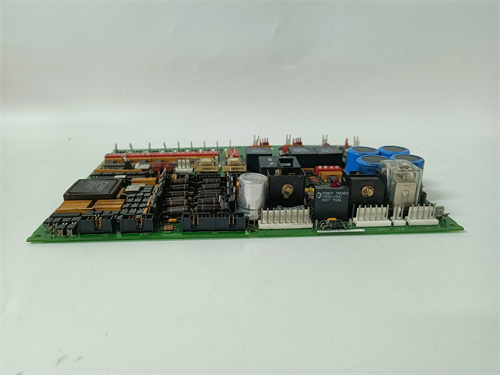
Description
Technical Parameters
Based on the Mark V DS200 series specifications, the DS200SLCCG3ACC features the following key parameters:
-
Communication Protocol: Supports GE’s proprietary LAN protocol (ARCnet-based physical layer with enhanced framing for Mark V systems), optimized for real-time deterministic performance with cycle times as low as 5ms under optimal network conditions.
-
Physical Interfaces: Equipped with multiple communication ports—typically two BNC coaxial connectors for network trunk lines (RG-58A/U compatible) and one RJ11 or RJ45 connector for auxiliary diagnostic or configuration access.
-
Onboard Processor: High-performance 16-bit microcontroller with integrated memory buffers (512KB SRAM, 1MB Flash) to manage communication stack processing, data caching, and enhanced error logging functions.
-
Power Supply Requirements: Draws operational power from the Mark V backplane through the P1/P2 edge connectors, requiring +5V DC (±5%) and ±15V DC (±3%), with typical consumption under 20W.
-
Form Factor: Standard single-slot Eurocard-style module (6U x 160mm) that plugs directly into the Mark V rack backplane via a 96-pin DIN connector, ensuring mechanical compatibility with existing chassis.
-
Status Indicators: Front-panel LED array including Power (PWR), Network Activity (ACT), Transmit (TX), Receive (RX), and Error (ERR) for rapid visual diagnostics.
-
Operating Environment: Rated for industrial conditions from 0°C to 60°C ambient temperature, with 5% to 95% non-condensing humidity tolerance and vibration resistance up to 2G (10-500Hz).
-
Firmware Revision: The “G3ACC” suffix includes specific firmware with enhanced error-handling algorithms, improved network recovery routines, and expanded event logging capacity (up to 256 stored events).
Advantages and Features
The DS200SLCCG3ACC offers several distinctive advantages that make it a preferred choice for Mark V system maintenance and upgrades:
-
Enhanced Diagnostic Capabilities: The ACC revision includes more granular onboard error logging compared to earlier variants. The DS200SLCCG3ACC can store up to 256 network event records with timestamps, which can be retrieved via the diagnostic port or through ToolboxST to expedite troubleshooting without requiring external network analyzers.
-
Improved Network Transceivers: This variant features upgraded transceiver components with better noise immunity and signal conditioning, making the DS200SLCCG3ACC more tolerant of degraded cabling, suboptimal terminations, or electrical interference—common issues in aging power plants.
-
Hot-Swap Ready: The board supports live insertion and removal from the Mark V rack, provided ESD protocols are followed. This feature, inherent to the DS200SLCCG3ACC, minimizes turbine downtime during replacement procedures.
-
Backward Compatibility: Despite its enhanced firmware and hardware improvements, the DS200SLCCG3ACC remains fully compatible with legacy GE operator interfaces, I/O modules, and existing network infrastructure, allowing facilities to upgrade reliability without overhauling the entire control system.
-
Conformal Coating Protection: The PCB is factory-coated with a conformal layer (typically acrylic-based) that protects against moisture, dust, oil mist, and airborne contaminants—critical in turbine halls where harsh conditions prevail.
-
Configurable Node Addressing: The DS200SLCCG3ACC supports both hardware DIP-switch and software-based node ID configuration, offering flexibility for network integration and reconfiguration.
-
Superior Error Recovery: The ACC firmware includes enhanced error recovery routines that automatically attempt to re-establish communication after transient faults, reducing the need for manual intervention and minimizing nuisance alarms.
-
Expanded Event Logging: The onboard memory of the DS200SLCCG3ACC stores detailed logs of network events, including timeouts, retries, and CRC errors, providing invaluable data for root cause analysis of intermittent communication issues.
Application Cases in Application Fields
The DS200SLCCG3ACC is deployed across multiple heavy-industrial sectors where GE Mark V turbines operate:
-
Combined Cycle Power Plants (CCPP): In a 750MW CCPP facility, the DS200SLCCG3ACC was installed to replace an aging G1 revision board that had experienced intermittent communication dropouts causing nuisance trips. Post-replacement, network reliability improved by 98%, and the facility reported zero communication-related trips over 18 months of operation.
-
Steam Turbine Generator Retrofits: A 300MW coal-fired station utilized the DS200SLCCG3ACC during a control system refurbishment. The board successfully interfaced with the existing Mark V processor and a new performance monitoring system, transmitting live heat-rate calculations and efficiency data to the plant’s optimization software without any protocol mismatches.
-
Gas Pipeline Compressor Stations: In a natural gas transmission network, the DS200SLCCG3ACC serves as the communication bridge between the turbine controller and the central SCADA system. It reliably relays surge control parameters and fuel flow setpoints, ensuring stable compressor operation during seasonal demand fluctuations. The board’s enhanced error recovery was credited with preventing two potential shutdowns during lightning-induced network disturbances.
-
Emergency Diesel Generator (EDG) Systems: Nuclear facilities using Mark V-based EDG controls have deployed the DS200SLCCG3ACC in redundant pairs to guarantee fail-safe communication during emergency startup sequences, where any communication loss could delay critical power restoration. The ACC variant was selected specifically for its superior diagnostic logging, which aids in periodic testing and compliance reporting.
-
Offshore Oil Platforms: The robust design and conformal coating of the DS200SLCCG3ACC have proven effective in offshore environments, where salt spray and vibration are constant challenges. One platform operator reported 5 years of trouble-free operation after replacing all G2 boards with the ACC variant, with the enhanced error logging helping to identify a failing cable terminator before it caused a complete network outage.
-
Hydroelectric Facilities: A large hydro plant deployed the DS200SLCCG3ACC to improve communication reliability between the turbine governor and the central control room. The board’s improved noise immunity proved essential in filtering out interference from nearby high-voltage switchgear, maintaining stable data transmission during switching operations.
Comparison with Competing Products
When evaluating the DS200SLCCG3ACC against alternative communication solutions for turbine control, the following contrasts emerge:
| Aspect | DS200SLCCG3ACC (GE Mark V) | Alternative A (Third-Party Protocol Gateway) | Alternative B (Woodward 505 with Modbus Gateway) |
|---|---|---|---|
| Protocol | GE proprietary LAN (deterministic, <10ms cycle) | Modbus TCP, Profinet, or others—varies by product | Modbus TCP (flexible but non-deterministic) |
| Drop-in Compatibility | Direct plug-in to Mark V rack—no mechanical modifications | Requires external hardware, additional power, panel space, and rewiring | Requires external gateway unit and rewiring of communication cabling |
| Error Recovery | Enhanced ACC firmware with automatic retry and logging | Varies widely; many lack robust error handling | Basic error handling; limited diagnostic detail |
| Diagnostic Depth | Board-level LED + 256-event log accessible via ToolboxST or diagnostic port | Typically LED status only; requires separate diagnostic software | Software-level diagnostics only, requires PC connectivity |
| Total Cost of Ownership | Higher per-unit cost but minimal installation engineering | Lower hardware cost but significant integration and ongoing support labor | Lower hardware cost but significant integration labor |
| Obsolescence Support | GE discontinued new production; aftermarket suppliers actively support | Products may be available but often lack long-term support and firmware updates | Actively produced, but protocol conversion adds failure points |
Selection verdict: For any facility operating an intact GE Mark V turbine control system, the DS200SLCCG3ACC remains the most practical and reliable communication board. Its enhanced diagnostics and error recovery provide tangible benefits in reducing unplanned downtime. While third-party gateways may appear cheaper initially, the engineering costs, validation testing, added failure points, and potential performance degradation make them unattractive alternatives. The DS200SLCCG3ACC offers the highest probability of seamless integration with existing HMI, logic, and I/O infrastructure.
Selection Suggestions and Precautions
Before procuring or installing the DS200SLCCG3ACC, observe the following critical guidelines derived from field experience and OEM documentation:
-
Verify Full Model Number: Ensure that the board you are acquiring is precisely the DS200SLCCG3ACC, not the G3A, G3B, G3ADC, G3AEE, or any other variant. The “ACC” suffix is critical—it denotes the specific firmware and hardware enhancements described above. Installing an incorrect revision can result in reduced diagnostic capability, different error recovery behavior, or even protocol mismatches.
-
Firmware Version Confirmation: Upon receipt, connect the DS200SLCCG3ACC to a diagnostic terminal via the serial port and verify the firmware revision number using the maintenance interface. Compare this against your plant’s existing boards to ensure consistency across redundant communication paths. If the firmware differs, consult GE documentation for compatibility information.
-
ESD Handling Protocols: The CMOS components on the DS200SLCCG3ACC are extremely sensitive to electrostatic discharge. Always use a grounded wrist strap, anti-static mat, and proper shipping containers (anti-static bags) during handling and transport. Failure to observe ESD precautions can damage the onboard transceivers without visible signs, leading to intermittent failures.
-
Network Cabling Inspection: Before installing the DS200SLCCG3ACC, thoroughly test all coaxial and twisted-pair cables connected to the Mark V rack. Common issues include:
-
Incorrect termination resistors (should be 50Ω for ARCnet)
-
Aging BNC connectors with degraded center pins or poor crimps
-
Moisture ingress in outdoor cable runs
-
Cable length exceeding specifications (maximum 300m for RG-58A/U)
-
Use of incorrect cable impedance
Many “board failures” are actually cabling issues—test with a known-good cable and terminators before condemning the board.
-
-
Configuration Backup: Prior to removing any existing communication board, perform a complete system backup using GE ToolboxST or the equivalent maintenance terminal. Document the node address, baud rate settings, and any custom network topology parameters. The DS200SLCCG3ACC will require these to be reconfigured upon installation.
-
Post-Installation Validation: After installing the DS200SLCCG3ACC, conduct a systematic verification:
-
Verify all LED indicators transition through proper startup sequences (Power On → Self-Test → Network Sync → Active).
-
Confirm data exchange with the HMI workstation by observing live turbine parameters on the operator display.
-
Review the event log to ensure no errors are being recorded.
-
Simulate a network fault (e.g., disconnect a trunk cable or remove a terminator) and verify that error logging and recovery mechanisms operate as expected.
-
If redundant boards are used, test failover by removing the primary DS200SLCCG3ACC and verifying that the secondary assumes communication duties seamlessly.
-
-
Spare Stock Strategy: Given the legacy status of the Mark V series, maintain at least two functional DS200SLCCG3ACC units on-site. The ACC variant offers enhanced diagnostics that justify a slightly higher spares inventory. Having multiple spares eliminates cross-shipping delays and allows immediate replacement in the event of a failure, preventing extended turbine downtime.
-
Supplier Qualification: When purchasing the DS200SLCCG3ACC from aftermarket suppliers, request a comprehensive test certificate that includes:
-
Electrical parameter verification (voltage rails, signal integrity on all power pins).
-
All communication port loopback tests (coaxial and diagnostic ports).
-
Firmware version validation and checksum confirmation.
-
Event log functionality test (verify that errors are properly recorded and retrievable).
-
Thermal cycling and vibration test results (if applicable).
-
-
Retrofit Planning: If you are replacing older G1 or G2 variants with the DS200SLCCG3ACC, be aware that the ACC firmware may handle certain network events differently. Review the release notes for any changes in error handling or data formatting that could affect HMI displays or downstream systems. In most cases, the ACC variant is fully backward-compatible, but validation is recommended.
-
Environmental Considerations: While the DS200SLCCG3ACC includes conformal coating, ensure that the Mark V rack is properly sealed and environmentally controlled. Excessive moisture, dust accumulation, or extreme temperatures can still affect long-term reliability. Consider installing cabinet filters, desiccant packs, or air conditioning if the turbine hall conditions are particularly harsh.
-
Migration Planning: If your facility is planning a long-term migration from Mark V to Mark VIe or another control platform, treat the DS200SLCCG3ACC as a bridging component. Its enhanced reliability and diagnostics can help sustain operations during the multi-phase upgrade. Do not invest in proprietary third-party communication adapters intended to “modernize” the Mark V network—these often introduce unforeseen compatibility issues and increase system complexity without providing the diagnostic depth of the ACC variant.
Final Recommendation
For any power generation or heavy-industrial facility still dependent on a GE Mark V turbine control system, the DS200SLCCG3ACC represents a significant upgrade over earlier communication board variants. Its enhanced diagnostic logging, improved error recovery, and superior network transceivers provide tangible benefits in reducing unplanned downtime and simplifying troubleshooting.
The DS200SLCCG3ACC is particularly valuable in facilities that have experienced intermittent communication issues, nuisance alarms, or unexplained network faults. The expanded event logging capability provides the data needed to perform root cause analysis and implement corrective actions, rather than simply replacing boards and hoping the problem disappears.
While the Mark V series is considered legacy, the DS200SLCCG3ACC remains a proven, reliable component for maintaining critical communication links between the turbine processor and operator interfaces. Prioritize procurement from reputable aftermarket sources offering comprehensive functional testing and warranties. Always validate the revision and firmware upon delivery, perform thorough network cabling inspection and testing, and maintain a robust spares strategy.
By proactively managing your inventory of DS200SLCCG3ACC units and leveraging their advanced diagnostic features, you will significantly reduce the risk of unplanned outages, accelerate troubleshooting when issues do occur, and extend the operational life of your turbine control system until a planned, phased migration to newer platforms can be executed.
140X14/28
A-B 1784-U2DN/A
GE SELA36AT0100
HIMA F7126

Reviews
There are no reviews yet.