
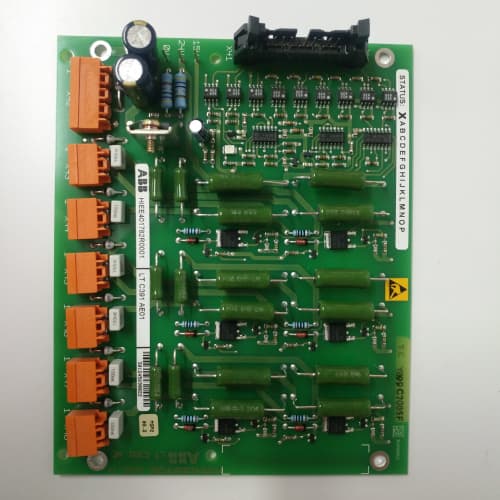
Description
Introduction to the ABB LT2005-S/SP19
Product Description
The ABB LT2005-S/SP19 is a sophisticated and high-precision guided wave radar level transmitter from ABB’s extensive line of measurement and analytics instrumentation. This device is engineered for reliable and accurate level measurement of liquids, interfaces, and solids in demanding industrial process conditions. The ABB LT2005-S/SP19 utilizes time-domain reflectometry (TDR) technology, where guided microwave pulses travel along a probe, reflecting at the point of material contact to provide a highly accurate level reading. This specific variant, denoted by the “-S/SP19” suffix, includes a single, rigid probe of a defined length (SP19) and is designed for general-purpose applications. The transmitter is celebrated for its immunity to process conditions such as changing density, temperature, pressure, and vapor, making it suitable for challenging environments.
Product Parameters
-
Product Series: ABB Levelflex Guided Wave Radar (Liquiphant / Levelflex family)
-
Model: LT2005-S/SP19
-
Device Type: Guided Wave Radar (GWR) Level Transmitter
-
Measurement Principle: Time-Domain Reflectometry (TDR)
-
Probe Type: Single, rigid probe (SP19), with a specified length and material (e.g., 19mm diameter, stainless steel).
-
Process Connection: Standard process flange (e.g., ANSI, DIN, JIS) as specified.
-
Output: Standard 4-20 mA HART analog signal, with digital communication overlay.
-
Power Supply: Typically 2-wire, loop-powered (10.5-42 VDC).
-
Accuracy: High accuracy, typically within a few millimeters.
-
Process Conditions: Suitable for high temperatures and pressures, specific ranges defined by model.
-
Enclosure Rating: Typically IP66/IP67 or equivalent for hazardous and outdoor areas.
Advantages and Features
The primary advantage of the ABB LT2005-S/SP19 is its reliable and accurate measurement in applications where other technologies, like traditional radar or ultrasonic, may struggle due to foam, vapor, turbulence, or low dielectric constant. Its guided wave principle ensures a strong, stable signal even in low-dielectric media or in the presence of agitators. The device is known for its ease of configuration and commissioning, often featuring push-button setup and advanced diagnostics. It offers excellent long-term stability with no need for recalibration. The robust, all-welded sensor design of the LT2005-S/SP19 makes it suitable for corrosive and high-pressure/temperature applications.
Application Cases in Industry
This level transmitter is used across a wide range of industries for critical inventory and process control. In the oil and gas sector, it measures level in separator vessels, crude oil storage tanks, and amine contactors. In chemical and petrochemical plants, the ABB LT2005-S/SP19 is used for interface detection in distillation columns, and level measurement in reactors and storage tanks for aggressive chemicals. Within power generation, it monitors level in condensate receivers and feedwater heaters. It is also widely applied in water and wastewater treatment, food and beverage, and pharmaceutical industries for hygienic and non-hygienic tank level applications.
Comparison with Competing Products
Competing products include guided wave radar transmitters from manufacturers like Emerson (Rosemount 5300), Siemens (Sitrans LR250), and Endress+Hauser (Micropilot). The ABB LT2005-S/SP19 competes through ABB’s strong global service network and the proven reliability of its Levelflex series. Its performance is comparable to other top-tier GWR devices, often competing on specific features such as probe design for challenging coatings, advanced echo-processing software, or the user-friendliness of its local interface. The LT2005-S/SP19 is often selected for its specific probe style (rigid single) which is optimal for certain applications like interface measurement or in vessels with internals.
Selection Suggestions and Precautions
Selecting the correct ABB LT2005-S/SP19 requires careful analysis of the application. The most critical factors are the process media (dielectric constant, corrosiveness, potential for coating), the required probe length (defined by SP19 length), and the process conditions (temperature, pressure). The probe style (single, rigid) is suitable for clean to mildly coating liquids and interface applications, but may not be ideal for heavy solids or highly viscous, coating materials. Ensure the process flange material and rating are compatible with the vessel. The instrument must be properly configured for the specific tank geometry and measurement range.
Precautions:
-
Installation must ensure the probe is correctly positioned, avoiding contact with tank walls, agitators, or other internals as per ABB’s installation guidelines.
-
For interface measurement, the dielectric constants of the two liquids must be sufficiently different for reliable detection.
-
In applications with potential for probe coating, regular inspection or selection of a different probe style (e.g., coaxial) may be necessary.
-
Ensure the process connection is properly sealed and rated for the process pressure and temperature.
-
The electronics housing should be mounted considering accessibility for commissioning and maintenance, and protected from direct weather exposure if not rated for it.
1756-CNB AB DCSPLC
1746-P1 AB PLC
1746-ITB16 AB PLC
1746-0W8 AB PLC
1746-0B16 AB PLC
1746-IB8 AB PLC

Reviews
There are no reviews yet.