
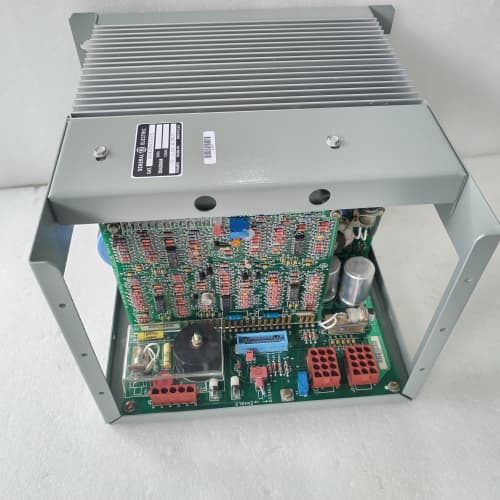
Description
Parameters
-
Input Type: Thermocouple J, K, T (default); E, S optional with factory configuration
-
Channels: 24 differential (fixed)
-
Resolution: 14-bit ADC, ±0.09°C accuracy (improved over B1’s ±0.12°C)
-
Cold Junction: Dual redundant sensors with D1 drift compensation
-
Isolation: 2500V RMS optical isolation
-
Power: +5V DC @ 1.2A, +15V DC @ 0.3A (requires both rails)
-
Scan Rate: 180ms per channel (faster than B1’s 250ms)
-
Coating: Basic conformal coating (suffix B) – single-layer acrylic
-
Temp Range: 0°C to +60°C
-
Mounting: 6U VME Eurocard, single-slot
-
Diagnostics: LED status per channel for open-circuit and over-range detection
Advantages & Features
-
D1 firmware offers a balanced compromise – better accuracy and speed than B1, without the complexity of later M1 adaptive algorithms
-
24-channel capacity maximizes I/O density, reducing total board count in large cabinets
-
Dual redundant cold-junction sensors provide failover reliability
-
Higher isolation (2500V) protects against ground loops and transient surges
-
Supports J/K/T out-of-the-box with E/S available by jumper/factory configuration
-
Drop-in replacement for DS3800HFPE and DS3800HFPE1B1B boards (identical pinout)
-
Front-panel LEDs for per-channel status, open-circuit, and over-range detection
Application Cases
-
Frame 7EA gas turbines with mixed J/K-type thermocouple arrays
-
Steam turbine monitoring with bearing (K-type) and exhaust (J-type) sensors
-
Retrofit upgrades from DS3800HFPE1B1B where better accuracy is needed without full cabinet overhaul
-
Indoor power plants with stable, non-corrosive environments (basic coating sufficient)
Competitor Comparison
-
vs. DS3800HFPE1B1B (B1 variant): Better accuracy (±0.09°C vs. ±0.12°C), faster scan (180ms vs. 250ms), and K/T support without jumpers
-
vs. DS3800HFPE1M1H (M1/H variant): Less accurate (±0.09°C vs. ±0.07°C), slower (180ms vs. 120ms), no heavy coating, narrower temp range – but lower cost and simpler firmware
-
vs. DS3800HFPC1M1H (C variant): More channels (24 vs. 16), higher isolation, redundant CJC, but requires +15V and slower scan (180ms vs. 120ms)
-
vs. ABB TB711 : Higher channel density (24 vs. 16) and better isolation, but slower scan (180ms vs. 100ms)
-
vs. Siemens 7MH410 : More channels and flexible type support, but older backplane interface
-
vs. Woodward 8440-2021 : Better channel density, redundant CJC, and lower cost per channel
-
vs. Honeywell 51304731 : Higher channel count and dual CJC, but lacks digital diagnostic logging
Selection Suggestions
-
Confirm your thermocouple types – D1 supports J/K/T natively; E/S require factory or jumper configuration
-
Verify backplane provides both +5V and +15V – this board requires both rails
-
Assess scan rate requirement – 180ms is suitable for most temperature monitoring applications
-
Evaluate environmental conditions – basic coating (B) is only for clean, dry indoor installations
-
If upgrading from B1, D1 offers noticeable accuracy and speed improvements – recommended mid-tier option
-
Order mating front connector (p/n 531X180SPAANG6 – specific to HFPE 24-channel pinout)
-
For critical turbines, consider DS3800HFPE1M1H for heavy coating and adaptive compensation
Precautions
-
Critical: Requires both +5V and +15V – do not install in slots without +15V supply
-
Critical: Verify thermocouple type configuration – E/S require specific linearization tables; confirm settings before commissioning
-
Allow 30-minute warm-up before calibration
-
Basic coating (B) does not protect against humidity or corrosive gases – keep cabinet environment clean and dry
-
Use thermocouple-grade extension wire – copper wire causes significant measurement errors
-
Store in ESD-safe packaging – edge connector is static-sensitive
-
Periodically check CJC sensor accuracy every 2 years (dual sensors should agree within 0.5°C)
-
Do not hot-swap – Mark IV backplanes require power-off for insertion/removal
-
If replacing a DS3800HFPE1B1B, ensure turbine logic supports D1 linearization tables (minor update required in some older cabinets)
-
For high-temperature applications (>1000°C), J-type is not suitable – consider S-type boards or alternative sensors
A-B 1756-OB32
A-B 193-EIOGP-42-24D
A-B 1756-IB16I



Reviews
There are no reviews yet.