
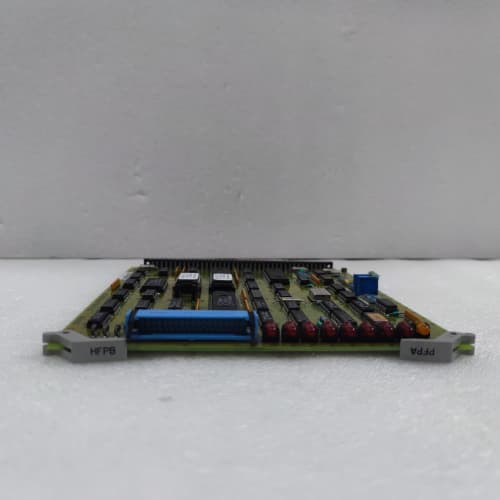
Description
Parameters
-
Input Type: Thermocouple J, K, T (default); optional E, S, R (M1 firmware supports R-type)
-
Channels: 16 differential (fixed, non-expandable)
-
Resolution: 14-bit ADC, ±0.07°C accuracy (M1 improved linearization)
-
Cold Junction: Single sensor with M1 adaptive drift compensation algorithm
-
Isolation: 1500V RMS optical isolation
-
Power: +5V DC @ 1.0A only (no +15V required)
-
Scan Rate: 120ms per channel (fastest among HFPC variants)
-
Coating: Heavy conformal coating (suffix H) – 3-layer acrylic, humidity and chemical resistant
-
Temp Range: -40°C to +85°C
-
Mounting: 6U VME Eurocard, single-slot
Advantages & Features
-
M1 firmware features adaptive cold-junction compensation that self-calibrates during operation, reducing drift over time
-
Enhanced EMI filtering (M1-specific) rejects up to 60dB of common-mode noise – critical near VFDs and large transformers
-
Heavy conformal coating protects against moisture, salt spray, and corrosive gases (sulfur, chlorine)
-
Fastest scan rate among HFPC variants (120ms) for time-critical temperature alarms
-
Hot-swappable with Mark IV backplanes (requires proper sequence)
-
Drop-in replacement for older DS3800HFPC, DS3800HFPC1L1H, and many DS3800HFPB boards (check pinout)
-
Front-panel LEDs for per-channel status, open-circuit, and over-range detection
Application Cases
-
Generator stator temperature monitoring in high-EMI environments (near VFDs)
-
Gas turbine exhaust temperature scanning where rapid response is critical
-
Offshore platforms with salt spray and high humidity (H coating)
-
Combined-cycle plants using R-type thermocouples for high-temperature zones (up to 1700°C)
-
Retrofit replacing DS3800HFPC standard boards where EMI issues were previously reported
Competitor Comparison
-
vs. DS3800HFPC1L1H (L1 variant): Faster scan (120ms vs. 150ms), better accuracy (±0.07°C vs. ±0.08°C), R-type support, and superior EMI rejection
-
vs. DS3800HFPB1F1E (coated B variant): Lower isolation (1500V vs. 2500V) and single CJC, but no +15V, wider temp range, and faster scan
-
vs. ABB TB711 : Better EMI rejection (60dB vs. 40dB) and wider temp range, but slower scan (120ms vs. 100ms for ABB’s latest)
-
vs. Siemens 7MH410 : More rugged and chemically resistant, but lacks PROFIBUS/PA communication
-
vs. Woodward 8440-2021 : Superior long-term drift performance (M1 adaptive algorithm) and lower cost per channel
-
vs. Honeywell 51304731 : Enhanced coating (3-layer vs. single) and R-type support, but lower channel density
-
vs. Bently Nevada 3500/42 : Thermocouple-specific (not vibration), better suited for temperature-critical applications
Selection Suggestions
-
Verify your thermocouple type – M1 supports J/K/T default; E/S/R available by request (check factory settings)
-
If you have R-type sensors for high-temperature zones (>1000°C), confirm the board is factory-configured for R-type
-
Assess EMI environment – if VFDs or large transformers are present, M1 is strongly recommended over L1 or standard HFPC
-
Confirm heavy coating (H) is necessary – for clean indoor environments, standard HFPC may suffice and cost less
-
Check backplane power – no +15V required, so this board can be used in any Mark IV slot
-
Order mating front connector (p/n 531X180SPAANG4 – specific to M1 variant’s pinout)
-
For critical turbine applications, purchase with a factory calibration certificate and 24-month warranty
Precautions
-
Critical: Do not mix with E/S/R thermocouples unless firmware explicitly supports them – M1 defaults to J/K/T
-
Allow 45 minutes warm-up before taking critical readings (heavy coating affects thermal equilibrium)
-
Do not clean with aggressive solvents – use isopropyl alcohol or dry compressed air only
-
Heavy coating (H) makes component-level repair impractical – replace rather than repair
-
Store in ESD-safe packaging – coating does not protect against static discharge
-
Verify front connector pinout matches your wiring harness – HFPC1M1H pin assignments differ from HFPB variants
-
Periodically check CJC accuracy every 2 years – M1’s adaptive algorithm reduces drift but does not eliminate it
-
Do not hot-swap if backplane power LED is amber/red – wait for steady green
-
If upgrading from DS3800HFPC standard, update turbine control logic for M1’s linearization tables (older logic may misinterpret data)
-
For R-type sensors, verify extension wire is R-type compatible (platinum-rhodium) – copper wire will cause significant errorS
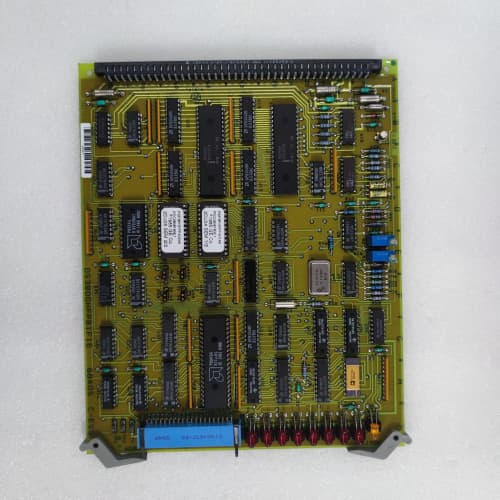
ABB RDCO-01C
FOXBORO P0916AA
A-B 1769-IQ32

Reviews
There are no reviews yet.