
Description
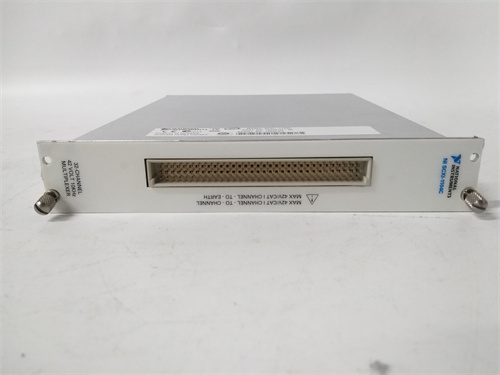
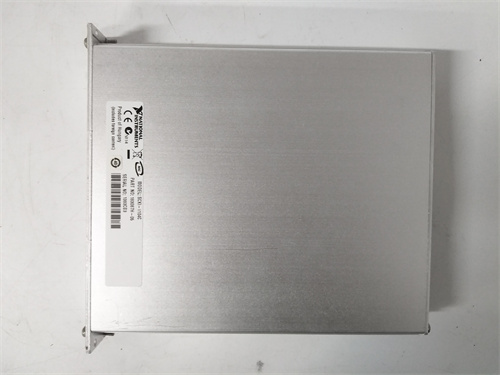
The NI SCXI-1104C is a high-performance, high-accuracy signal conditioning module from National Instruments’ SCXI platform. Designed as a multichannel instrumentation amplifier, it is engineered to reliably interface sensitive, low-voltage analog sensors with data acquisition (DAQ) systems, making it a crucial component for precision measurement and test applications in both industrial and laboratory environments.
Product Description
The NI SCXI-1104C is a sophisticated 32-channel differential analog input module. Its core function is to amplify, filter, and isolate low-level signals from sensors like strain gauges, thermocouples, and RTDs before they are digitized by a downstream DAQ device. Integrating the NI SCXI-1104C into an SCXI chassis creates a robust front-end system that protects sensitive measurement signals from electrical noise and provides the necessary signal conditioning for accurate data capture. This module is a preferred choice for applications demanding high channel counts and exceptional measurement integrity. For engineers building high-fidelity data acquisition systems, the NI SCXI-1104C offers a scalable and reliable solution. Its programmable gain and filtering capabilities make it exceptionally versatile. The architecture of the NI SCXI-1104C is centered on delivering clean, stable signals, which is fundamental for any critical measurement or control system.
Product Parameters
-
Manufacturer: National Instruments (NI).
-
Platform: SCXI (Signal Conditioning eXtensions for Instrumentation).
-
Model: SCXI-1104C.
-
Module Type: 32-Channel, Programmable Instrumentation Amplifier.
-
Input Channels: 32 differential analog input channels.
-
Programmable Gain: Software-selectable gains of 1, 2, 5, 10, 20, 50, 100, 200, 500, and 1000.
-
Input Range: Selectable per channel, typically from ±100 mV to ±10 V full-scale, depending on the gain setting.
-
Filtering: Includes programmable low-pass Bessel filters (4 Hz or 10 kHz cutoff) for anti-aliasing and noise rejection.
-
Excitation Source: Provides voltage excitation (up to +10 VDC) for sensors like strain gauges that require it.
-
Connection: Front-mounting screw terminals (via an SCXI-1320, 1321, or similar terminal block) for field wiring.
Advantages and Features
-
High-Density & High Accuracy: Offers 32 isolated differential channels in a single slot, providing excellent channel density while maintaining high accuracy (e.g., low offset drift, high CMRR).
-
Programmable Signal Conditioning: Software-configurable gain and filtering allow one module to adapt to a wide variety of sensor types and signal levels, simplifying system design and inventory.
-
Superior Noise Immunity: Differential inputs, combined with programmable low-pass filtering and high Common-Mode Rejection Ratio (CMRR), effectively reject noise in electrically harsh industrial environments.
-
Sensor Excitation: Built-in voltage excitation eliminates the need for external power supplies for quarter-bridge, half-bridge, or full-bridge strain gauge configurations.
-
Seamless Software Integration: Fully programmable and controlled within the NI-DAQmx driver software and LabVIEW environment, ensuring straightforward configuration and data flow integration.
Application Cases in Industry
-
Structural Test & Monitoring: Used extensively for multichannel strain gauge measurement on aircraft components, automotive frames, and civil engineering structures (bridges, buildings).
-
Precision Manufacturing: Monitoring force and pressure in automated assembly and machining processes using load cells and pressure transducers.
-
Research & Development: High-channel-count data acquisition for vibration analysis, material testing (tensile testers), and prototype validation in laboratory settings.
-
Process Validation: Recording low-level analog signals from various transducers in pilot plants or qualification test stands for process optimization.
Comparison with Competing Products
Competing signal conditioning systems come from companies like Dewesoft, HBM, or generic DAQ card manufacturers. The NI SCXI-1104C differentiates itself through its deep integration within the NI ecosystem (SCXI, PXI, CompactDAQ) and its software-centric configurability. Compared to fixed-gain conditioners, it offers unparalleled flexibility. Versus simpler multiplexer modules, it provides active amplification and filtering per channel, resulting in superior signal quality for low-level sensors. Its primary competitor is often other NI modules (like the newer NI-9237 for bridge sensors), where the SCXI-1104C stands out for its very high channel density in a modular chassis format.
Selection Suggestions and Precautions
-
Verify System Compatibility: Ensure you have a compatible SCXI chassis (e.g., SCXI-1000/1001) and a controlling DAQ device (like an NI PCI/PXI/USB DAQ card) with appropriate scanning capabilities for 32 channels.
-
Select Correct Terminal Block: The NI SCXI-1104C requires a separate screw terminal block (e.g., SCXI-1320 or SCXI-1321). Verify you have the correct terminal block for your wiring needs.
-
Match Sensor Requirements: Confirm the module’s specifications (gain range, excitation voltage, filter settings) meet the requirements of your specific sensors (e.g., strain gauge bridge completion, required sensitivity).
-
Proper Wiring and Grounding: For low-voltage measurements, proper shielded cabling, differential connections, and attention to grounding schemes are critical to realize the module’s full noise rejection performance.
-
Software and Driver Setup: Ensure you have the latest NI-DAQmx driver installed and understand how to configure the module’s gains, filters, and excitation within your application software (e.g., LabVIEW, LabWindows/CVI).
smart
ABB 3HAB8440-1 PLC
3HAC17343-1 ABB PLCPLC
ABB 3HAC1855-1
ABB 3HAC021456-001
3HAC031851-001 PLC
ABB 3HAC029157-001 I/O


Reviews
There are no reviews yet.