
Description
Introduction and Overview
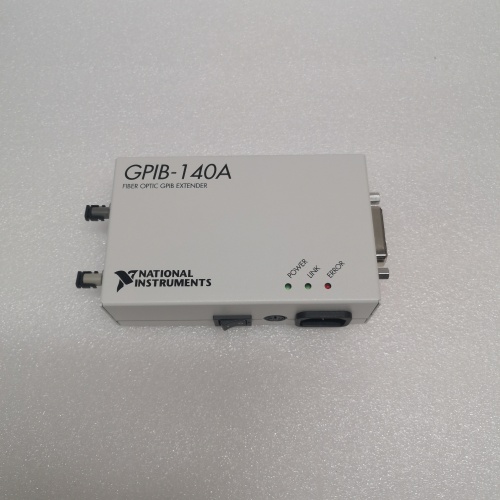
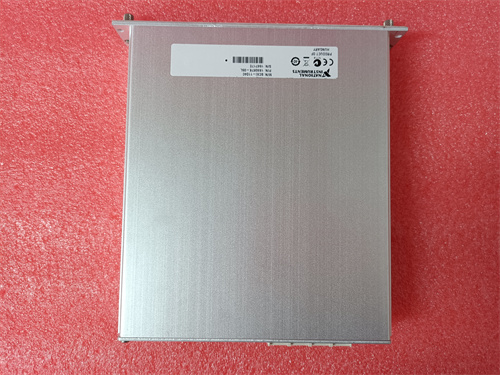
The NI GPIB-140 is a specialized fiber optic extender manufactured by National Instruments (NI) designed to significantly extend the distance over which GPIB (IEEE 488) instruments can communicate with a controller. This device addresses one of the primary limitations of the GPIB standard—its short cable length restriction (typically 20 meters total or 2 meters per device)—by converting electrical GPIB signals to optical signals for transmission over fiber optic cables.
The NI GPIB-140 consists of a pair of units: one connected to the GPIB controller (typically a PC with a GPIB interface card) and the other connected to the GPIB instruments. These units communicate with each other over fiber optic cable, allowing the GPIB system to be separated by distances up to 2 kilometers while maintaining full GPIB functionality and performance. This capability makes the NI GPIB-140 an essential tool for distributed test systems, remote monitoring applications, and environments with high electrical noise where standard GPIB cabling would be impractical or impossible.
Technical Parameters (Product Parameters)
The NI GPIB-140 is engineered for transparent extension of GPIB systems with robust performance characteristics. Its key specifications include:
-
Product Type: GPIB Fiber Optic Extender (set of two units)
-
Maximum Distance: Up to 2 km (1.24 miles) between units using multimode fiber optic cable
-
GPIB Compatibility: Fully IEEE 488.1 and IEEE 488.2 compliant
-
Data Transfer Rate: Supports GPIB data rates up to 1.15 MB/s (compatible with standard GPIB speeds)
-
Fiber Optic Connector Type: ST-style connectors (standard for multimode fiber)
-
Fiber Type: Multimode fiber optic cable (typically 62.5/125 μm or 50/125 μm)
-
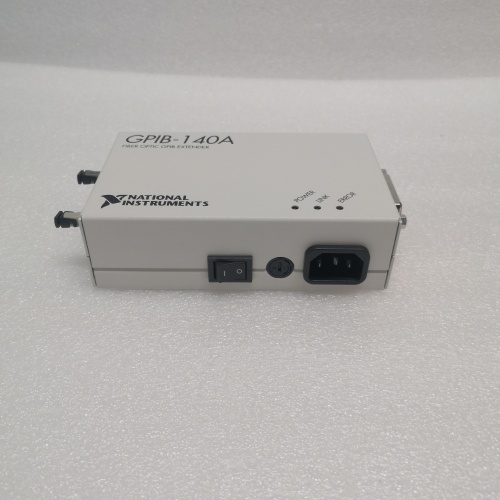
Power Supply: External AC power adapter (included with each unit)
-
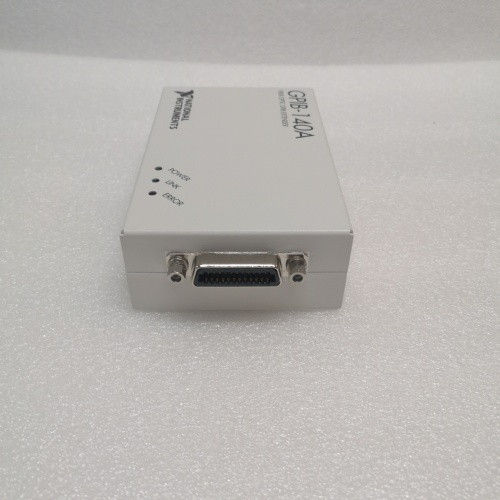
Indicators: Front-panel LEDs for power, GPIB activity, and fiber link status
-
Operating Temperature: 0°C to 55°C (industrial operating range)
-
Dimensions: Compact enclosure suitable for bench-top or rack-mount applications
-
GPIB Connectors: Standard 24-pin IEEE 488 connectors on both units
-
Transmission Mode: Full duplex optical communication
The NI GPIB-140 maintains complete GPIB functionality across the extended distance, including all handshaking, addressing, and control signals required for proper instrument communication.
Advantages and Features
The primary advantages of the NI GPIB-140 focus on its ability to overcome distance and noise limitations of traditional GPIB cabling.
-
Dramatic Distance Extension: The most significant feature of the NI GPIB-140 is its ability to extend GPIB communication from the standard 20-meter limit to up to 2 kilometers. This enables test systems to be distributed across large facilities, with instruments located in different rooms, buildings, or remote areas while maintaining control from a central location.
-
Electrical Isolation and Noise Immunity: By converting electrical signals to optical signals, the NI GPIB-140 provides complete galvanic isolation between the controller and the instruments. This eliminates ground loop problems and provides exceptional immunity to electromagnetic interference (EMI), making the NI GPIB-140 ideal for use in electrically noisy environments such as near high-voltage equipment, motors, or RF transmitters.
-
Transparent Operation: The NI GPIB-140 requires no special software drivers or programming changes. To the controller and the instruments, the extended GPIB connection appears exactly like a standard local GPIB connection. All existing GPIB applications, drivers (such as NI-488.2), and instrument control software work seamlessly with the NI GPIB-140 without modification.
-
Simple Installation: The NI GPIB-140 units are plug-and-play devices. Installation simply involves connecting one unit to the controller, the other to the instruments, and linking them with fiber optic cable. No configuration switches or complex setup procedures are required for basic operation.
-
Signal Integrity: The NI GPIB-140 maintains full signal integrity across the extended distance, ensuring reliable communication and preventing data corruption that might occur with long copper cable runs.
Application Fields and Use Cases
The NI GPIB-140 is widely used in test and measurement applications requiring remote instrument control or operation in challenging environments.
-
Aerospace and Defense Testing: In large aircraft or satellite test facilities, the NI GPIB-140 allows control electronics to be located in a clean control room while instruments are placed in environmental chambers or on test stands hundreds of meters away. This protects sensitive equipment while maintaining precise control.
-
Electromagnetic Compatibility (EMC) Testing: During EMC testing, instruments must often be placed inside shielded rooms or anechoic chambers. The NI GPIB-140 provides the necessary isolation and distance to locate the controlling computer outside the chamber while maintaining full control of GPIB instruments inside.
-
High-Energy Physics and Research: In particle accelerator facilities and large research laboratories, the NI GPIB-140 enables control of instruments located in radiation areas or near powerful magnets where electronics would be damaged or affected. The fiber optic link provides the necessary distance and isolation.
-
Industrial Process Monitoring: Manufacturing facilities use the NI GPIB-140 to connect GPIB-based analyzers and measurement instruments located on the production floor to centralized quality control systems in separate buildings.
-
Remote Environmental Monitoring: Weather stations, environmental monitoring sites, and remote research installations utilize the NI GPIB-140 to transmit data from GPIB instruments to centralized data collection points over significant distances.
Comparison with Competing Products
The NI GPIB-140 competes with GPIB extender solutions from other manufacturers such as ICS Electronics (model 4865) and various generic GPIB-over-fiber converters.
-
Advantages of NI GPIB-140: As a National Instruments product, the NI GPIB-140 offers guaranteed compatibility with NI GPIB controllers and the industry-standard NI-488.2 driver software. The build quality and reliability are excellent, with robust enclosures suitable for both lab and industrial environments. The NI GPIB-140 also benefits from NI’s extensive technical support and documentation.
-
Disadvantages: The NI GPIB-140 requires external power at both ends, which may be inconvenient in some remote installations. It is designed specifically for multimode fiber; applications requiring single-mode fiber for even longer distances may need additional converters. Compared to newer Ethernet-based GPIB extenders, the NI GPIB-140 is dedicated to point-to-point fiber connections rather than network-based distribution.
-
Versus Ethernet Solutions: While Ethernet-based GPIB servers (such as NI’s own GPIB-ENET series) offer network connectivity and potentially greater flexibility, the NI GPIB-140 provides lower latency and more deterministic timing, which is critical for applications requiring precise synchronization and high-speed handshaking.
Selection Suggestions and Precautions
When selecting and implementing the NI GPIB-140, consider the following recommendations:
-
Distance Requirements: Verify that your required distance is within the 2 km capability of the NI GPIB-140. For longer distances, consider additional repeaters or alternative solutions such as single-mode fiber converters.
-
Fiber Optic Cable Selection: The NI GPIB-140 is designed for multimode fiber with ST connectors. Ensure you select appropriate fiber optic cable (62.5/125 μm or 50/125 μm) with ST terminations. Pre-terminated cables are available in various lengths and are recommended for ease of installation.
-
Power Availability: Each NI GPIB-140 unit requires AC power. Ensure power outlets are available at both ends of the fiber link. Consider using uninterruptible power supplies (UPS) for critical applications to maintain operation during power fluctuations.
-
GPIB Configuration Limits: Remember that the NI GPIB-140 extends the GPIB bus but does not increase the maximum number of devices (typically 15 total, including the controller). Plan your system configuration accordingly.
-
Environmental Considerations: If installing in harsh environments, ensure the NI GPIB-140 units are protected from moisture, dust, and extreme temperatures outside their specified operating range.
Safety Precautions: When working with the NI GPIB-140 and fiber optic cables, observe standard safety practices:
-
Never look directly into the end of a fiber optic cable connected to an active transmitter, as invisible laser radiation may be present
-
Handle fiber optic cables carefully to avoid breakage and ensure minimum bend radius specifications are followed
-
Disconnect power before servicing either unit
-
Use only the provided power adapters to avoid voltage mismatches
-
Ensure proper ventilation around each unit to prevent overheating
-
Follow all local electrical codes and regulations when installing in industrial environments
5453-279
5456-676
5463-550 PLC
5463-780
5463-783 PLC
5463-785


Reviews
There are no reviews yet.