
Description
Product Overview and Description
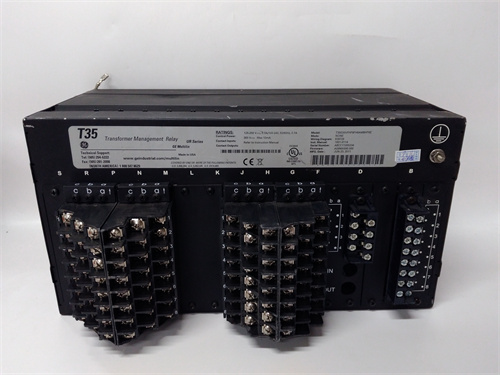
The GE T30-04E is a specific model from GE’s (General Electric) industrial timer relay series, likely part of their iconic T30 line of compact, multi-function, plug-in timing relays. This device is an electromechanical or solid-state timing module designed to provide precise delayed control signals in automation circuits. The primary function of the GE T30-04E is to introduce an adjustable time delay between a control signal (the initiation of the timer) and the operation of its output relay contacts. It serves as a vital component for sequencing operations, preventing simultaneous starts, providing dwell times, or creating repeating intervals in machinery control panels. While not a PLC module itself, the GE T30-04E is a fundamental discrete control component often used in conjunction with or as a supplement to PLC systems for simple, hardwired timing logic. Its plug-in design and clear dial or knob for time setting make it a user-friendly and reliable solution for countless industrial timing applications.
Product Parameters and Specifications
-
Product Type: Multi-Function Plug-In Timer Relay
-
Manufacturer Part Number (MPN): T30-04E
-
Brand: GE (General Electric, now often under GE Industrial or related successors)
-
Series: T30 Series
-
Timing Functions: The suffix “04E” indicates a specific timing mode. Common modes include:
-
On-Delay (Timer ON delay): Output energizes after a set time from input energization.
-
Off-Delay (Timer OFF delay): Output de-energizes after a set time from input de-energization.
-
Interval (One-Shot): Output pulses for a set time upon input signal.
-
Flasher (Repeat Cycle): Output cycles on and off based on set times.
-
-
Time Range: Adjustable over a specific range (e.g., 0.1 seconds to 10 hours, depending on model), typically set via a rotary dial or dip-switches.
-
Output: Electromechanical relay contacts (SPDT or DPDT – Form C), with a specified rating (e.g., 10A at 240V AC).
-
Input Voltage: Operates on a specific control voltage, commonly 24-240V AC/DC (the exact range is defined by the “04E” variant).
-
Mounting: Standard 8- or 11-pin plug-in base (e.g., octal-style base), allowing for easy replacement without rewiring.
-
Indicators: LED for power/input status and often an LED for output status.
-
Housing: Compact, enclosed plastic or phenolic case.
Key Advantages and Features
The key advantage of the GE T30-04E is its simplicity, robustness, and ease of use. It provides a cost-effective and highly reliable timing solution without the need for software programming or complex configuration. The plug-in design ensures quick installation and even quicker replacement in case of failure, minimizing downtime. The clear, direct time setting (via a dial or knob) allows for easy adjustment by maintenance personnel on the shop floor. Its electromechanical relay output can switch a wide range of loads (motors, solenoids, contactor coils) directly, adding to its versatility. The timer is designed for long electrical life and stable timing accuracy across a range of industrial temperatures. For applications where a simple, independent time delay is needed, the GE T30-04E offers a dependable and straightforward alternative to programming a PLC timer function.
Application Scenarios and Use Cases
This timer relay is ubiquitous in industrial control panels for simple sequencing and protection. Common applications include:
-
Motor Control: Implementing a delay between the start of a main motor and a subsequent auxiliary pump or fan (start-up sequencing), or providing a cooling fan run-on period after a machine stops (off-delay).
-
Conveyor Systems: Creating a delay between the release of items from one conveyor to the next to prevent jamming.
-
Pump Control: Providing a minimum off-time (anti-cycle timer) for pumps to prevent short cycling.
-
Lighting Control: Automatically turning off lights in a warehouse or stairwell after a set period (off-delay).
-
Machine Tool Cycles: Controlling dwell times for drilling, tapping, or clamping operations.
-
Back-up for PLC Systems: Sometimes used as a hardwired safety timer independent of the PLC for critical delays.
Comparison with Competing Products
The GE T30-04E competes with other multi-function plug-in timer relays from manufacturers like Allen-Bradley (Bulletin 700), Siemens (3RP1), Omron (H3CR), Schneider Electric (REXL), and Eaton (Cuttle). Compared to a timing function inside a PLC, the T30-04E is a dedicated hardware device that operates independently, which can be an advantage for safety or simplicity. Versus other plug-in timers, the GE T30 series is known for its durability, wide voltage range acceptance, and straightforward design. The specific “04E” model’s features (timing mode, voltage, time range) would be compared directly to a competitor’s equivalent model (e.g., an Allen-Bradley 700-HR for on-delay). Selection often hinges on brand preference, existing panel standards, and availability.
Selection Guidelines and Important Notes
Selection Advice:
-
Define the Timing Function: Precisely identify whether you need On-Delay, Off-Delay, Interval, or another mode. The “04E” suffix must match this requirement.
-
Verify Voltage Ratings: Match the timer’s input (coil) voltage (e.g., 120V AC) with your control circuit voltage. Also, ensure the output contact rating is sufficient for the load (amperage, AC/DC).
-
Time Range: Select a model whose adjustable time range encompasses your required delay. Using a 0-10 second timer for a 5-minute delay is impossible.
-
Base Compatibility: Ensure you have or purchase the correct 8-pin or 11-pin plug-in base for the timer module.
-
Consider Environment: For high-vibration environments, a solid-state timer might be more reliable than an electromechanical one.
Important Precautions:
-
Load Rating: Do not exceed the output relay’s electrical rating, especially when switching inductive loads (motors, solenoids). Use an intermediate contactor for high currents.
-
Inductive Load Protection: For DC inductive loads, use a flyback diode across the load. For AC inductive loads, an RC snubber or metal-oxide varistor (MOV) is recommended to protect the timer’s contacts from arcing and prolong their life.
-
Correct Wiring: Follow the wiring diagram on the timer’s body or datasheet precisely. Incorrect wiring of the input voltage or output contacts is a common mistake.
-
Mechanical Life: While the electrical life is high, the mechanical life of the internal relay is finite. For applications requiring millions of cycles, a solid-state output timer or a PLC may be more appropriate.
-
Timer Reset: Understand the timer’s reset behavior. Some timers reset immediately if the input signal is lost during timing, while others may have a specific reset logic.
AIP578
DME3000-111P
AIP571
HA-SO-103B
DSDP140B
XVME-660 PLC



Reviews
There are no reviews yet.