
Description
Product Description
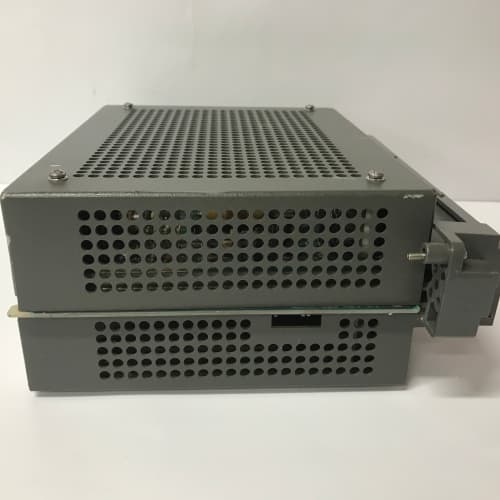
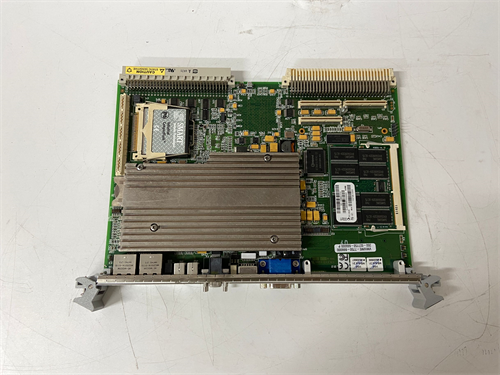
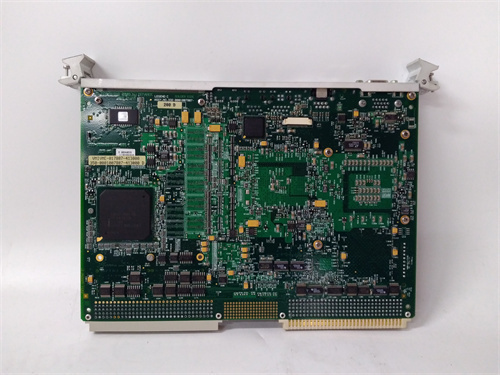
The GE PCIE-5565RC-100000 is a high-performance, reflective memory network interface card designed for use in real-time deterministic computing systems, often associated with GE’s (now Emerson’s) high-end control and simulation platforms. This card enables the creation of a low-latency, shared memory network across multiple computers or industrial controllers, allowing them to exchange data with nanosecond-level consistency. The PCIE-5565RC-100000 is critical for applications requiring ultra-fast, deterministic data synchronization, such as hardware-in-the-loop (HIL) simulation, distributed real-time control, and high-speed data acquisition. Integrating the GE PCIE-5565RC-100000 into a system creates a tightly coupled, high-speed data fabric essential for time-critical operations. The cutting-edge technology and precision timing of the GE PCIE-5565RC-100000 make it a cornerstone for the most demanding synchronization and control challenges.
Product Parameters
-
Manufacturer / Brand: GE Intelligent Platforms (now part of Abaco Systems after Emerson’s divestiture)
-
Product Type: Reflective Memory / Real-Time Network Interface Card (NIC)
-
Model: PCIE-5565RC-100000
-
Host Interface: PCI Express (PCIe) x4 lane interface.
-
Network Technology: Reflective Memory (also known as RFM or SCRAMNet), a real-time, shared memory network.
-
Network Speed: Operates at a high data rate, typically 2.12 Gigabits per second (170 MB/s sustained) over fiber optic cable.
-
Fiber Optic Port: Duplex LC connector for connection to the reflective memory ring network.
-
Memory Size: Features onboard memory (e.g., 256 MB) that is mirrored across all nodes on the network.
-
Deterministic Latency: Provides extremely low and predictable point-to-point latency (microseconds), which is its defining characteristic.
-
Software Support: Includes drivers for real-time operating systems (RTOS) like VxWorks, QNX, and Linux, as well as Windows.
-
Applications: Used in simulation, test, and high-performance control systems.
Advantages and Features
-
Ultra-Low, Deterministic Latency: The primary advantage of the GE PCIE-5565RC-100000 is its ability to share data between multiple systems with consistent, microsecond-level latency, which is orders of magnitude faster and more predictable than standard Ethernet.
-
Simple Programming Model: It presents a simple shared memory model to the application. Data written to a local memory address is automatically and almost instantly reflected to the same address on all other nodes in the network, simplifying complex inter-process communication.
-
High Data Integrity: Uses a robust, ring-based network topology with fault management. Data is protected by CRC and the network can often tolerate a single break without total failure.
-
Synchronization and Timestamping: Often includes hardware-based, network-wide time synchronization capabilities, allowing all nodes to have a common, precise time reference for data correlation.
-
Ideal for Hard Real-Time Systems: Its performance is unaffected by network traffic load, making it perfectly suited for closed-loop control, simulation, and data acquisition where timing is critical.
Application Cases in Application Fields
-
Aerospace & Defense HIL Simulation: In a flight simulator, multiple computers running aircraft dynamics, engine, and avionics models use the GE PCIE-5565RC-100000 network to exchange state variables in real-time, ensuring a perfectly synchronized simulation for testing flight control hardware.
-
Power Grid Real-Time Simulation: For simulating and testing protection relays, a network of real-time simulators uses reflective memory to share instantaneous voltage and current waveforms across a modeled electrical grid.
-
Industrial Test Stands: In an automotive test cell for engine control unit (ECU) validation, a real-time computer controlling the dynamometer and a separate computer running the vehicle model synchronize data via this card to create a seamless test environment.
-
Large-Scale Physics Experiments: Used in particle accelerator control systems where data from thousands of sensors must be correlated with nanosecond precision across distributed acquisition nodes.
Comparisons with Competing Products
The GE PCIE-5565RC-100000 competes in the niche market of deterministic, low-latency interconnects:
-
Reflective Memory vs. Deterministic Ethernet (e.g., TSN, Profinet IRT): While Time-Sensitive Networking (TSN) brings determinism to Ethernet, reflective memory like the PCIE-5565RC-100000 typically offers lower latency and a simpler, memory-based programming model. Ethernet solutions excel in broader interoperability and longer distances.
-
GE/Abaco vs. Other Reflective Memory Vendors (e.g., VMIC, Systran): The GE/Abaco product line is one of the industry standards. Comparisons are often based on specific performance metrics (latency, memory size), driver support for specific RTOS, and the ecosystem of compatible hardware.
-
Reflective Memory vs. InfiniBand: InfiniBand offers very high bandwidth and low latency but is more complex to program and typically used in high-performance computing (HPC). Reflective memory is favored for its simplicity and deterministic performance in hard real-time control and simulation.
-
Legacy vs. Modern: While a proven technology, newer PCIe Gen3 and Gen4 reflective memory cards from Abaco offer higher speeds. The PCIE-5565RC-100000 represents a mature, widely deployed generation of this technology.
Selection Suggestions and Precautions
-
Confirm Host System Compatibility: Verify that your industrial computer or server has an available PCIe x4 (or larger) slot and is compatible with the required device drivers for your operating system (Windows, Linux, VxWorks, etc.).
-
Design the Network Topology: Reflective memory networks are typically arranged in a ring. Plan the fiber optic cable lengths and the order of nodes. Ensure you have the correct type of multimode fiber (e.g., OM3) and LC connectors.
-
Software and Driver Development: Utilizing this card requires specific driver integration and software development to map application data structures into the shared memory space. This is not a plug-and-play industrial protocol.
-
Redundancy Considerations: For mission-critical applications, design a dual-redundant ring network using two cards per node to provide a backup data path in case of a cable or card failure.
PR6423/106-OF1 PR6423/106-0F1
PR6424/104-141 CON041
PR6423/100-141 CON041
PR9350/12 PLC
PR6423/10R-040 plc



Reviews
There are no reviews yet.