
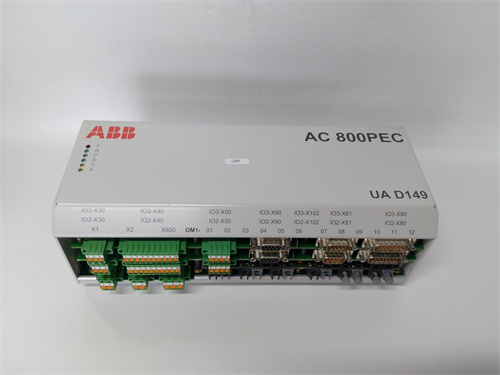
Description
The ABB UAD149 is a vital signal converter and isolator module within the well-established ABB UNITROL family of excitation systems for synchronous generators. This component is engineered to ensure precise, reliable, and isolated measurement of critical generator parameters, directly supporting the stable and efficient operation of power generation equipment.
Product Description
The ABB UAD149 is a dedicated voltage and current transducer module. Its core function is to sample high-power electrical signals from a generator’s terminals, such as stator voltage or current, and convert them into accurate, low-level, and galvanically isolated analog signals suitable for the UNITROL control system’s processing units. When an engineer specifies the ABB UAD149, they are integrating a component designed for precision in high-electrical-noise environments. Its isolation barrier is critical for protecting sensitive control electronics from high-voltage transients and ground loops, ensuring the long-term integrity of the excitation regulator. Implementing the ABB UAD149 is a standard practice for maintaining measurement accuracy and system safety in power generation control loops. This module’s reliability is a cornerstone of the UNITROL system’s ability to regulate generator voltage and reactive power effectively. Proper operation of the ABB UAD149 is essential for the overall performance and protection of the synchronous machine.
Product Parameters
-
Manufacturer: ABB (UNITROL product line).
-
Series: UNITROL 1000, 5000, and compatible series excitation systems.
-
Model: UAD149.
-
Function: Voltage & Current Transducer (Analog Isolator/Converter).
-
Input Signals: Typically accepts inputs from generator Terminal Voltage (VT/PT) and Terminal Current (CT) signals.
-
Output Signals: Provides scaled, isolated analog outputs (e.g., 0-20 mA, ±10 V, or other ranges) to the control system’s analog input cards.
-
Isolation: Features high-grade galvanic isolation between the primary (high-voltage/high-current side) and secondary (control side) circuits.
-
Accuracy: High precision, typically within a fraction of a percent, for faithful signal reproduction.
-
Mounting: Designed for DIN rail mounting within the excitation cubicle.
Advantages and Features
-
High-Precision Isolation: Provides essential galvanic isolation, preventing dangerous voltages from reaching the control system and eliminating measurement errors caused by ground potential differences.
-
Exceptional Accuracy: Delivers highly accurate signal conversion, which is fundamental for precise voltage regulation and protective functions.
-
Robust Design: Built to withstand the electrical noise, vibration, and temperature fluctuations present in power generation environments.
-
Proven Reliability: As a key component in thousands of installed UNITROL systems, the ABB UAD149 has a long track record of dependable service.
-
System Integration: Engineered for seamless compatibility with the UNITROL architecture, ensuring correct signal scaling and simplified configuration.
Application Cases in Industry
-
Thermal Power Plants: Used in the excitation systems of gas and steam turbine-driven generators for main grid power supply.
-
Hydroelectric Power Plants: Critical for controlling the excitation of hydro generators, impacting both voltage stability and power factor correction.
-
Industrial Generation: Applied in captive power plants within industries like pulp & paper, metals, and chemicals, where reliable on-site generation is crucial.
-
Marine & Offshore: Used in the power management systems of ships and oil platforms that utilize synchronous generators.
Comparison with Competing Products
Competing excitation systems from manufacturers like Basler (DECS series) or GE (EX2100) utilize their own proprietary transducers and signal conditioning modules. The primary advantage of the ABB UAD149 is its certified, plug-and-play compatibility and optimized performance within the ABB UNITROL ecosystem. Compared to using generic third-party signal isolators, the ABB UAD149 is specifically calibrated for the system’s requirements, offers guaranteed performance data, and is fully supported by ABB’s engineering and documentation. Its design is focused on the specific needs of generator signal conditioning, rather than being a general-purpose industrial isolator.
Selection Suggestions and Precautions
-
Verify System Compatibility: Confirm that the ABB UAD149 is listed as the correct transducer for your specific UNITROL system version (e.g., UNITROL 5000) and generator rating. Consult the system circuit diagrams and parts list.
-
Match Signal Specifications: Ensure the module’s input ranges (e.g., 0-120V AC, 0-5A AC) match your generator’s instrument transformer (VT/CT) outputs, and that its output range matches the expectation of the control system’s input card.
-
Calibration Check: While the module is pre-calibrated, it is good practice to verify signal accuracy during commissioning or after replacement using a precision multimeter or calibrator.
-
Wiring Safety: Always de-energize and properly ground the generator and excitation system before working on or replacing the ABB UAD149. Primary-side connections involve high voltages and currents.
-
Source Authentic Parts: For guaranteed safety and performance, procure this critical component from ABB or authorized distributors to avoid non-certified substitutes that could compromise system reliability and safety.
LD800HSE ABB dcs
ABB NAIO-01 dcs
NCSA-01 ABB dcs
ABB NTAC-01 dcs
NAIO-02 ABB
ABB AI815


Reviews
There are no reviews yet.