
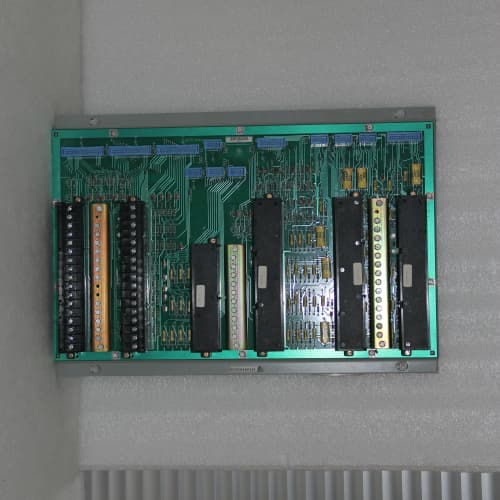
Description
Parameters
| Parameter | Specification |
|---|---|
| Output Channels | 3 independent, bi-directional current outputs (sourcing/sinking) |
| Output Range (Configurable) | ±20mA, ±50mA, or 0–50mA (software selectable per channel) |
| Resolution | 16-bit D/A conversion (effective resolution 14-bit at ±50mA range) |
| Accuracy | ±0.15% of full scale at 25°C; ±0.35% over -40°C to +70°C |
| Output Compliance Voltage | -10V to +10V (with 24V DC supply) |
| Load Impedance Range | 50Ω to 2kΩ (optimized for 100–500Ω servo coil impedance) |
| Dither Frequency | 70–400Hz, adjustable in 5Hz steps; amplitude 0–20% of full scale |
| Dither Amplitude Resolution | 10-bit (0.1% steps) |
| Update Rate | 1kHz (deterministic per channel) |
| Step Response Time | <2ms to 95% of final value (with 200Ω load) |
| Isolation | 2500Vrms optical isolation (control logic to output stage) |
| Protection | Short-circuit protected (current limited to 150mA), thermal shutdown at 105°C junction, reverse polarity protection on power inputs |
| Diagnostics | Open-load detection, output current monitor (1% accuracy), over-temperature warning, supply undervoltage lockout (<18V DC) |
| Power Supply | 24V DC ±20% (18–32V), 400mA typical + 20mA per output channel (load dependent) |
| Operating Temperature | -40°C to +70°C (ambient) |
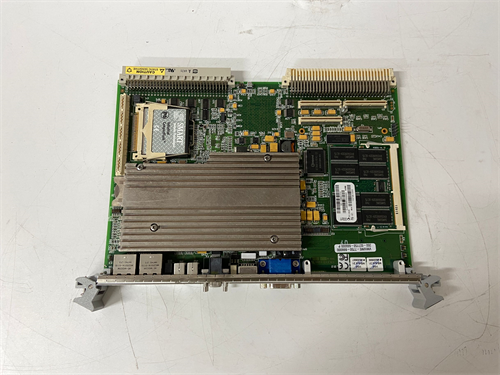
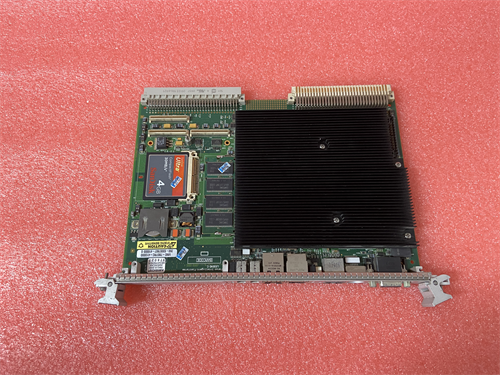
| Mounting | 6U VME Eurocard, 160mm depth, compatible with Mark VIe universal backplane |
| Front Panel | 3x LED indicators (Channel A/B/C active/fault); 37-pin D-sub connector |
| Certifications | UL 508A, CSA C22.2, ATEX Zone 2, IEC 61508 SIL 2 capable (with diagnostic channel) |
Advantages & Features
-
Integrated Dither Generation – Unlike standard analog output modules that require external dither signal injection, the GE DS3828BH3A internally generates a high-frequency dither superimposed on the command current. This reduces static friction in servo valves by 40-60%, extending valve life and improving low-flow linearity. The dither amplitude and frequency are independently programmable for each channel, allowing optimization for different valve makes (Moog, Bosch-Rexroth, Vickers) without external circuitry.
-
Dual Redundant Power Inputs – The GE DS3828BH3A accepts two independent 24V DC feeds with diode-ORed isolation. If one supply drops below 18V, the module instantly switches to the secondary supply with zero output glitch (<50µs). This is essential for turbine emergency trip systems where loss of actuator control for >5ms can cause overspeed events.
-
Fast Deterministic Response – The 1kHz update rate and <2ms step response make the GE DS3828BH3A suitable for fuel control in aero-derivative gas turbines where rapid load changes require valve positioning within 3-5ms. The output current slew rate is programmable from 5mA/ms to 100mA/ms, allowing fine-tuning for both fast-acting and slow-acting actuators.
-
Comprehensive Diagnostics with Channel Health Monitoring – Each output channel on the GE DS3828BH3A includes a precision current-sense amplifier that continuously compares commanded vs. actual output. If the actual current deviates by >5% for >50ms (indicating open-load or partial short), a health flag is reported to the controller via the backplane status word, enabling fail-safe actions (e.g., transfer to backup valve or turbine runback).
-
Thermal Management and Overload Protection – The output stages are built with high-current MOSFETs rated at 105°C junction temperature. The GE DS3828BH3A includes a 5W heatsink and conducts thermal monitoring via an onboard sensor. If junction temperature exceeds 100°C, the module automatically reduces the maximum output current to 70% of the setpoint; if temperature reaches 105°C, the affected channel shuts down and latches until a power cycle. This prevents catastrophic failure in high-ambient environments like turbine enclosures.
-
Software Configurable Output Polarity and Ramping – The GE DS3828BH3A supports both unipolar (0–50mA) and bipolar (±20mA or ±50mA) modes, plus a programmable output ramp rate (0.1–10mA per step) to avoid hydraulic shock when the valve is commanded suddenly from the controller. This is particularly useful for steam turbine warming-up sequences where thermal stresses must be limited.
Application Cases
-
Gas Turbine Fuel Control Valve Actuation – In a GE Frame 7FA gas turbine, the GE DS3828BH3A drives the main gas fuel control valve (Moog D633 series servo valve with 200Ω coil resistance) at ±40mA command. The integrated dither at 300Hz amplitude of 8% reduces valve hysteresis from 2% to 0.5%, improving combustion dynamics and reducing NOx emissions during part-load operation. A second channel on the same module drives the liquid fuel bypass valve, while the third channel is used for the pilot fuel valve – a compact 3-valve control from a single GE DS3828BH3A.
-
Steam Turbine Electro-Hydraulic (E/H) Converter Control – In a 500MW steam turbine, four Woodward S-16 servo valves are used for HP/IP control valve positioning. The GE DS3828BH3A provides ±20mA signals to each valve, with the dither feature (200Hz, 5% amplitude) eliminating “stiction stick-slip” during low-load operation. The fast response (<2ms) allows the turbine to follow grid frequency deviations (50Hz ±0.5Hz) without valve hunting, reducing mechanical wear on valve stems.
-
Hydro Turbine Gate Servo Positioning – In a Kaplan turbine application, the GE DS3828BH3A drives the distributor gate actuator coil (120Ω impedance) with a ±50mA signal. The built-in output current monitoring detected an incipient short in the actuator coil (current deviation 8% during a scheduled ramp test), allowing maintenance to replace the actuator before a unit trip occurred during peak load. The module’s ability to provide fault logs via the Mark VIe historian was crucial for predictive maintenance planning.
-
Generator Excitation Thyristor Gate Drive – In the GE EX2100 excitation system, a derivative of the GE DS3828BH3A (firmware variant) generates firing pulses for the power bridge thyristors. While the base module outputs analog current, a specialized EPROM on the GE DS3828BH3A converts the digital firing angle command to a synchronized gate current, ensuring less than 0.5° firing delay variation across all 6 thyristor branches. This improves generator terminal voltage regulation accuracy from ±2% to ±0.5%.
Competitor Comparison
| Feature | GE DS3828BH3A | Siemens 6ES7355-2VH10 (Positioner module) | ABB CI830 + AO801 combo | Rockwell 1756-OF8 + external signal conditioner |
|---|---|---|---|---|
| Channels per slot | 3 (bi-directional) | 1 (uni-directional) | 8 (AO801) but no dither | 8 (AO801) but no dither |
| Dither Generation | Built-in (70-400Hz, programmable) | External required (adds SITRANS) | Not available | Not available |
| Update Rate | 1kHz deterministic | 100Hz (typical) | 250Hz | 500Hz |
| Output Range | ±20mA / ±50mA (configurable) | 0-20mA only | 4-20mA only | 0-20mA / 0-10V |
| Bi-directional (sourcing/sinking) | Yes (both polarities) | No (sourcing only) | No (sourcing only) | No (sourcing only) |
| Load Impedance Range | 50Ω – 2kΩ | 100Ω – 600Ω | 250Ω – 1kΩ | 100Ω – 750Ω |
| Current Monitoring | Yes (1% accuracy, per channel) | No (valve feedback separate) | No | No |
| Thermal Protection | Junction temp sensing + derating | Limited (overtemp shutdown only) | Standard (no derating) | Standard (no derating) |
| SIL Rating | SIL 2 (with diagnostic channel) | SIL 1 | SIL 2 | SIL 1 |
| Relative Cost | High (specialized) | Mid | Low-Mid | Mid-High |
The GE DS3828BH3A is the only module in this comparison that integrates bi-directional current capability, programmable dither, and built-in load diagnostics in a single slot. Siemens’ solution requires an external positioner and lacks bipolar output, making it unsuitable for hydraulic servo valves with ± current requirements. ABB and Rockwell offer higher channel density but cannot drive servo valves directly — they require external signal conditioners (e.g., Moog D633 interface boards), which add panel space and failure points. For turbine control applications where valve performance and diagnostic confidence are critical, the GE DS3828BH3A is the superior choice. In retrofit projects replacing legacy Mark IV/V servo driver cards, the GE DS3828BH3A provides drop-in functional equivalence with improved thermal and diagnostic features.
Selection Suggestions
-
Select the GE DS3828BH3A if your application involves proportional servo valves, torque motor actuators, or electro-hydraulic converters that require bi-directional current (both sourcing and sinking) and dither injection. It is the standard choice for GE gas and steam turbine fuel/steam control loops.
-
When specifying the GE DS3828BH3A, you must also order the mating terminal block (e.g., TB400 or TB500 series) that matches your field wiring. The module’s DB37 connector is not field-wirable directly — always use the dedicated terminal block with screw clamps or spring-cage terminations. For SIL 2 applications, use the TB400-SIL version which includes redundant feedback terminals for external current sense verification.
-
For multi-valve applications (e.g., gas turbine with main fuel, pilot fuel, and liquid fuel), a single GE DS3828BH3A provides 3 channels, which is typically sufficient. If you have more than 3 servo valves, use multiple GE DS3828BH3A modules — but note that the backplane synchronization ensures all channels update simultaneously (within ±5µs) across multiple modules, a feature not available in competitive solutions.
-
If your actuator coil impedance is outside the 50Ω–2kΩ range, you must use an external series resistor to match the recommended load. The GE DS3828BH3A maintains specified accuracy only within this range; lower impedance will cause excessive current (triggering the overcurrent protection), and higher impedance will reduce output voltage compliance, limiting the maximum achievable current.
-
For new installations using high-performance Moog or Bosch servo valves with integrated LVDT feedback, pair the GE DS3828BH3A with an analog input module (e.g., DS3826SSHN or DS3826SSHNTCA) to close the position loop entirely within the Mark VIe controller, avoiding an external valve amplifier. This integrated solution is documented in GE publication GEI-100680.
-
When ordering spare units for existing turbines, verify the firmware revision on your current GE DS3828BH3A (visible on the front label or via Mark VIe Toolbox). The output dither frequency mapping changed after revision 4.2; using a newer revision module in a rack with older controllers (pre-v6.0) will require a firmware upgrade of the entire Mark VIe system — consult GE service bulletin GEK-115742.
Precautions
-
Output Short-Circuit Behavior – The GE DS3828BH3A has current-limiting protection at approximately 150mA per channel, but this is not a foldback type. During a sustained short (<10Ω load), the output stage dissipates up to 3.6W per channel, which can raise the module’s internal temperature rapidly. Ensure the module is installed in a ventilated slot with at least 15mm clearance above and below the card, and do not operate with short-circuited outputs for more than 5 minutes continuously.
-
Grounding Scheme – The GE DS3828BH3A output common is internally tied to the negative side of the 24V DC power supply. If your servo valve has a differential input (no common ground), this is acceptable. However, if your valve has a single-ended input with a separate isolated ground, connecting the module’s output common to that ground may create ground loops. In such cases, use an external loop isolator (e.g., analogue signal isolator with 1kV isolation) between the GE DS3828BH3A and the valve.
-
Dither Adjustment – Incorrect dither frequency can induce mechanical resonance in the servo valve. The GE DS3828BH3A allows dither from 70Hz to 400Hz — you must know the valve manufacturer’s recommended dither frequency (typically 200Hz for Moog, 300Hz for Bosch). Do not enable dither without confirming with the actuator datasheet; improper dither can reduce valve life by 50% due to rapid spool wear.
-
Power Supply Sizing – The GE DS3828BH3A requires 400mA quiescent current plus the output load current. If all 3 channels are configured for ±50mA at maximum swing, the total current drawn from the 24V supply is approximately 400mA + 3 x 70mA (due to internal losses) = 610mA. Ensure your 24V power supply can deliver at least 1A per module (allow 30% margin) and that the supply has adequate transient response for load steps.
MVI56-MCMˮ ͷ
ABB PFEA111/112
Siemens 6SC6112-2VA01
.jpg)


Reviews
There are no reviews yet.