
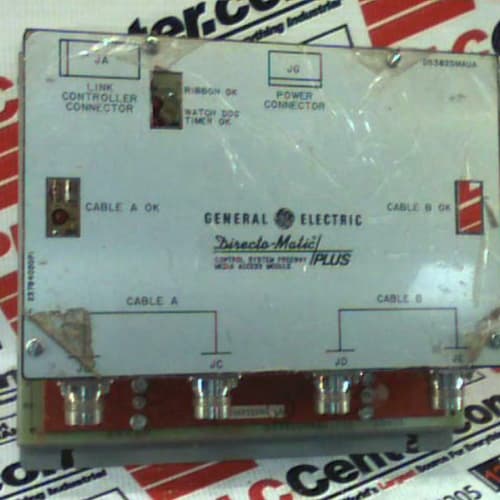
Description
Key Parameters
-
Input Channels: 16 differential or 32 single-ended (software-configurable)
-
Analog Input Types: 0–10V, ±10V, 4–20mA, thermocouple (J/K/T/E/R/S), RTD (Pt100)
-
Resolution: 16-bit ADC with 0.05% accuracy
-
Sampling Rate: 100 Hz per channel (aggregate)
-
Isolation: 1500V RMS channel-to-backplane
-
Diagnostics: Open-circuit detection, over-range/under-range alerts, cold-junction compensation
-
Temp Range: –30°C to +70°C
-
Power Supply: +5V, ±15V from VME backplane
-
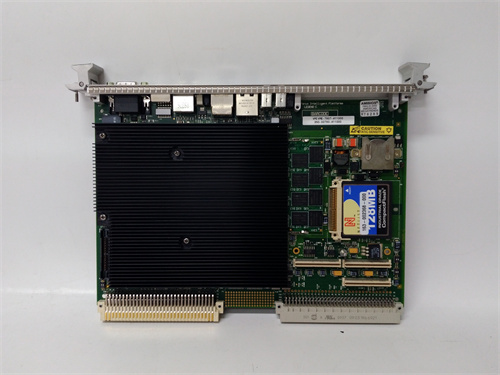
Physical: 6U VME single-slot board
Advantages
-
Multi-type input support – handles voltage, current, thermocouple, and RTD without external signal conditioners.
-
High accuracy – 16-bit resolution ensures precise turbine parameter monitoring (critical for exhaust temperature averaging).
-
Built-in cold-junction compensation – eliminates external reference junction boxes for thermocouples.
-
Open-circuit detection – immediately flags broken sensor wires to prevent false trips or incorrect control actions.
-
Channel grouping – each bank of 8 channels can be configured independently for different sensor types.
Applications
-
Gas turbine exhaust thermocouple averaging – monitors up to 32 thermocouples for overtemperature protection.
-
Compressor inlet pressure and temperature – used for surge control and performance calculations.
-
Steam turbine bearing and seal steam temperatures – RTD inputs for alarm and trip logic.
-
Generator cooling and winding temperature monitoring – critical for generator protection.
vs Competitors & Related Variants
| Feature | DS3800NVPA | Generic VME Analog Input Board |
|---|---|---|
| Native Mark IV firmware support | Yes (proprietary scaling) | No (requires custom mapping) |
| Input types supported | Voltage, current, TC, RTD | Usually only voltage/current |
| Resolution | 16-bit | 12–14-bit typical |
| Cold-junction compensation | Built-in per channel | External required |
| Open-circuit detection | Yes (per channel) | Rarely available |
| Channel density | 16 diff / 32 SE | 8–16 diff typical |
Selection Tips
-
Sensor matching – verify your field sensors match the configurable ranges of the DS3800NVPA; for RTDs, use 3-wire connections to cancel lead resistance.
-
Thermocouple type – select the correct thermocouple type (J/K/T/E/R/S) via software configuration; the General Electric DS3800NVPA supports all common types.
-
Channel grouping – plan your wiring so that channels with similar signal types are grouped together (banks of 8) for easier configuration.
-
Calibration – perform a two-point calibration (zero and span) using a precision calibrator for critical measurement channels.
-
Spare strategy – keep one DS3800NVPA per 8 installed units; thermocouple input stages are sensitive to over-voltage transients.
Critical Precautions
-
Over-voltage – never apply voltage above ±30V to any analog input; this can damage the front-end ADC of the DS3800NVPA.
-
Thermocouple wiring – use the correct extension-grade thermocouple wire (not copper) to avoid cold-junction errors; maintain polarity.
-
RTD wiring – use shielded 3-wire cabling; the shield must be grounded only at the DS3800NVPA end.
-
Ground loops – ensure field transmitters are isolated or use single-point grounding to avoid common-mode voltage exceeding ±10V.
-
Electrostatic discharge – handle the DS3800NVPA with a grounded wrist strap; CMOS input stages are ESD-sensitive.
-
Firmware compatibility – confirm the main processor firmware version supports the DS3800NVPA; older Mark IV versions may not recognize the 16-bit resolution and may require a software update.
-
Humidity – avoid condensation; the General Electric DS3800NVPA is conformal-coated but moisture ingress can affect thermocouple cold-junction accuracy.
A-B 1756-TBCH
A-B 1756-TBCH
A-B 1756-TBNH




Reviews
There are no reviews yet.