
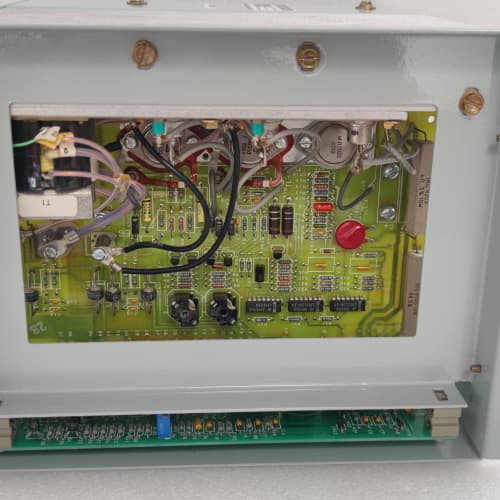
Description
Technical Parameters
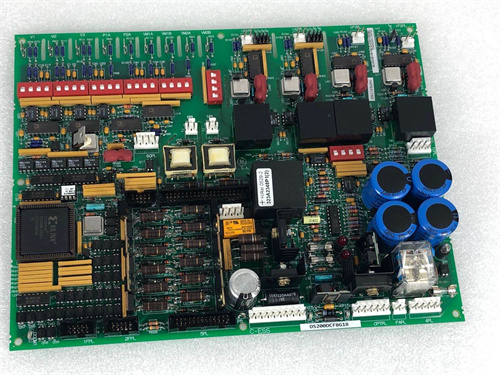
Below are the key electrical and physical specifications for the DS3800NPSE1A1A:
| Parameter | Specification |
|---|---|
| Input Voltage | 125 VDC nominal (range 100–150 VDC); also supports 24 VDC via external adapter configuration |
| Output Rails | +5 VDC / 15A (main logic supply), ±15 VDC / 2A (analog front-end supply) |
| Isolation | Non-isolated (common-ground design); relies on system-grade grounding for noise rejection |
| Signal Interface | 1 differential analog input (0–10V or 4–20mA configurable) for power health telemetry |
| Operating Temperature | –30°C to +65°C (industrial extended range) |
| Physical Form Factor | 6U height × 4HP width (approx. 262mm × 20mm), standard VME backplane connector |
| Status LEDs | 3 indicators: PWR OK (green), OVP – overvoltage protection (red), TEMP – overtemperature warning (yellow) |
| Certifications | CE, UL 508 (Industrial Control Equipment) – for non-hazardous locations only |
Critical note: The DS3800NPSE1A1A does not support hot-swapping. Any insertion or removal under power will likely damage the backplane gold-fingers and the rack’s power management ICs.
Key Features & Advantages
-
Inherent Redundancy via Parallel Topology – The DS3800NPSE1A1A employs a dual-MOSFET parallel switching architecture. Even if one power MOSFET fails, the board continues to deliver output in a derated mode for up to 10 minutes—crucial time for executing an emergency turbine shutdown sequence.
-
Harsh Environment Protection – The PCB is coated with a 50μm thick Conformal Coating (acrylic-based), providing excellent resistance against H₂S gas corrosion and moisture condensation commonly found in combined-cycle power plants.
-
Exceptional Dynamic Response – Load regulation is ≤ ±0.5%, and recovery time from a 10%–100% load step is under 50μs. This surpasses most industrial power modules and is essential for handling transient current surges from digital servo valves (DSV) during fuel stroke adjustments.
-
Hardware-Level Self-Diagnostics – Onboard comparators continuously monitor output voltages. If deviation exceeds ±5%, the DS3800NPSE1A1A immediately sends a hardware interrupt (non-maskable) via the backplane to the main CPU board (e.g., DS3800N series), bypassing any software polling delays—a critical feature for overspeed protection logic.
Typical Application Cases
-
Gas Turbine Combined-Cycle Power Plants – The DS3800NPSE1A1A is installed in Mark IV cabinets for GE Frame 6B / 7E turbines, providing dedicated power to magnetic pickup units (MPU), thermocouple amplifiers (TC), and LVDT servo valve drivers. Any ripple exceeding 100mVpp on its output directly impacts flame detection stability.
-
Steam Turbine Bypass Control Systems – In Heat Recovery Steam Generator (HRSG) bypass stations, this board supplies pressure transmitter signal conditioners, ensuring main steam pressure tracks load changes with minimal lag.
-
Legacy Fleet Spare Replacement – Many Chinese and Southeast Asian plants commissioned between 2000–2010 still rely on the DS3800NPSE1A1A. When field engineers observe excessive output ripple or intermittent resets, replacing this board with a verified refurbished unit is the standard corrective action.
-
HIL Simulation Test Benches – For hardware-in-the-loop simulation of turbine control algorithms, the DS3800NPSE1A1A is used to emulate real field power supply characteristics, validating new protection logic under simulated voltage dips.
Competitive Comparison
| Aspect | DS3800NPSE1A1A (GE) | Woodward 8440-2113 (Actuator Power) | Siemens 6ES7407-0KA02-0AA0 (PLC Power) |
|---|---|---|---|
| Total Output Power | ~180W (+5V/15A + ±15V/2A) | 120W (single 24V/5A) | 240W (24V/10A) |
| Redundancy Scheme | Internal parallel derating (no external OR-ing) | Supports external diode redundancy modules | Requires external redundancy module (6ES7408) |
| Transient Recovery (50% step) | 50μs | 200μs | 1ms (typical) |
| Safety Certification | Only compatible with GE proprietary backplane (non-standard VME pinout) | General IEC 61131 compliant | Full TÜV SIL3 certified |
| Availability & Price | Obsolete; ~$2,500–$4,000 on secondary/refurb market | ~$1,200–$1,800 (active production) | ~$1,000–$1,500 (active production) |
| Key Weakness | Non-isolated – common ground introduces noise; no standardized diagnostic protocol | Lacks ±15V rails for analog front-ends | Physically too large (2 slots wide) – cannot fit Mark IV rack |
The DS3800NPSE1A1A derives its value exclusively from its proprietary backplane interface and ultra-fast transient response. Standard commercial power supplies cannot serve as drop-in replacements.
Selection Guidelines & Precautions
-
Replacement Sourcing – Since GE officially discontinued the DS3800NPSE1A1A in 2015, you must source from third-party repair houses or refurbishers. Before purchasing, request the factory test report including ripple waveform captures at 25°C and 65°C. Verify that the firmware revision (if applicable) matches your Mark IV backplane (P/N 193X493AAC series). Revisions prior to V2.1 do not support 24VDC external input mode.
-
External Input Filtering – Due to its non-isolated topology, the DS3800NPSE1A1A requires an external electrolytic capacitor bank (minimum 2200μF / 200V) placed physically close to the input terminals. Without this, voltage sags during diesel generator transfer events will trigger undervoltage lockout (UVLO) falsely. Verify that your DC bus already includes an LC filter reactor.
-
Thermal Management – At full load, the DS3800NPSE1A1A dissipates approximately 25W. It relies on forced-air convection from the rack’s fan tray. If installed in the topmost slot where ambient temperature may exceed 60°C, you must derate the load to 70% (i.e., limit +5V current to ~10.5A); otherwise, the yellow TEMP LED will flash intermittently and eventually latch the output off.
-
Grounding System – This board’s non-isolated design demands a single-point ground with resistance < 1Ω for the entire Mark IV cabinet. Mixing it with isolated power supplies (e.g., from a third-party DCS) will create ground-loop currents that destroy the onboard TVS protection diodes – this is the most frequent field failure mode observed.
-
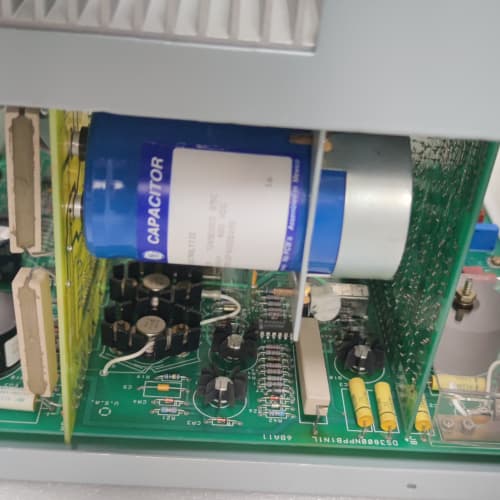
Capacitor Aging & Maintenance – The aluminum electrolytic capacitors on the DS3800NPSE1A1A have a rated lifetime of 5,000 hours at 65°C (approximately 7 months of continuous operation). It is strongly recommended to perform an ESR (Equivalent Series Resistance) measurement on primary filter capacitors C8 and C12 during every semi-annual outage. If ESR exceeds twice its initial value, schedule a full board replacement – do not attempt to replace capacitors individually, as the multi-layer PCB is highly susceptible to via damage during desoldering.
-
Firmware/Configuration Verification – Some batches of the DS3800NPSE1A1A include an onboard EEPROM storing calibration coefficients for the analog health-monitoring channel. After replacing the board, you must recalibrate the analog input readback using a precision voltage source (0–10V) and adjust the offset/gain potentiometers (R23 and R47) per GE Maintenance Manual GEI-100512. Skipping this step will cause the DCS to report incorrect power supply voltages.
Siemens 6ES7131-4BF00-0AA0
SCHNEIDER VCF5= V5+ KCF3PZ
A-B 100-C23D10

.jpg)

Reviews
There are no reviews yet.