
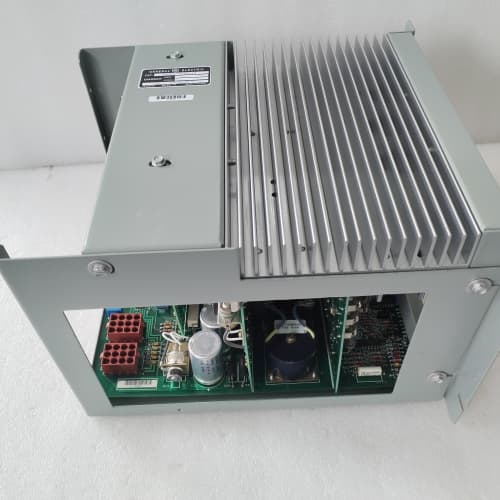
Description
Key Technical Parameters
| Parameter | Specification |
|---|---|
| Manufacturer | General Electric (GE) |
| Series | Mark V (Speedtronic) |
| Full Model | DS3800NGRA1G1B |
| Power Supply | +5V DC @ 5.5A, +15V DC @ 1.2A, -15V DC @ 0.8A (via backplane) |
| Temperature Inputs | 8 thermocouple (Type J/K/T, 24-bit ADC, ±0.5°C) + 8 RTD (Pt100, 3-wire, 24-bit ADC, ±0.3°C) = 16 total channels |
| Fan Outputs | 8 mechanical relays, 8A continuous @ 250VAC or 30VDC (surge 15A for 200ms) |
| Tachometer Inputs | 2 channels with predictive validation and adaptive filtering (up to 20 kHz) |
| Communication | Mark V proprietary parallel backplane bus |
| Operating Temperature | -40°C to +75°C (military-grade) |
| Storage Temperature | -55°C to +100°C |
| Vibration Resistance | 5g RMS, 10–500 Hz (MIL-STD-810G compliant) |
| LED Indicators | Power (green), Fan Run (8x amber), Tach Fail (red x2), Over-Temp Alarm (red), RTD Fault (yellow), Relay Degradation Warning (orange), Adaptive Optimization Active (blue), Adaptive Filter Active (purple), Model Learning (flashing blue), Backplane Active (green), Bus Fault (red) |
Advantages and Distinctive Features
-
Machine-Learning Adaptive Thermal Optimization (Revision G): The DS3800NGRA1G1B continuously refines its predictive thermal model over time, adapting to fan wear, dust accumulation, new cards added to the cabinet, or ambient temperature drift—maintaining optimal cooling efficiency throughout the board’s lifecycle.
-
Dual Temperature Sensor Support (T/C + RTD): 8 thermocouple + 8 RTD inputs provide 16 total temperature channels, supporting mixed sensor types or redundant monitoring in the same cabinet.
-
Dual Tachometer Inputs with Predictive Validation: Monitors fan speed and uses the predictive thermal model to validate performance, generating pre-failure warnings if speed deviates from expected values.
-
8A Mechanical Relays with Predictive Maintenance: Delivers 8A continuous output (15A surge) with real-time contact resistance monitoring and orange “Relay Degradation” warning LED.
-
24-Bit Ultra-High Precision ADC: ±0.5°C for thermocouples, ±0.3°C for RTDs—the highest accuracy in the Mark V lineup.
-
RTD Fault Detection: Continuously monitors RTD lead resistance and detects open-circuit, short-circuit, or lead-wire degradation.
-
Adaptive Tachometer Filtering: Automatically adjusts debounce parameters based on fan speed, eliminating false failure alarms.
-
500-Event Fault Log: Stores temperature alarms, tach failures, RTD faults, relay degradation events, adaptive optimization events, and fallback activations.
-
Silver-Alloy Relay Contacts: Silver-cadmium-oxide contacts resist welding and pitting under high-inrush conditions.
Typical Application Fields
-
Large Turbine Control Cabinets: Where both thermocouple and RTD sensors are used with adaptive optimization for changing conditions.
-
Offshore Oil & Gas Platforms: Extreme environments with long-term adaptive cooling optimization and speed verification.
-
Desert Power Plants: 75°C upper limit with continuous model refinement for seasonal temperature swings.
-
Arctic Compressor Stations: -40°C low-temperature tolerance with adaptive optimization for extreme seasonal changes.
-
Nuclear Auxiliary Turbines: High reliability with predictive diagnostics, redundant temperature sensing, and tachometer validation.
-
Facilities with Frequent Cabinet Changes: Where cards are added/removed over time, requiring ongoing model adaptation.
-
Safety-Critical Cooling Systems: Where fan failure detection, relay health monitoring, and sensor integrity are mandatory.
Comparison with Related Models
| Feature | DS3800NGRA1G1B | DS3800NGRA1G1A | DS3800NGRA1F1F | DS3800NFMC1F1E |
|---|---|---|---|---|
| Output Type | Mechanical relay | Mechanical relay | Mechanical relay | Solid-state (DC only) |
| Output Current | 8A | 8A | 8A | 3A |
| Thermocouple Inputs | 8 | 8 | 8 | 8 |
| RTD Inputs | 8 | 8 | 8 | None |
| Total Temp Channels | 16 | 16 | 16 | 8 |
| Tachometer Inputs | 2 | None | None | 2 |
| Predictive Tach Validation | Yes | N/A | N/A | Yes |
| ADC Resolution | 24-bit (±0.5/0.3°C) | 24-bit (±0.5/0.3°C) | 24-bit (±0.5/0.3°C) | 24-bit (±0.5°C) |
| Adaptive Optimization | Yes (continuous ML) | Yes (continuous ML) | No (fixed) | No (fixed) |
| Predictive Maintenance | Yes | Yes | Yes | No |
| RTD Fault Detection | Yes | Yes | Yes | No |
| Fault Log Capacity | 500 events | 500 events | 500 events | 500 events |
| Operating Temp | -40°C to +75°C | -40°C to +75°C | -40°C to +75°C | -40°C to +75°C |
| AC Fan Capability | Yes | Yes | Yes | No |
| Cost (Used) | Ultra-Premium+ | Ultra-Premium+ | Ultra-Premium+ | Ultra-Premium |
Selection Recommendations
-
Choose the DS3800NGRA1G1B if:
-
Your fans require mechanical relay outputs with 8A continuous rating (AC or DC).
-
Your cabinet uses both thermocouple and RTD temperature sensors, or you require redundant temperature monitoring (16 total channels).
-
You need tachometer feedback for speed verification and predictive validation.
-
You want continuous machine-learning-based adaptive optimization that adjusts to changing conditions over time.
-
Predictive relay maintenance is required to avoid unplanned downtime.
-
You require RTD fault detection for sensor integrity monitoring.
-
Your installation is in extreme environments (-40°C to +75°C) with high vibration.
-
You want the absolute highest level of fault logging (500 events) with all diagnostic features.
-
-
Choose the DS3800NGRA1G1A if: You need 8A relays, 16 temperature channels, and continuous adaptive optimization but do not require tachometer feedback.
-
Choose the DS3800NGRA1F1F if: You need 8A relays and 16 temperature channels with fixed predictive modeling (without continuous adaptive optimization or tachometer feedback).
-
Choose the DS3800NFMC1F1E if: You prefer solid-state DC outputs (3A) with tachometer feedback, predictive validation, and predictive modeling but cannot drive AC fans and do not need RTD support.
Critical Precautions
-
ESD Protection: The DS3800NGRA1G1B contains sensitive 24-bit ADC components. Always wear a grounded ESD wrist strap. Static damage to the ADC will degrade temperature accuracy.
-
RTD Wiring: Use 3-wire Pt100 RTDs with proper lead-wire compensation. All three wires must be connected. Open/short circuits trigger the yellow “RTD Fault” LED.
-
RTD Lead Resistance: Use RTD extension wire with resistance ≤10Ω per lead. Higher resistance will affect accuracy and may trigger lead-wire degradation warnings.
-
Relay Inductive Load Derating: The 8A rating applies to resistive loads. For inductive fan motors, derate to 6A or use an external RC snubber across each relay output.
-
Relay Contact Welding: Under severe short-circuit conditions (e.g., locked rotor), contacts may weld. The predictive maintenance circuit will detect increased contact resistance. Always test fan rotation after a power surge.
-
Tachometer Wiring: Use shielded twisted-pair cable. The adaptive filtering on the DS3800NGRA1G1B reduces noise sensitivity, but proper grounding is essential. Connect shield to the designated terminal—not at the fan end.
-
Tachometer Signal Requirements: Accepts NPN open-collector or voltage pulse signals (5–24V). Ensure compatibility. Do not exceed 24V on tach inputs.
-
Adaptive Optimization Learning: The DS3800NGRA1G1B performs continuous learning. The blue “Adaptive Optimization Active” LED illuminates when the model is actively refining. The initial 24-hour baseline period (flashing blue) is still required for initial model establishment.
-
Model Persistence: The adaptive model is stored in non-volatile memory. If the board is powered off for extended periods, the model persists but will begin recalibrating upon power-up.
-
No Hot-Swap: Always depower the Mark V rack before inserting or removing the DS3800NGRA1G1B.
-
Slot Assignment: Install in auxiliary I/O slots (typically slots 8–10). Do not install in CPU or analog input slots—relay switching transients can couple noise into sensitive circuits sharing the backplane.
-
CPU Dependency: The DS3800NGRA1G1B has no onboard logic. The Mark V CPU must process all temperature data, tachometer feedback, and send fan commands. If backplane communication is lost, the board defaults to 100% fan speed—all advanced features are disabled in fallback mode.
-
Firmware Compatibility: Revision G firmware requires Mark V CPU firmware v6.0 or higher for full continuous adaptive optimization, predictive tach validation, RTD support, predictive maintenance, and 24-bit ADC functionality. If your CPU runs v5.5, adaptive optimization will be disabled (fixed model only—tachometer, RTD, and predictive maintenance still function). For v5.0–v5.4, the board reverts to 16-bit mode with no advanced features (basic relay and tachometer functions only). Confirm compatibility before purchasing.
-
Power Supply Capacity: The DS3800NGRA1G1B draws 5.5A on the +5V rail—the highest current draw of any Mark V board. Verify that your Mark V rack’s power supply has sufficient capacity. Overloading the +5V rail can cause system instability, corrupt the adaptive model memory, and affect RTD measurement accuracy. Consider upgrading the rack’s power supply if necessary.
A-B 20B-ENC-1
KEYENCE PZ-M31P
A-B 1784-CF128


Reviews
There are no reviews yet.