
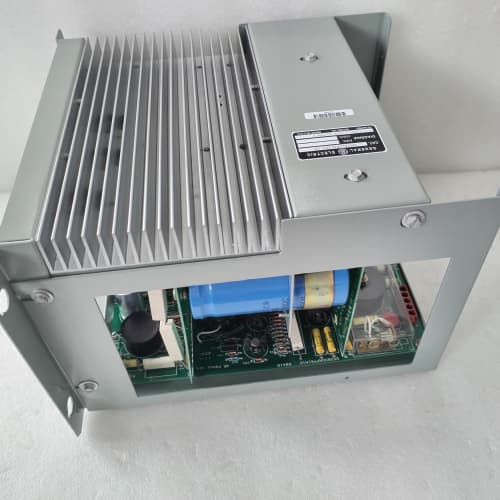
Description
Key Technical Parameters
| Parameter | Specification |
|---|---|
| Manufacturer | General Electric (GE) |
| Series | Mark V (Speedtronic) |
| Full Model | DS3800NFMC1F1D |
| Power Supply | +5V DC @ 3.8A, +15V DC @ 0.7A, -15V DC @ 0.5A (via backplane) |
| Temperature Inputs | 8 differential thermocouple channels (Type J/K/T, 24-bit ADC, ±0.5°C accuracy) |
| RTD Inputs | None |
| Fan Outputs | 8 solid-state relays, 3A continuous @ 24–48VDC (surge 5A for 100ms) |
| Tachometer Inputs | None |
| Communication | Mark V proprietary parallel backplane bus |
| Operating Temperature | -40°C to +75°C (military-grade) |
| Storage Temperature | -55°C to +100°C |
| Vibration Resistance | 5g RMS, 10–500 Hz (MIL-STD-810G compliant) |
| LED Indicators | Power (green), Fan Run (8x green), Over-Temp Alarm (red), Predictive Model Active (blue), Fallback Active (yellow), Bus Fault (red), Model Learning (flashing blue) |
Advantages and Distinctive Features
-
8 Full Thermocouple Inputs: The DS3800NFMC1F1D retains all 8 temperature channels—unlike the 4-channel “1E1C” variant—providing comprehensive zone-by-zone thermal monitoring for large cabinets.
-
Predictive Thermal Modeling (Revision F): The DS3800NFMC1F1D learns the thermal response of your cabinet during the first 24 hours of operation (flashing blue LED). It then anticipates temperature rises based on load changes and fan operation patterns, proactively triggering fan adjustments before temperatures reach setpoints—reducing overshoot by up to 50%.
-
Onboard Temperature Threshold Logic: Stores high/low setpoints in EEPROM, enabling autonomous ON/OFF fan control during backplane communication loss.
-
Adaptive Temperature Averaging: Smooths rapid temperature fluctuations, reducing unnecessary fan cycling by up to 30% and extending fan bearing life.
-
3A Solid-State Outputs: Drives larger 48VDC fans or multiple smaller fans in parallel with silent, maintenance-free switching.
-
24-Bit Ultra-High Precision ADC: Provides ±0.5°C accuracy for precise thermal management.
-
200-Event Fault Log: Stores temperature alarms, predictive model events, and fallback activations for rapid diagnostics.
-
Extreme Environmental Tolerance: Rated for -40°C to +75°C with 5g vibration resistance.
Typical Application Fields
-
Large Turbine Control Cabinets: Where 8 temperature sensors monitor multiple zones, and comprehensive thermal data is required.
-
Offshore Oil & Gas Platforms: The -40°C to +75°C range and 5g vibration tolerance withstand harsh marine environments.
-
Desert Power Plants: Extended 75°C upper limit supports un-air-conditioned shelters.
-
Arctic Compressor Stations: -40°C low-temperature tolerance ensures reliable startup after extreme cold soak.
-
High-Cycle Applications: Predictive modeling and adaptive averaging reduce switching frequency, extending fan life in variable-load conditions.
-
Remote Unstaffed Stations: Autonomous fallback logic ensures cooling continues during communication loss.
Comparison with Related Models
| Feature | DS3800NFMC1F1D | DS3800NFMC1E1C | DS3800NFMC (Base) | DS3800NFIB1D1B |
|---|---|---|---|---|
| Output Type | Solid-state (DC only) | Solid-state (DC only) | Solid-state (DC only) | Solid-state (DC only) |
| Output Current | 3A | 3A | 2A | 3A |
| Thermocouple Inputs | 8 channels | 4 channels | 4 channels | 8 channels |
| Tachometer Inputs | None | None | None | None |
| ADC Resolution | 24-bit (±0.5°C) | 24-bit (±0.5°C) | 12-bit (±2°C) | 16-bit (±1°C) |
| Predictive Thermal Modeling | Yes (unique) | No | No | No |
| Onboard Logic | Yes (threshold + averaging + modeling) | Yes (threshold + averaging) | No | Yes (threshold + averaging) |
| Operating Temp | -40°C to +75°C | -40°C to +75°C | 0°C to +60°C | -20°C to +65°C |
| Vibration Rating | 5g RMS | 5g RMS | 1g RMS | 2g RMS |
| Fault Log Capacity | 200 events | 200 events | Basic | 100 events |
| Fallback Mode | Autonomous ON/OFF | Autonomous ON/OFF | Full speed (100%) | Autonomous ON/OFF |
| Cost (Used) | Premium | High | Low | Medium-High |
Selection Recommendations
-
Choose the DS3800NFMC1F1D if:
-
Your fans are DC-powered (24V or 48V) with current draw ≤3A.
-
Your cabinet requires 8 temperature sensors for comprehensive zone monitoring.
-
You do not require tachometer speed feedback.
-
You want predictive thermal modeling to proactively manage temperature and reduce overshoot.
-
You need ultra-precise temperature monitoring (±0.5°C) for critical thermal management.
-
You require autonomous fallback cooling during CPU communication loss.
-
Your installation is in extreme environments (-40°C to +75°C) with high vibration.
-
You want comprehensive fault logging with predictive model event tracking.
-
-
Choose the DS3800NFMC1E1C if: You need extreme temperature tolerance and 3A outputs but can accept 4 thermocouple inputs (without predictive modeling).
-
Choose the DS3800NFIB1D1B if: You need 8 thermocouple inputs with adaptive averaging but can accept -20°C to +65°C range (and lower cost).
-
Choose the base DS3800NFMC if: You need 2A outputs, 4 thermocouple inputs, have a climate-controlled environment, and do not require onboard logic.
Critical Precautions
-
ESD Protection: The DS3800NFMC1F1D contains sensitive 24-bit ADC and MOSFET components. Always wear a grounded ESD wrist strap. Static damage to the ADC will degrade temperature accuracy to >3°C.
-
DC Polarity and Voltage: Solid-state outputs are DC-only and polarity-sensitive. Connect positive to “+” and negative to “-“. Reverse polarity will destroy the output MOSFET. Do not exceed 48VDC—AC voltages cause immediate catastrophic failure.
-
Current Derating: At 75°C, derate to 2.2A per output. For multiple channels active, reduce total load by 10% per channel to avoid thermal shutdown.
-
Predictive Model Learning Period: The DS3800NFMC1F1D requires a 24-hour learning period after first power-up (flashing blue LED). During this time, the board will operate in standard threshold mode while building its thermal model. Do not interrupt power during this period—interruption will reset the learning process. The model is stored in non-volatile memory and persists through power cycles after learning completes.
-
Model Reset: If cabinet configuration changes (e.g., fans replaced, new cards added), reset the predictive model via Mark V software command to force a new learning cycle. Failure to do so may result in inaccurate predictions and suboptimal fan control.
-
No Tachometer Inputs: The DS3800NFMC1F1D has no tachometer capability. Do not connect speed sensors.
-
No Hot-Swap: Always depower the Mark V rack before inserting or removing the DS3800NFMC1F1D.
-
Slot Assignment: Install in auxiliary I/O slots (typically slots 8–10). Do not install in CPU or analog input slots.
-
Fallback Threshold Configuration: Configure autonomous ON/OFF thresholds via Mark V software. If not configured, the DS3800NFMC1F1D defaults to 100% fan speed during communication loss—predictive modeling and adaptive averaging will be disabled in fallback mode.
-
Firmware Compatibility: Revision F firmware on the DS3800NFMC1F1D requires Mark V CPU firmware v5.5 or higher for full predictive modeling, 24-bit ADC functionality, and autonomous logic. If your CPU runs v5.0–v5.4, the board will function but predictive modeling will be disabled (threshold and averaging only). For v4.x systems, the board reverts to basic 16-bit mode with no onboard logic. Confirm compatibility before purchasing.
-
Power Supply Capacity: The DS3800NFMC1F1D draws 3.8A on the +5V rail—the highest of any “NFMC” variant. Verify that your Mark V rack’s power supply has sufficient capacity, especially if multiple high-current boards are installed. Overloading the +5V rail can cause system instability and corrupt the predictive model memory.
A-B 1769-0B16
SIEMENS 6ES7322-1HF01-0AA0
GE IC6993MDL655



Reviews
There are no reviews yet.