
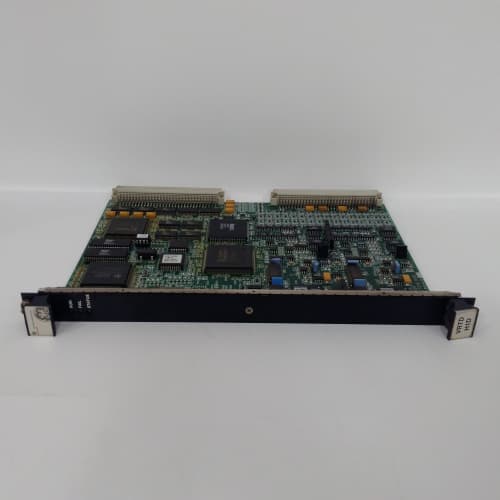
Description
Key Specifications
| Parameter | Specification |
|---|---|
| Input Channels | 8 differential analog input channels |
| Sensor Types Supported | Eddy current proximity probes, accelerometers (IEPE/charge), velocity sensors |
| Input Signal Range | –24 V to +24 V DC (proximity probes); ±10 V AC (accelerometers/velocity) |
| Measurement Parameters | Shaft relative vibration, absolute bearing vibration, shaft position, eccentricity, case expansion (optional) |
| Frequency Response | DC to 12 kHz (expanded over H1A) |
| Resolution | 16-bit ADC with improved signal-to-noise ratio |
| Accuracy | ±0.5% of full scale (improved over H1A) |
| Sample Rate | Up to 25 kHz per channel (simultaneous sampling — improved over H1A) |
| Protection Functions | Over-vibration trip (alert/danger), shaft position deviation, rate-of-change detection, trend-based early warning |
| Input Protection | Overvoltage protection (±40 VDC), ESD protection (IEC 61000-4-2 Level 4) |
| Isolation | 1500 VDC (channel-to-backplane) |
| Diagnostics | 750-event fault log with timestamps and waveform snapshots (expanded over H1A) |
| Operating Temp | 0 °C to +60 °C |
| Power Draw | 12 W (+5 V / +3.3 VDC) |
| Connectors | Front-panel 32-pin terminal block with captive washer screws and corrosion-resistant gold plating |
| Built-in Test | Sensor bias voltage monitoring, open/short detection, signal quality analysis |
Advantages & Distinctive Features
-
Comprehensive Vibration Monitoring: Supports all major sensor types—eliminates separate dedicated vibration monitors.
-
Higher Accuracy: ±0.5% full scale (versus ±1% on H1A) ensures more precise vibration measurements for critical protection.
-
Higher Sample Rate: 25 kHz (versus 20 kHz on H1A) captures higher-frequency vibration components for early fault detection (bearing wear, gear mesh, blade pass).
-
Extended Frequency Response: 12 kHz (versus 10 kHz on H1A) provides wider bandwidth for high-speed machinery.
-
Trend-Based Early Warning: Monitors long-term vibration trends—alerts before alert/danger levels are reached, enabling predictive maintenance.
-
Signal Quality Analysis: Analyzes waveform integrity to detect sensor degradation, cable issues, or electrical noise before false trips occur.
-
Integrated Protection Logic: On-board alarm/trip processing ensures deterministic response (<5 ms).
-
750-Event Fault Log with waveform snapshots—enables comprehensive post-event and predictive analysis.
-
Captive Washer Terminals: Prevents screw loosening due to vibration—essential for turbine control cabinets.
-
Hot-Swappable: No rack power-down for replacement.
-
Direct Retrofit: Replaces all VVIBH1A series boards with enhanced capabilities.
Application Fields
-
Gas Turbines: Bearing vibration, shaft displacement, eccentricity monitoring
-
Steam Turbines: Bearing and casing vibration, thrust position, case expansion
-
Compressors: Centrifugal and axial compressor vibration for surge protection
-
Generators: Stator end-winding and bearing vibration
-
Pumps: Critical feedwater and boiler circulation pump vibration
-
Fans and Blowers: ID/FD fan bearing vibration
-
Wind Turbines: Main bearing and gearbox vibration
-
High-Speed Machinery: Applications requiring 25 kHz sample rate and 12 kHz frequency response
Comparison with H1A and Competitors
| Feature | GE IS200VVIBH1B | GE IS200VVIBH1A | Bently Nevada 3500 | Rockwell XM-120 |
|---|---|---|---|---|
| Channels | 8 | 8 | 4 | 4 |
| Accuracy | ±0.5% | ±1% | ±1% | ±1% |
| Sample Rate | 25 kHz | 20 kHz | 10 kHz | 5 kHz |
| Frequency Response | 12 kHz | 10 kHz | 5 kHz | 2 kHz |
| Trend-Based Early Warning | Yes | No | No | No |
| Signal Quality Analysis | Yes | No | No | No |
| Fault Logging | 750 events + waveforms | 500 events | 100 events | No |
| Terminal Type | Captive washer | Standard screw | Standard screw | Standard screw |
The GE IS200VVIBH1B offers superior accuracy, sample rate, frequency response, and advanced diagnostics compared to both its predecessor and competitors—making it the ideal solution for comprehensive vibration monitoring in demanding turbine applications.
Selection Guidelines
-
When to choose: Any Mark VIe application requiring vibration monitoring and protection—especially where ±0.5% accuracy, 25 kHz sampling, or trend-based early warning is beneficial.
-
When to upgrade from H1A: Replace H1A boards with GE IS200VVIBH1B when higher accuracy, faster sampling, trend-based early warning, or signal quality analysis is required.
-
Sensor Selection: Verify field sensors are compatible. Proximity probes require ±24 VDC power supply; accelerometers may need IEPE excitation (2–10 mA, programmable).
-
Filtering Configuration: Program low-pass filters per channel to reject high-frequency noise while preserving relevant vibration frequencies (typically 1–5 kHz for bearings, up to 12 kHz for gear mesh).
-
Alarm/Trip Level Setting: Configure alert and danger levels per API 670 guidelines. Use trend-based early warning to alert at 70% of alert level for predictive maintenance.
-
Compatibility: Fits all Mark VIe VME64x racks. Requires ControlST v6.5 or higher for full features (v6.0 operates in H1A compatibility mode).
Operational Precautions
-
Wiring: Follow GE wiring diagrams (GEH-6860)—correct polarity and shield grounding essential. Use shielded twisted-pair cables; ground shield at terminal board only.
-
Sensor Bias Voltage Check: For proximity probes, verify bias voltage within specified range (–24 V to –4 V) via Toolbox ST—out-of-range indicates sensor or cable fault.
-
Calibration: Factory calibrated—verify vibration amplitude against known reference during commissioning for critical protection channels.
-
Alarm/Trip Testing: Perform simulated vibration tests (function generator or manual barring) to verify alarm and trip logic.
-
Trend-Based Early Warning Testing: Simulate gradual vibration increase to verify early warning generation before alert/danger levels.
-
Signal Quality Monitoring: Review signal quality metrics in Toolbox ST—degrading quality indicates sensor/cable issues.
-
LED Diagnostics: Green = normal; Amber = alert or signal quality warning; Red = danger/trip. Refer to GEH-6860 for expanded blink codes.
-
Fault Log: Access 750-event log via Toolbox ST for post-event analysis.
-
Hot-Swap: Remove/insert slowly under power—processor auto-recognizes new module.
-
Spare Stock: Maintain 1 spare per 3–4 racks; “H1B” backward-compatible with H1A sockets.
-
Annual Verification: Verify each channel against known vibration reference during outages; compare baseline data.
-
Filter Setting Review: Review filter settings annually—adjust if new vibration frequencies appear.
-
Firmware Updates: Ensure the GE IS200VVIBH1B is in “standby” mode during updates.
-
ESD: Handle by edges only with grounded wrist strap.
GE S710D-EST2
SCHNEIDER 140ACI03000
A-B 1756-IB16
Hollysys FM171


Reviews
There are no reviews yet.