
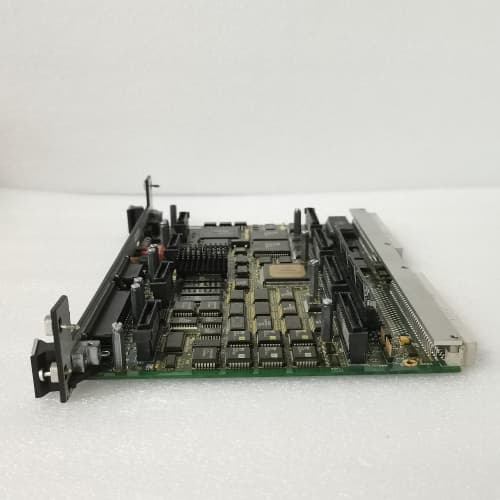
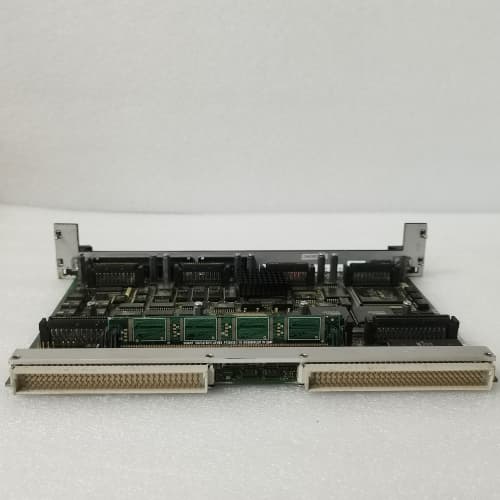
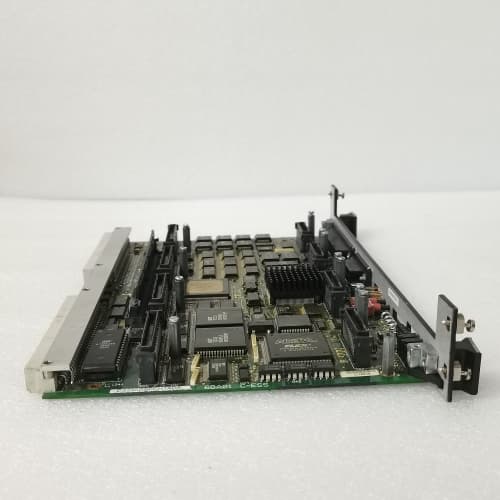
Description
Technical Parameters & Specifications
| Parameter | Specification |
|---|---|
| Manufacturer | General Electric (GE) |
| Series | Mark V Speedtronic |
| Full Model | DS200DSFBG2A |
| Board Type | Digital Signal Feedback / Speed Processing Board |
| Input Channels | 2 dedicated speed sensor inputs (magnetic pickups) |
| Additional Inputs | 4 general-purpose pulse/frequency inputs (configurable) |
| Input Voltage Range | ±5V to ±50V AC (auto-ranging) |
| Frequency Range | 1 Hz to 20 kHz |
| Output Interface | Parallel VME backplane (digital speed data to CPM) |
| Accuracy | ±0.05% of reading over full range |
| Operating Temp | -30°C to +65°C |
| Protection | Conformal coating + gold-plated edge connectors |
| Physical Dimensions | 6U VME format (233mm × 160mm) |
| MTBF | > 130,000 hours |
Core Advantages & Key Features
-
Flexible I/O Configuration – The DS200DSFBG2A offers a different channel allocation compared to the DSFBG1 series: 2 dedicated speed channels and 4 general-purpose pulse inputs. This makes it ideal for applications requiring more auxiliary frequency measurements rather than redundant speed channels.
-
High-Speed Signal Conditioning – The DS200DSFBG2A processes raw MPU signals with advanced filtering and zero-crossing detection, delivering clean digital frequency data even in electrically noisy turbine environments.
-
Dual Redundant Speed Monitoring – Two dedicated input channels allow for simple comparison or 1-out-of-2 (1oo2) voting for speed monitoring, suitable for applications where triple redundancy is not mandated.
-
Versatile General-Purpose Inputs – Four auxiliary pulse inputs can be configured for various applications including shaft position, gear tooth counting, flowmeter pulse counting, or external frequency reference, offering greater flexibility than the DSFBG1 series.
-
Onboard Diagnostics – Six LEDs indicate channel status, signal presence, and communication health with the main processor.
-
Automatic Threshold Adaptation – The board automatically adjusts to varying MPU signal amplitudes without manual gain adjustment, simplifying installation and maintenance.
-
Isolated Inputs – Each speed and pulse channel is optically isolated from the backplane, protecting the main processor from field wiring faults or voltage spikes.
-
Plug-and-Play Compatibility – The DS200DSFBG2A integrates seamlessly with all Mark V main processors, including DS200CPCAG1A, and works alongside driver boards such as DS200DPCAG1ADC and DS200DPCAG1ADB without additional interface hardware.
Typical Applications
-
Gas Turbine Speed Sensing (Non-Critical) – Monitors turbine shaft speed for control purposes in applications where triple redundant overspeed protection is not required (e.g., auxiliary turbines or backup units).
-
Steam Turbine Auxiliary Monitoring – Provides speed feedback for auxiliary steam turbines or small turbine-generator sets where redundancy requirements are less stringent.
-
Compressor Speed Monitoring – Tracks high-speed compressor shaft RPM for performance monitoring in applications where multiple additional pulse inputs are needed for auxiliary measurements.
-
Flowmeter Pulse Counting – The four general-purpose inputs can be used to monitor pulse-output flowmeters for fuel gas or steam flow measurement.
-
Geartooth Counting & Position Detection – General-purpose inputs can count gear teeth for phase angle detection used in ignition timing or vibration analysis.
-
Multi-Purpose Data Acquisition – The combination of 2 speed channels and 4 pulse inputs makes this board suitable for applications requiring simultaneous monitoring of multiple frequency sources.
Field Example: A European CHP plant using a smaller auxiliary gas turbine replaced a custom frequency counter with the DS200DSFBG2A. The four general-purpose inputs simultaneously monitored shaft speed, fuel flowmeter pulses, and two geartooth position sensors, reducing panel complexity by 40%.
Comparison: DS200DSFBG2A vs. DSFBG1 Series vs. Competitor
| Feature | DS200DSFBG2A | DS200DSFBG1AEB (Latest DSFBG1) | DS200DSFBG1ADB (DSFBG1) | Competitor (Woodward 8440-2200) |
|---|---|---|---|---|
| Primary Function | Digital speed + pulse feedback | Digital speed feedback | Digital speed feedback | Speed/frequency measurement |
| Dedicated Speed Channels | 2 (1oo2 voting) | 3 (predictive voting) | 3 (smart voting) | 2 channels |
| General-Purpose Inputs | 4 (configurable) | 2 (configurable) | 2 (configurable) | None |
| Frequency Range | 1 Hz – 20 kHz | 0.5 Hz – 30 kHz | 0.5 Hz – 25 kHz | 2 Hz – 15 kHz |
| Accuracy | ±0.05% | ±0.01% | ±0.02% | ±0.10% |
| Input Sensitivity | ±5V (minimum) | ±2V (minimum) | ±3V (minimum) | ±10V (minimum) |
| Adaptive Filtering | Standard | Gen 3 (real-time profiling) | Gen 2 (programmable) | No |
| Fault Event Logging | None | 100 events (time-stamped) | 50 events | None |
| Predictive Failure Analysis | No | Yes | No | No |
| Operating Temp | -30°C to +65°C | -40°C to +75°C | -40°C to +70°C | -25°C to +60°C |
| Hot-Swap Support | Yes | Yes | Yes | No |
| MTBF | > 130,000 hours | > 200,000 hours | > 180,000 hours | 100,000 hours |
Selection Guidelines & Precautions
-
Determine Redundancy Requirements – The DS200DSFBG2A provides 2 dedicated speed channels, suitable for applications where triple redundancy (2oo3 voting) is not required by safety standards. For SIL-rated overspeed protection, consider the DSFBG1 series with 3 channels.
-
Evaluate Auxiliary Input Needs – If your application requires more than 2 additional pulse inputs (for flowmeters, position sensors, etc.), the DS200DSFBG2A with 4 general-purpose inputs is the better choice compared to DSFBG1 boards.
-
Verify Sensor Compatibility – The DS200DSFBG2A accepts magnetic pickup (MPU) signals with amplitudes from ±5V to ±50V AC. For proximity probes with DC output, ensure proper signal conditioning or external converters are used.
-
Check Frequency Requirements – Confirm that the maximum speed frequency does not exceed 20 kHz. For very high-speed compressors or turbines exceeding this limit, consider the DSFBG1 series with 25-30 kHz capability.
-
Sensor Cable Quality – Use shielded twisted-pair cables (AWG 22–24) for all speed sensor connections to minimize EMI pickup. Maximum recommended cable length is 300 meters for reliable signal integrity.
-
Grounding Practices – Proper grounding is critical for stable speed measurement. Connect cable shields to the designated ground terminal at the board end only, avoiding ground loops.
-
Configuration of General-Purpose Inputs – The four auxiliary pulse inputs can be configured via onboard jumpers for voltage level (5V, 12V, 24V) or current (NPN/PNP). Refer to GE manual GEK-119592 for detailed setting options.
-
Firmware Compatibility – When integrating the DS200DSFBG2A with a Mark V system, ensure the main processor firmware supports this board variant. Compatibility is verified with DS200CPCAG1A revision 2.0 or higher.
-
Spare Parts Strategy – The DS200DSFBG2A is not a replacement for DSFBG1 boards; it serves a different application profile with more general-purpose inputs and fewer speed channels. Verify which board type matches your system design before ordering spares.
Summary
The DS200DSFBG2A is a versatile digital signal feedback board within the GE Mark V series, offering a distinct configuration with 2 dedicated speed channels and 4 general-purpose pulse inputs. This makes it ideal for applications requiring multiple auxiliary frequency measurements alongside basic speed monitoring, such as flowmeter pulse counting, position sensing, or multi-source data acquisition. While it offers lower accuracy, lower temperature range, and fewer speed channels than the DSFBG1 series (including DS200DSFBG1A, DS200DSFBG1ACB, DS200DSFBG1ADB, and DS200DSFBG1AEB), its flexible I/O allocation serves a different application niche. The board integrates seamlessly with DS200CPCAG1A processors and works alongside driver boards including DS200DPCAG1ADC and DS200DPCAG1ADB. Selection requires careful evaluation of redundancy requirements, auxiliary input needs, frequency range, and environmental conditions to ensure the correct board is chosen for your specific turbine or compressor application.
cutler-hammer KW3400F
FOXBORO RH924YF
KOLLMORGEN LE03565
EMERSON 5X00489G01


Reviews
There are no reviews yet.