
Description
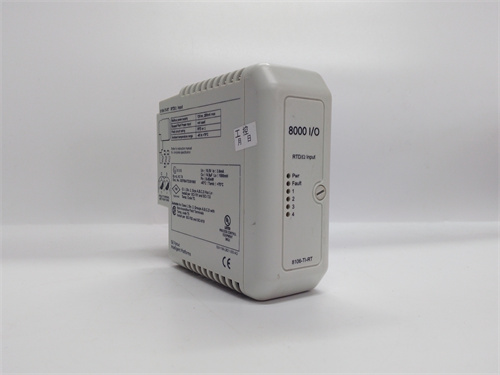
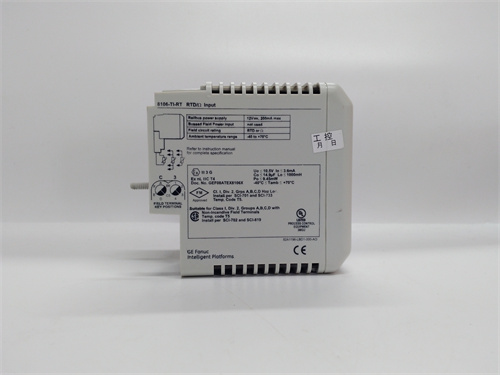
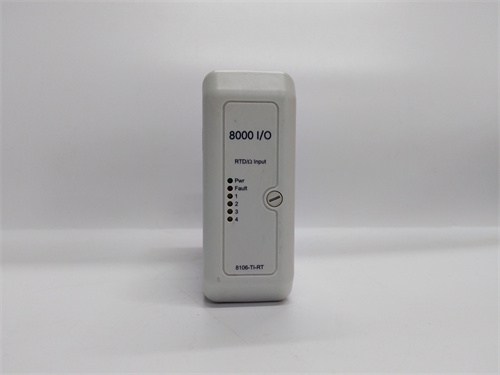
GE 8106-TI-RT — Remote Terminal Unit (RTU) for SCADA and Telemetry
Product Description: GE 8106-TI-RT
GE 8106-TI-RT is a Remote Terminal Unit (RTU) from General Electric, designed for robust supervisory control and data acquisition (SCADA) and telemetry applications. As part of the GE Telvent (now part of GE Grid Solutions) product line, this RTU is engineered to operate reliably in geographically dispersed and often harsh environments, such as electrical substations, oil and gas pipelines, and water distribution networks. The GE 8106-TI-RT functions as an intelligent field data concentrator and controller, gathering inputs from various sensors (e.g., voltage, pressure, flow), executing local control logic, and communicating the data back to a central master station via various communication networks. Its rugged design and flexible I/O make it a cornerstone for remote monitoring and control infrastructure.
Product Parameters
-
Device Type: Remote Terminal Unit (RTU).
-
Architecture: Typically features a modular or fixed I/O design based on a robust, real-time processing core.
-
Processing: Utilizes a dedicated, real-time operating system (RTOS) for deterministic performance.
-
Input/Output (I/O) Capabilities:
-
Analog Inputs (AI): For measuring 4-20 mA, 0-10 VDC, thermocouples, RTDs.
-
Digital Inputs (DI): For status monitoring (dry contacts, voltage levels).
-
Digital Outputs (DO): Relay or solid-state outputs for control (e.g., trip/close commands).
-
Counter/Frequency Inputs: For flow meters or speed sensors.
-
-
Communication Protocols: Extensive protocol support is a hallmark, including:
-
Legacy/Serial: DNP3 (Serial), Modbus RTU, IEC 60870-5-101/104.
-
Network/IP-Based: DNP3 over TCP/IP, Modbus TCP/IP, IEC 61850 (often as an option).
-
Fieldbus: PROFIBUS-DP, others.
-
-
Physical Communication Ports: Multiple serial ports (RS-232/485), Ethernet ports (RJ-45), and optional slots for radio, cellular, or fiber modems.
-
Power Supply: Wide-range DC or AC input (e.g., 24-48 VDC, 85-265 VAC) suitable for battery-backed systems.
-
Environmental Rating: Designed for harsh conditions (e.g., -40°C to +70°C operating temperature, high immunity to EMI/RFI).
Advantages and Features
-
Extreme Environmental Ruggedness: The GE 8106-TI-RT is built to withstand temperature extremes, humidity, vibration, and electrical noise, making it ideal for unmanned locations like substations or pipeline block valve sites.
-
Comprehensive Protocol Support: Its extensive library of standard and legacy SCADA protocols ensures seamless integration with almost any central control system (master station) and a wide variety of intelligent electronic devices (IEDs) in the field.
-
Autonomous Control and Logic Execution: Beyond simple data gathering, it can execute complex control sequences locally (e.g., interlocking, pump sequencing), ensuring continued operation even during communication outages with the master station.
-
High Reliability and Availability: Features like watchdog timers, self-diagnostics, and support for redundant communication paths and power supplies contribute to a very high mean time between failures (MTBF), which is critical for infrastructure assets.
-
Flexible I/O and Expansion: Its modular architecture (in many variants) allows for field customization and expansion to match the exact point count and types required by the application, providing a future-proof solution.
Application Cases in Various Fields
-
Electrical Utilities (Transmission & Distribution): Monitoring and control of remote substations, including circuit breaker status, transformer taps, and feeder currents (Feeder Terminal Unit – FTU applications).
-
Oil & Gas Pipelines: Monitoring pressure, flow, and temperature at block valve stations; controlling cathodic protection systems; and detecting leaks.
-
Water/Wastewater Management: Remote control of pumps and valves in lift stations and reservoirs; monitoring tank levels, chlorine residual, and flow rates.
-
Renewable Energy: Supervising and controlling remote wind farm collector substations or solar inverter fields.
-
Transportation: Monitoring and control for tunnel ventilation, lighting, and traffic management systems.
Comparisons with Competing Products
The GE 8106-TI-RT competes with RTUs from other major industrial and grid automation players like Schneider Electric (Modicon M580 RTU / Telvent legacy), Siemens (SIMATIC RTU3000 series), Honeywell (ControlEdge), and Emerson (ControlWave). Its strengths lie in GE’s long-standing dominance in the utility sector, its unparalleled protocol flexibility (especially for legacy systems), and its proven ruggedness. Competitors may offer more modern programming environments (e.g., IEC 61131-3) or tighter integration with their specific PLC ecosystems, but the 8106-TI-RT remains a benchmark for demanding, protocol-diverse telemetry applications.
Selection Suggestions and Precautions
-
Define Communication Protocol with Master: The single most critical selection factor is ensuring the 8106-TI-RT supports the specific protocol (e.g., DNP3 Level 2, IEC 104) and version required by your central SCADA/EMS master station.
-
Accurate I/O Point List Development: Create a detailed list of all field signals (type, range, quantity) to size the RTU correctly. Include a growth margin (e.g., 20%) for future expansion.
-
Assess Environmental and Power Conditions: Confirm the RTU’s environmental specs match the installation site. For DC-powered sites (common in utilities), ensure the voltage range is compatible and plan for battery backup.
-
Plan for Communications Media: Select the appropriate communication interface modules (e.g., fiber transceiver, cellular modem, licensed radio) based on the available infrastructure and data latency requirements at the remote site.
EMERSON CE4033S2B1
EMERSON VE4035S2B1
CE4035S2B1 EMERSON

Reviews
There are no reviews yet.